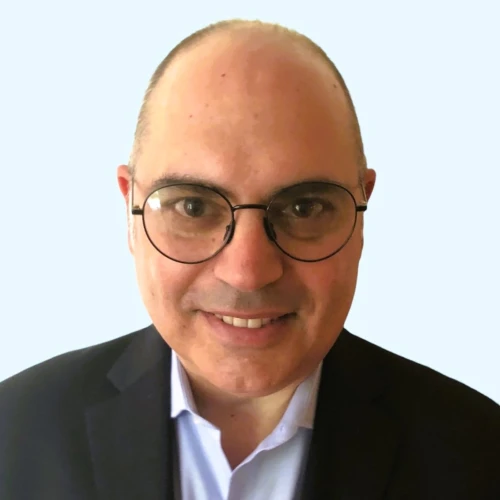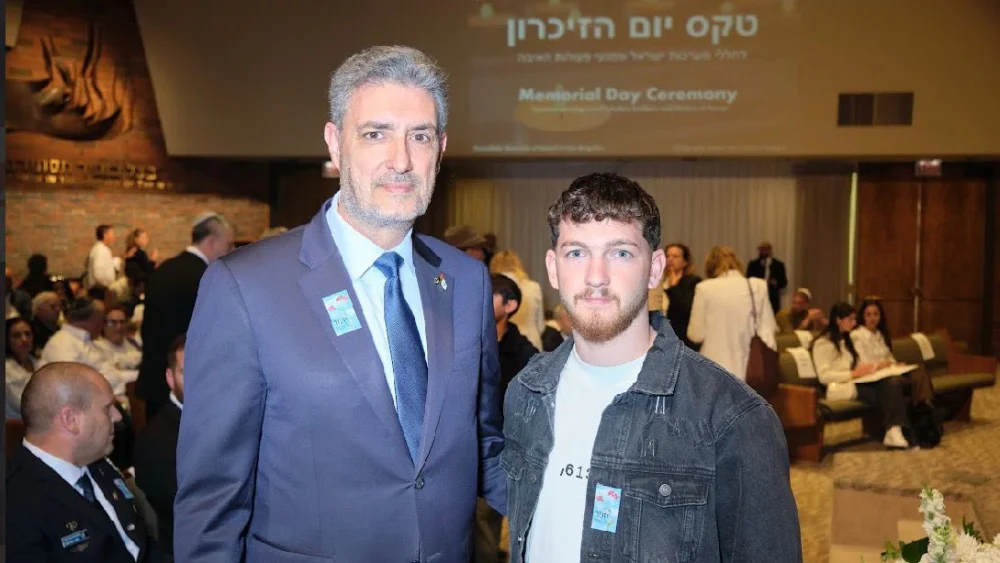
The 500 people who gathered on Monday for a Yom Hazikaron, Israeli Memorial Day ceremony in Los Angeles show the “deep connection between the Diaspora and the State of Israel,” Israel Bachar, Israeli consul general to the Pacific Southwest, told JNS on Monday.
“I do not believe that you can separate the two. I think we’re interdependent on each other,” the Israeli envoy said. “Israel cannot survive without the Diaspora’s support, and the Diaspora needs Israel for its identity and a safe haven in a time of need.”
The consulate hosted the event, which was held at Stephen Wise Temple, a Reform congregation. The ceremony honored fallen Israeli soldiers and victims of terrorism, including Amiram Cooper, 84, a founder of Kibbutz Nir Oz whom Hamas killed in captivity, and Din Nehorai Bar, 27, whom terrorists killed in Kibbutz Re’im near the Nova music festival on Oct. 7.
Bachar told JNS that “we are in an active war that’s still going on, so definitely everything is more palpable, more visceral.”
“We have a lot of new bereaved families this year,” he said. “Since Oct. 7 to today, we have an additional 2,000 families who were affected, lost their loved ones. In Israeli terms, it’s a lot. It’s a huge quantity of people that lost their loved ones.”
Bachar said during the ceremony that “on this sacred day, it is our duty to say not only ‘thank you’ to those who stand guard over our land, but above all, to those who gave their lives to ours.”
He and all of the other speakers addressed the audience in Hebrew, and a simultaneous English translation was projected on screens.
“Israel’s Memorial Day for the fallen soldiers and victims of terror is our moment to pause, to bow our heads, to say ‘thank you’ and also, ‘sorry,’” Bachar said at the event. “To remember that every Israeli who walks freely, every Jew who knows they have a home no matter where they are, we all owe this to them.”
He also told bereaved families during the ceremony that “the entire nation stands with you. Crowned with glory, we bind to your loved ones the crown of Israel’s rebirth. We cannot comprehend the magnitude of their sanctity.”
“Your pain is our pain,” the envoy said.
Bachar told JNS that “at the end of the day,” Israel is “the only place that Jews can feel safe.”
The Israeli envoy told JNS that many of the Israeli soldiers who were killed in battle were born outside of Israel. “The connection is there,” he said. “It’s a mutual pain. There’s a lot of Israelis who decided to make their life here in America and not in Israel, but they carry Israel with them every day.”

‘Be strong’
Bar Kupershtein, who was freed from Hamas captivity in Gaza in October 2025, recited Avraham Halfi’s poem “First We Weep” during the ceremony in Hebrew.
Kupershtein was kidnapped during the Nova music festival, where he worked as a security guard, on Oct. 7.
He told JNS that it was important for him to come and “say something for all of the people that died” fighting to free hostages like him.
“I’ve been through something. I don’t know how to explain to people,” he said. “It was very hard. Two years in the tunnel, in captivity in the enemy of Israel.”
Kupershtein was one of six people in a cramped tunnel who slept on the floor and had little food and just “dirty water, salt water.” On Yom Hazikaron last year, terrorists told the six that they had killed some Israeli soldiers.
“We cried,” Kupershtein told JNS. “This is a sad day, and in the same day, soldiers died for us.”
Kupershtein was able to survive Hamas captivity for two years through his “big faith” and thinking about his family, he told JNS.
Kupershtein has been the head of his family since an accident rendered his father wheelchair-bound several years ago. While he was held hostage in Gaza, he wondered who was caring for his family.
He told himself that he needed to survive and be strong for his family.
‘One of a kind’
In January 2025, Guy Karmiel, 20, was one of five soldiers killed when a building collapsed from detonated explosives in northern Gaza. Shmulik Karmiel, his uncle, honored Guy in a speech at the ceremony on Monday.
He told JNS that it was “the mission that I never wanted to accept in my life.”
“In honor of Guy and all the rest of the soldiers that were fallen since Israel was established, I had to stand up and be as strong as I can and speak as much as I can about them—the good things, the hardship that we are going through, the family that are left behind,” Karmiel told JNS. “But at the same time, to try to be as proud as I can and for the future of Israel.”
Karmiel saw his nephew as his own son.
“He was a playful kid, beautiful kid, a good-hearted kid,” he told JNS. “He was the center of attention between his friends in where he grew up in Gedera all the way to the army where he served. He was one of a kind.”
Guy Karmiel was “the guy that always wanted to make peace between anyone and everyone and never wanted anyone to fight, always try to find a way to make peace between them,” his uncle told JNS.
“That’s what I wish myself and I wish Jewish people around the world and I wish everyone around the world to try and make peace between themselves,” he said.
One of Shmulik Karmiel’s favorite memories of his nephew was bringing him to Los Angeles before his military service, despite Guy asking him to wait until after his service.
“I did not listen to him,” he told JNS. “I bought him a ticket and surprised him and brought him here for three weeks, exactly two months before he got drafted to the army.”
“That was the best thing I’ve ever done in my life,” he said.
During the three weeks Guy was in town, he and his uncle went to a Lakers game, snowboarded and visited Las Vegas.
“Anything and everything he asked for, I said ‘yes’ to,” Shmulik Karmiel told JNS. “Little did I know that that’s going to be the last time he’ll visit L.A.”