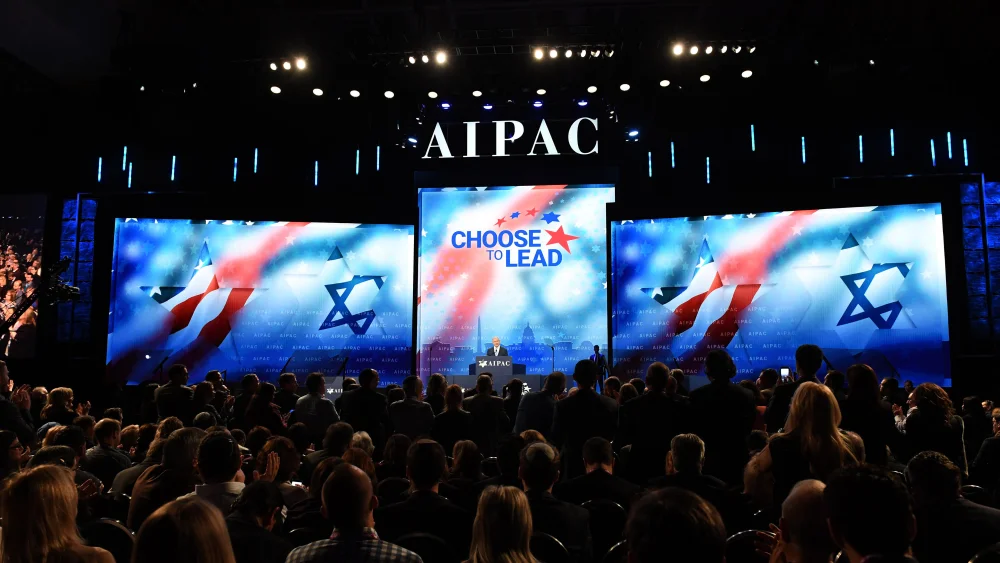
The Union for Reform Judaism warned on Monday that Democratic criticism of the American Israel Public Affairs Committee singles out the pro-Israel organization and, in some cases, crosses over into antisemitism.
The Reform movement stated that it is “deeply concerned” by efforts to portray AIPAC as uniquely malign in campaign finance debates, as political rhetoric around Israel intensifies.
“Every candidate has the right to accept or reject funding from any PAC, including AIPAC’s, but the harsh language being used by some to denigrate and vilify AIPAC borders on—and in some instances crosses over into—antisemitism,” the URJ stated.
The statement followed a recent Democratic National Committee meeting at which several resolutions critical of Israel and AIPAC were introduced but ultimately shelved.
“We are pleased that this effort failed,” the URJ stated. “Just as one can oppose AIPAC in good faith, one can oppose and forcefully criticize specific Israeli policies and still support a democratic, pluralistic Jewish state of Israel and a strong U.S.-Israel relationship.”
The group warned that to “disproportionately demonize AIPAC as a distinctively harmful dark-money entity crosses the line into antisemitic tropes about sinister Jewish political influence.”
The debate reflects broader divisions among Democrats and Jewish advocacy groups. The liberal pro-Israel group J Street has endorsed candidates more critical of Israeli government policy and has polled Jewish voters on AIPAC’s role in Democratic primaries.
In a recent survey, J Street asked whether voters support AIPAC spending money—some of it raised from Republican donors—against candidates critical of the Israeli government. The group said 40% of Jewish voters were less likely to support candidates endorsed by AIPAC, while about two-thirds opposed such spending.
AIPAC rejected the findings, calling the survey question a “push poll” and reiterating that it “is a bipartisan organization that supports a strong U.S.-Israel partnership.”
“Our members back candidates who want to strengthen the alliance and oppose those who don’t,” AIPAC wrote.