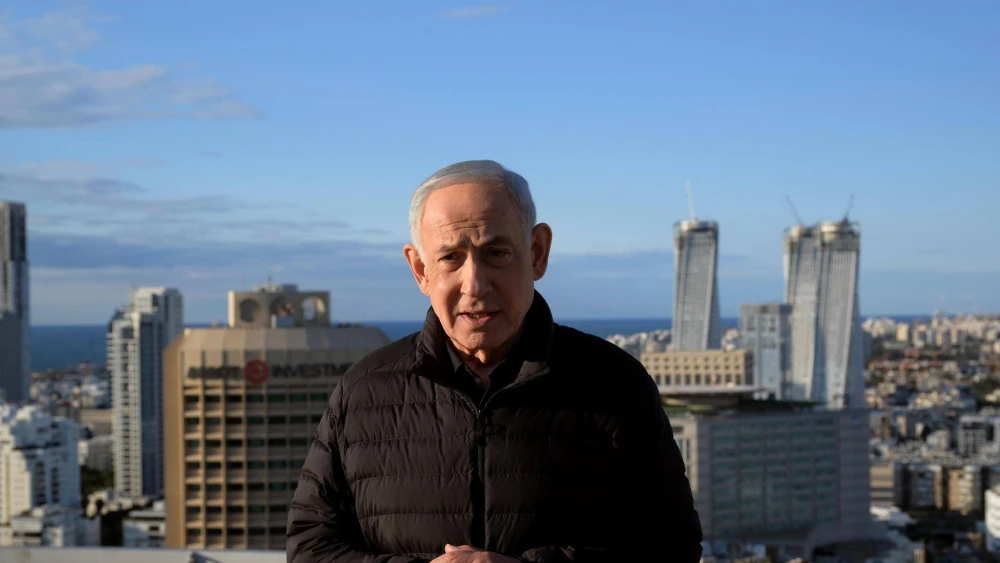
Israeli Prime Minister Benjamin Netanyahu said on Thursday evening that a potential diplomatic breakthrough with Lebanon could lead to a peace agreement, while emphasizing that any progress would require the disarmament of Hezbollah.
Israel and Lebanon agreed to a 10-day ceasefire on Thursday following calls between U.S. President Donald Trump and the leaders of each country, Netanyahu and Lebanese President Joseph Aoun.
“We have an opportunity to forge a historic peace agreement with Lebanon,” Netanyahu said in a statement translated from Hebrew. “President Trump intends to invite me and the president of Lebanon to try to advance this agreement.”
After Trump announced the truce on social media, the State Department released a statement detailing the agreement between the sides.
“Israel and Lebanon will implement a cessation of hostilities” beginning at 5 p.m. Eastern on April 16 for “an initial period of 10 days, as a gesture of goodwill by the government of Israel, intended to enable good-faith negotiations toward a permanent security and peace agreement between Israel and Lebanon,” the statement said.
In his remarks in Hebrew broadcast on Israeli media, Netanyahu said this opportunity exists because, during the “War of Redemption,” Israel had fundamentally changed the balance of power in Lebanon, including the elimination of Hezbollah leader Hassan Nasrallah.
“We activated the pagers. We eliminated the massive arsenal of 150,000 rockets and missiles that Nasrallah prepared to destroy Israel’s cities. We eliminated Nasrallah,” he said. “This balance has shifted to such an extent that over the past month, we began receiving calls from Lebanon to hold direct peace talks between us. This is something that hasn’t happened in over 40 years.”
He was referring to the 1983 Israel-Lebanon May 17 Agreement, the last attempt at a formal arrangement between the two countries, which was never fully implemented.
Explaining why he had agreed to a 10-day ceasefire called for by Trump, the prime minister said, “I answered that call and I agreed to a timeout, or more accurately, a temporary 10-day ceasefire, to try and advance the agreement we began discussing during the meeting of ambassadors in Washington.”
Rejected Hezbollah’s preconditions
The Israeli and Lebanese ambassadors to the United States met in Washington on Tuesday in the first direct high-level talks between the two countries since 1993, agreeing to continue discussions toward future negotiations.
Netanyahu said Israel had two fundamental demands for peace talks with Lebanon: “First, the disarmament of Hezbollah. Second, a sustainable peace agreement, peace through strength.”
He stressed that Israel had rejected Hezbollah’s preconditions for a truce.
“To achieve this ceasefire, Hezbollah insisted on two conditions: First, that Israel must withdraw from all Lebanese territory, back to the international border. Second, a ceasefire based on the ‘quiet for quiet’ model. I agreed to neither of these, and indeed, those two conditions are not being met,” he said.
Israel is remaining in Lebanon “in a reinforced security buffer zone,” the prime minister insisted.
“This is a security buffer that starts at the sea and continues to Mount Dov and the foothills of Mount Hermon, up to the Syrian border. This is a security strip 10 kilometers deep, which is much stronger, more intense, more continuous and more solid than what we had previously. That is where we are, and we are not leaving.”
“This allows us, first and foremost, to block the danger of an invasion into our communities, and secondly, it allows us to prevent direct anti-tank fire into the communities. The residents are now protected from these two dangers,” he added. “Of course, there are still problems; They still have rockets left. We will have to deal with that as well, as part of the progress toward a security agreement and a sustainable peace treaty.”
On the ceasefire with Iran, which took effect on April 8, Netanyahu said, “I have spoken with President Trump over these last two days and he told me he is tremendously determined to continue the naval blockade and to bring about the dismantling of Iran’s nuclear capability, what remains of it.
“He is not giving up on this. He is certain he can eliminate this threat once and for all, continuing the great things we have done together. Of course, we will also handle the missile threat and the enrichment capability. I will not elaborate. These are two very important moves that can fundamentally change our security and diplomatic situation for years to come.”
Netanyahu added, “With God’s help, we will act, and with God’s help, we will succeed.”