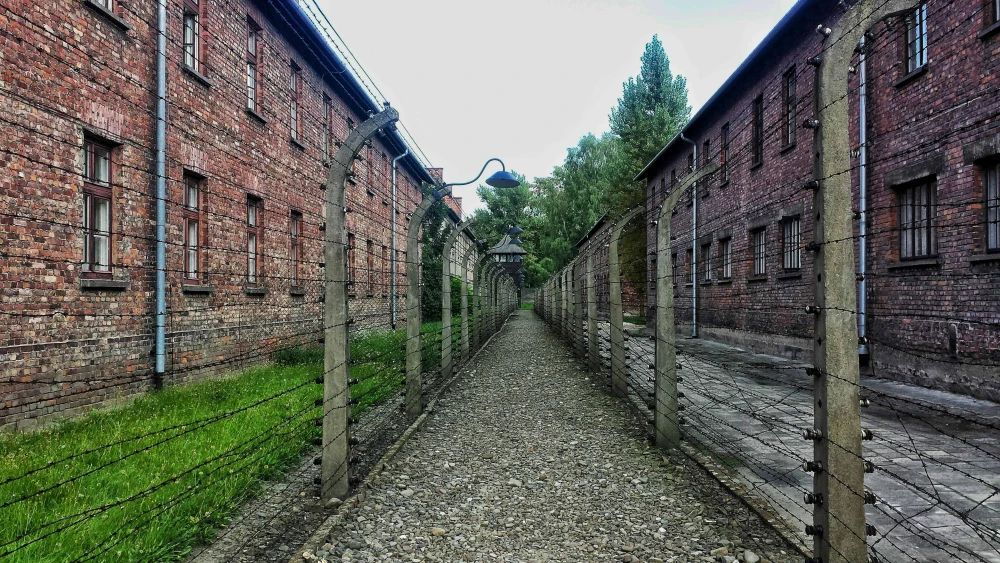

Days before a planned media tour in Israel, Iranian rockets lit up the sky and forced a sudden change of course. Instead of reporting from Tel Aviv, I found myself on the grounds of the Auschwitz concentration camp in Poland.
As a non-Jewish Venezuelan American, visiting this country and place had never been high on my list. But as a journalist covering stories that stretch from Caracas to Tehran to college campuses across the United States, I now understand why it should have been.
I arrived in Poland with a group of Hispanic journalism students through the Fuente Latina organization. We had signed up for a fellowship in Israel, eager to report on the aftermath of the Oct. 7 attacks and pursue international bylines.
Then the war with Iran that started on Feb. 28 disrupted air travel and upended those plans. Fuente Latina rerouted our program and gave us something just as valuable: the historical context needed to understand the events unfolding today.
In Warsaw, the past is not buried. Buildings still bear the scars of bullets and explosions, yet life moves through them. That tension between destruction and renewal is impossible to ignore.
I interviewed Irene Shashar, who survived the Holocaust as a child after escaping the Warsaw Ghetto through its sewer system. “I walk on tiptoe so as not to step on the skeletons that are surely there beneath the surface,” she told me. After the war, she moved to Peru before making her home in Israel, but the memory of that time never left her.
Others I met carried that past in different ways. Ofer Laszewicki, a Spanish Israeli journalist and the grandson of Holocaust survivors, grew up without extended family on his mother’s side. That absence drove him to research his family’s past in Warsaw. Weeks before we spoke, he was standing at a Jewish monument when a woman approached him and said, “Hitler was right,” then mimed a beheading with her hand.
“I walk on tiptoe so as not to step on the skeletons that are surely there beneath the surface.”
At Auschwitz-Birkenau, our guide, Agata Miodowska, shared her own encounter with modern-day antisemitism. In Paris, a taxi driver overheard her discussing Shabbat plans with a friend. “Are you Jewish?” he asked. When they answered yes, he ordered them out of the car and left them on the street.
These were not isolated incidents. They were reminders that the hatred that began with boycotts and escalated to industrialized mass murder has not disappeared.
On college campuses, hatred of Jews and Israel has surged in ways unseen in generations, leaving students to navigate a renewed climate of exclusion and hostility. To be Latino today sometimes means living with a quiet tension, as headlines about raids, detentions and enforcement turn ordinary routines into moments of risk for many in our community.
Before this trip, those realities sometimes felt near, but not fully grasped. They were headlines and statistics, something happening elsewhere.
In Poland, that distance collapsed. The past was no longer abstract. It felt immediate and urgent. As an immigrant from Venezuela, I recognized something familiar in these stories: displacement, survival and the search for belonging. The histories are profoundly different, but the instinct to endure and rebuild resonates with me.
I believe that if everyone in America could see the ghetto walls, sit in one of the 70 chairs in Krakow’s Ghetto Heroes Square that reminds of the expulsion of Jews from their homes, or listen to klezmer music just as I did, perhaps they might come to see history and humanity with different eyes.
Perhaps Ofer would not receive death threats for retracing his grandmother’s steps or perhaps Agata would not have been thrown out of a taxi in Paris.
The experience reshaped how I understand the Jewish story and my responsibility as a journalist. Reporting from Poland reaffirms that journalism is not simply about breaking news, but about placing events in a deeper historical context—one that continues to shape the present.
My lesson on the ground in Jewish history will be an enduring reminder to choose life over pain, respect over violence and decency over hatred.