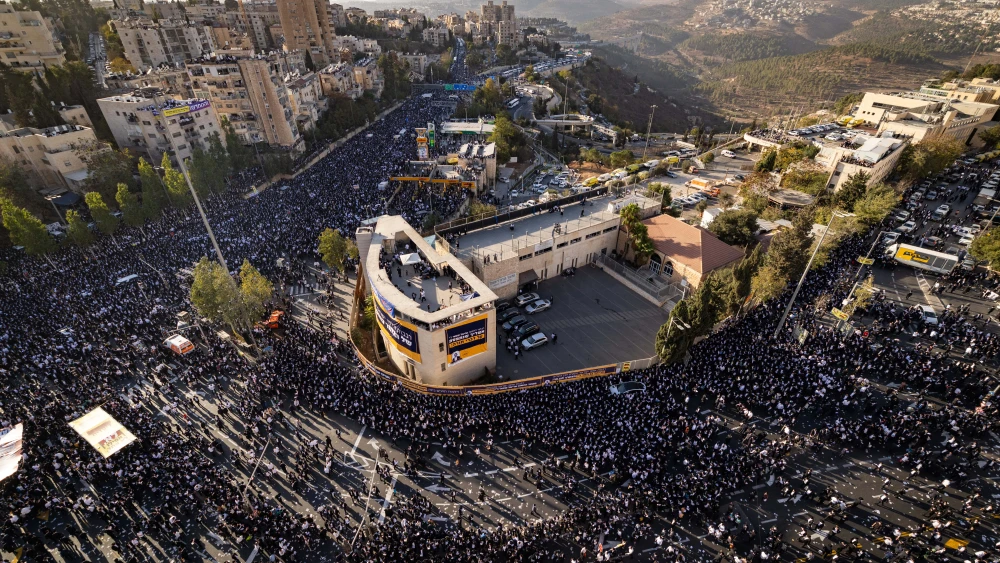

Jerusalem has come to a standstill. Hundreds of thousands of Haredim have flooded the city’s main arteries, their chants echoing through the streets as schools cancel classes and universities move online. Across town, thousands more gather in a counter-protest.
Inside the Knesset, the shockwaves are already felt. Ministers from the Sephardi ultra-Orthodox party, Shas, have resigned, and whispers of a coalition collapse are growing louder.
Yet despite all this tension and shadows of greater plans, the protest movement makes little strategic sense; it reads less as a calculated manoeuver than as a desperate gamble by a community running out of political leverage.
We all know why they came out on Oct. 30—not for judicial reform, not for the hostages, and not even for Israeli Prime Minister Benjamin Netanyahu. The Haredim mobilize for one thing above all: themselves.
That is their democratic right, but it is a poor strategy for building a persuasive protest movement.
This time, the flashpoint is the draft—an issue that has produced one of the rarest things in Israeli politics: broad consensus. A recent poll found 84.5% of Israeli Jews support drafting Haredim; ask Israelis whether the sky is blue and you’d get a less clear answer.
Protests exist to rally support, pressure policymakers, and, at their extreme, disrupt to force change. Haredi demonstrations, however, are different: their slogans and narratives largely speak inwards, reinforcing communal norms rather than reaching for the broader public. In an atmosphere where public sentiment toward the Haredim is actively hostile, these protests are actively harmful to any achievement of their aims.
Feelings about the Haredim are so negative now that “stick it to them” actually works as a campaign line.
“Sticking it” to protesters is hardly a new political strategy; wherever there is disruption, there will always be those campaigning for order. Yet the Haredi protests stand out for their utterly lopsided incentives.
This imbalance stems partly from Israel’s tribal political landscape—the enduring divides of right versus left, religious versus secular—which narrow voter choice and make even independents consider only a handful of acceptable parties. Still, on the draft question, there is rare agreement: a majority of voters across every political bloc, except the Haredim themselves, support drafting them.
Despite their deep faith, the Haredim aren’t expecting Moses to part the seas of Israeli public opinion. So why do they protest?
Beyond reinforcing internal unity in a community far less uniform than their black coats suggest, they hold two cards: disruption and political clout.
Historically, Haredi demonstrations have drawn their power from one or both. The “Haredi Intifada” of the 1990s—aimed largely at preserving the sanctity of the Sabbath—was a masterclass in disruption. On those long Jerusalem Saturdays, the “day of rest” was punctuated by the blare of car horns, the thud of stones against windshields, and the echo of chants as pitched street battles raged along Bar-Ilan Street, the fault line between Mea She’arim and the secular city beyond.
In the end, such confrontations worked: driving routes were changed, streets were closed, and even cultural events that the Haredim opposed were cancelled or relocated.
So does disruption work? Sometimes, but not this time.
Disruption depends on the math. When the issue isn’t significant enough for people to sacrifice their own comfort, disruption wins. When it catches officials off guard, it forces quick compromises, and disruption wins again.
But the draft isn’t that kind of issue. Most Israelis are prepared to see Haredim dragged—kicking and screaming if necessary—into the army. Compared to the burden carried by reservists, a blocked highway is a minor inconvenience.
The rule of thumb is simple: if people are willing to vote on it, disruption won’t work. And by that measure, the draft is untouchable. In a July poll, it ranked as the top issue for one in five Israelis; with the hostage crisis receding, that share has almost certainly grown.
So, what about their second card? While the policy of draft exemption for yeshivah students began with David Ben-Gurion, Israel’s founding prime minister, it was expanded and entrenched by Menachem Begin.
Political clout has been the Haredim’s decisive tool since Begin’s 1977 victory as leader of the Likud, when he traded blanket draft exemptions for Haredi yeshiva students in exchange for breaking the Labor Party’s decades-long monopoly on power.
Of the 20 coalitions since the 1977 election, only three have had no Haredi representation. Not all of those coalitions have relied on Haredi support, but recently, with political personalities dividing the country, the Haredi parties’ more transactional approach, combined with a growing population, has given them the prime minister’s crown to bestow.
So is that why they’re protesting now—to remind Netanyahu just how indispensable they are?
I doubt it. The protest doesn’t change the pieces on the board. The Haredi opposition to the draft was well known long before they flooded Jerusalem to prove it. What it does do is create tension for Netanyahu—wedging him between the ultra-Orthodox bloc and the more pro-draft voices within his own party. Yet the optics may actually weaken the Haredi hand: the larger and angrier the crowds, the more visible the public consensus against them, and the narrower Netanyahu’s room to manoeuvre.
The second effect is trickier: leverage. Haredi leaders may hope that by opposing the new draft law, reportedly softer than its predecessor, they can trigger one of Israel’s most reliable political reflexes: if the Haredim oppose it, the public will rally behind it.
If this is their hope, they are truly desperate. It’s unlikely the bill will clear the legal advisers in its current form, and if it returns harsher, the Haredim won’t be assembling another mass protest to stop it.
Ultimately, despite the machinations and manoeuvring that characterize Israeli politics, Israel is still a democracy. No matter how strong the Haredim appear as kingmakers, they are facing an insurmountable barrier of public opinion determined against their interests.
The Haredim have few cards left to play. After withdrawing from government, this protest may be their final, desperate gamble before the coalition collapses entirely. Yet if that happens, whatever new government emerges will almost certainly act against their interests.
They are cornered, and from that perspective, a collective prayer might be the only move left on the board.