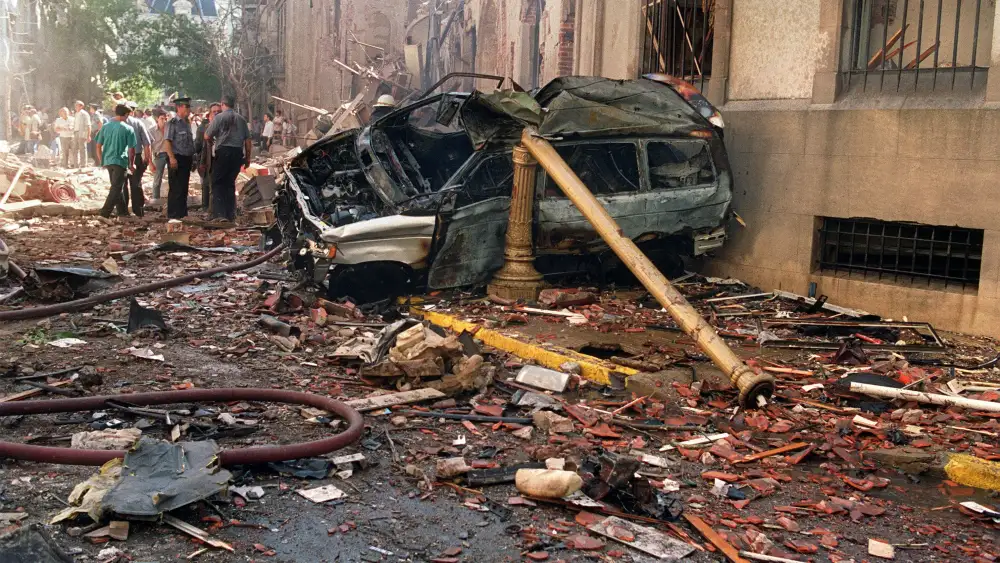

Today we mark 34 years since the murderous bombing of the Israeli Embassy in Buenos Aires, which left 29 dead— Israelis, Argentines and nationals of other countries—dozens of wounded, and bereaved families who carry the scars to this day. Two and a half years later, the Argentine capital was struck by another terrorist attack, this time at the AMIA (the country’s main Jewish community center), which exacted an even greater toll: 85 dead and more than 300 wounded.
Two similar attacks: the same city, the same method—a car bomb—and the same architects: Iranian direction, Hezbollah execution.
On March 17, 1992, a suicide bombing destroyed the Israeli Embassy in Argentina, killing 29 and injuring 242. Hezbollah claimed responsibility, with Iran’s support. This attack is part of a decades long campaign of terror against Israelis and Jewish communities worldwide. pic.twitter.com/br85o7MMUu
— Government Press Office 🇮🇱 (@GPOIsrael) March 17, 2026
The investigations conducted since, primarily by Israeli authorities led by the Mossad intelligence agency, established beyond any doubt the initial suspicion that Iran—by decision of its highest leadership—"commissioned” the acts of terror, financed, trained and assisted the perpetrators; and that Hezbollah, its proxy, served as the operational contractor. A classic partnership between a state sponsor of terror and its agents, designed to obscure the fingerprints.
One was the largest attack ever carried out against an Israeli target abroad, the other the largest attack against any Jewish target outside Israel’s borders. These terrorist attacks were a devastating blow to Israel, to its intelligence and diplomatic security apparatus, and to the Israeli foreign service. They tore open deep wounds that shook Argentine society as well—a country physically and emotionally remote from the bloodshed of the Middle East, separated by some 12,000 kilometers (7,460 miles) from Jerusalem to Buenos Aires.
On this day in 1992, Israeli Ambassador @danielocarmon was serving at Israel’s Embassy in Buenos Aires when the Iranian regime directed a deadly Hezbollah terrorist attack.
— Israel Foreign Ministry (@IsraelMFA) March 17, 2026
29 were killed, including his wife, Eliora. He survived and continues to bear witness to Iran’s terror. https://t.co/NuyPimgHgX
The day everything changed
For me, as a diplomat at the embassy, this was not merely an illustration of the concept of “the front line of the diplomatic battle.” It was a personal encounter with bereavement. In 1989, we arrived in Argentina—my wife Eli (Eliora), our four children and I—to serve at the embassy in Buenos Aires. Not long afterward, our fifth daughter was born there. The city became a warm home. Those were good and beautiful years, personally and professionally.
More than once I wondered whether among those “diplomats” there were also members of the Islamic Revolutionary Guard Corps. Twice—in New York and later while serving as Israel’s ambassador to India—I found myself sharing a hotel elevator with the Iranian foreign minister and his entourage. Each such “encounter” stung to the core and was a reminder of how difficult it is for the world to look the danger of a religious revolutionary regime that sponsors terrorism squarely in the eye.
Once I could no longer restrain myself. At a large gathering at the United Nations General Assembly focused on “victims of terror,” the Lebanese representative declared that Hezbollah was the best thing that had ever happened to his country. For me that was the cue to deliver the speech that had been quietly forming in my mind for a long time, and to present “personal testimony” about Hezbollah. I am glad the words resonated in the hall and beyond.
The investigation that led to Iran
Over the years, I followed the progress of the investigation into both attacks, in Israel and in Argentina. As more details emerged, the picture grew clearer. The relentless effort by Argentine prosecutor Alberto Nisman, of blessed memory, to investigate the attack on the Jewish community center resulted in 22 international arrest warrants being issued against senior Iranian officials. The conclusion of the investigation in Israel allowed access to verified intelligence that aided diplomatic, media and intelligence efforts to rally international partners in the fight against global terror—with a particular focus on the Iranian variant. The findings of the Israeli investigation also foiled additional attacks planned by Iran and Hezbollah.
I am not a man of vengeance. I take no pleasure in the death of my enemies. But I will confess honestly that the deaths of Imad Mughniyeh (Hezbollah’s military commander), Qasem Soleimani (commander of Iran’s Quds Force), Hassan Nasrallah (Hezbollah’s secretary-general), and most recently Ali Khamenei, did not grieve me. How symbolic that the opening of the campaign against Iran, the day of Khamenei’s death, fell on the 12th of Adar—the anniversary of the embassy bombing.
Same terrorists. New titles. Same faces.
— Israel Foreign Ministry (@IsraelMFA) March 17, 2026
The Iranian regime has just promoted two senior Iranian terrorists wanted by INTERPOL for the 1994 AMIA bombing - which murdered 85 people.
Ahmad Vahidi – now commander of the IRGC.
Mohsen Rezaei – now a senior military adviser to… pic.twitter.com/PELJLenFvZ
In the shadow of the war, this will be the first year in 34 years that our family will not gather on March 17 at Har HaMenuchot (Jerusalem’s main municipal cemetery), at the grave of our Eli. A painful reminder that the struggle is not yet over—but also an expression of a fierce determination to look toward the future with hope.
Originally published by Israel Hayom.