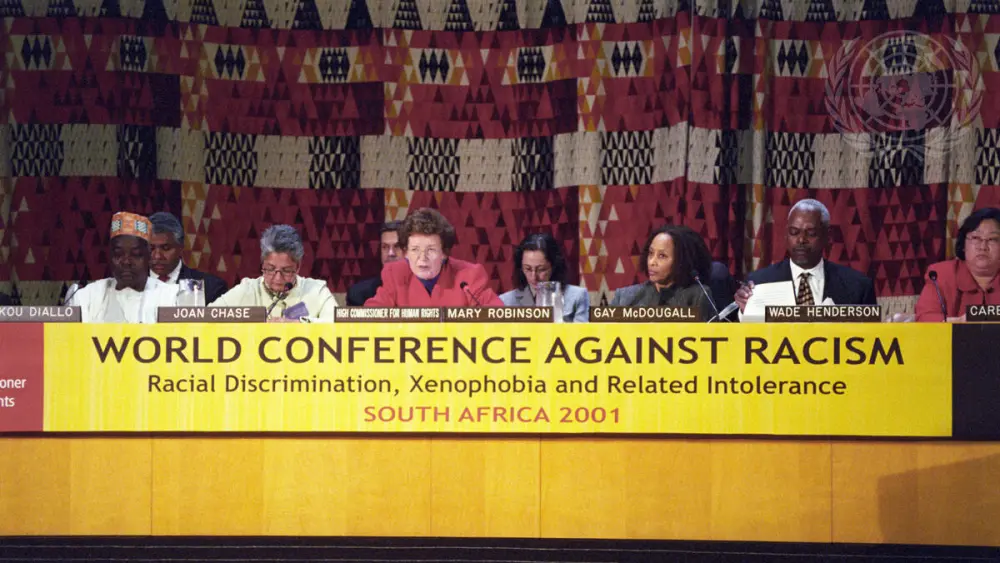

The Durban Conference in South Africa in September 2001 was not just an event; it was a turning point. It was the modern-day Wannsee that planned the contemporary destruction of the Jewish people.
I was there for the Italian newspaper, La Stampa. The stench of something rotten was already emanating from the preparations for the great gathering “against racism” convened by the United Nations, with the participation of an enormous number of NGOs—some 3,000—all of them with knives between their teeth, determined to demonstrate that, under the banner of human rights, the real enemy was Israel.
It was there, even more than with the U.N.'s “Zionism is racism” resolution of 1975, that Stalin’s path was resumed. In 1952-53, he had initiated and theorized a new great hunt against the Jews, inventing the blood libel of the “Jewish doctors’ plot” and staging the Slánský trial. The systematic murder and deportation of Jews were interrupted by the dictator’s death in 1953.
But with theorists such as Maxime Rodinson and Francis Crémieux, the premises were laid for declaring Israel the new enemy of humanity. The positions that ultimately led to Durban maintained that “the Israeli government has long been simply an agent of American imperialism.”
The supposed proof lay in the malign role of Jews in the world. The doctors accused in the so-called conspiracy—all innocent, their confessions extracted under torture—became “identical to the Nazi doctors of Dachau,” in the pay of the Americans.
The inversion begins
This was the beginning of the inversion that, on Oct. 7, 2023, led to Israel and the Jews being accused of genocide instead of the evident intentions of Hamas and its barbaric determination being condemned.
At Durban, the death sentence against Israel went hand in hand, for the first time, with the preemptive legitimization of terrorism, now carried out by “freedom fighters” rather than the terrorists of Munich or Fiumicino.
At a demonstration along the battered streets on the outskirts of Durban, just days before Sept. 11, the crowd marched behind portraits of its mastermind, Osama bin Laden. Along the dusty road, young NGO activists called—as their documents did—on “all of civil society,” from the Maya to the Tibetans, everyone oppressed by racism, to embrace the struggle against Israel and transform it into the fundamental human-rights struggle.
When I told the editors at my newspaper, La Stampa, they replied that I had an obsession with that poor Saudi shepherd.
The conference was organized by a United Nations that had by then been captured by the great Third World and Islamic blocs that had reliably provided the Soviet Union with a majority. “Zionism is racism,” the 1975 resolution, was an addendum to the death sentence against Judaism following Hitler’s attempt to eliminate it from the planet.
Israel was the new target of antisemitism, invariably linked to anti-Americanism and viewed as the spearhead of the colonial and imperialist West.
Every truth was erased. Israel’s almost desperate attempts to share the territory and make territorial concessions to the Arab world were rejected time and again. In 2000, after Arafat had been brought back despite his appalling embrace of terrorism, the Second Intifada erupted.
By the time Durban took place, we were in the midst of the Intifada—a preliminary Oct. 7. Its preparatory documents had been written and discussed in Strasbourg, Santiago and, astonishingly, Tehran, where since 1979 an Islamist regime had ruled whose foundational principle was the destruction of the State of Israel.
Israel as absolute evil
In Durban, Fidel Castro, Yasser Arafat and Robert Mugabe converged, and the Jewish question was inserted into the heart of demands for billions in reparations for slavery. Israel obviously had nothing to do with this history, but it was portrayed as absolute evil.
The Palestinianism of Durban held that Israel was racist, imperialist, colonialist and genocidal—and therefore even a slave-owning power. All these adjectives are meaningless when applied to a country that represents the miraculous return home, disarmed and hungry, of the people indigenous to that land, armed only with hoes and books. They armed themselves only when, awakening from the dream, they realized that their lives were once again at risk. And even then, Israel continued to surrender large pieces of territory in the search for peace.
I was there
In Durban, I rented a room inside a compound surrounded by high walls. I shared it with a journalist from the Italian left-leaning daily, La Repubblica, who was thrilled by the opportunity to encounter Castro and the other idols of the era in the corridors—and, with a little luck, perhaps Nelson Mandela as well.
There was the official conference, the domain of Mary Robinson, who purported to moderate the international proceedings and restrain them from excessively harsh resolutions that had in fact been planned from the beginning. Then there were the stadium and other NGO gathering places, where antisemitic hatred was expressed in every possible way: leaflets, speeches, songs and actual physical hunts for Jews.
Several times I had to run away and seek refuge in a building belonging to the local Jewish community, where one could also find something to eat.
Thousands of NGO members wore T-shirts bearing the image of Mohammed al-Dura alongside the conference logo. The production of leaflets about Palestinian suffering was endless. Jews were depicted with missiles and knives, blood dripping from their mouths and murdered children.
The word “genocide” was already commonplace.
From the podium, in a crowded, darkened hall, Fidel Castro, while demanding financial reparations for entire continents for slavery and colonialism, spoke of “the terrible genocide being perpetrated today against our Palestinian brothers” by Israel’s then-prime minister, Ariel Sharon, whom he described as a far-right leader acting in alliance with the “hegemonic superpowers.”
Arafat celebrated the universal acceptance of his worldview, describing the situation as the “expression of the racist colonial conspiracy” to uproot the Palestinians and conquer their land.
In short, the troops of that global war had finally assembled—a war that only days later would find its expression in the attack on the Twin Towers. That was the true meaning of Durban. And the Palestinian cause, together with the destruction of Israel, was baptized as the indispensable prerequisite for every revolutionary struggle.
The astonishment and disbelief in Israel and the United States were enormous. After everything the Jews had endured, and while they were suffering through the Intifada, finding themselves once again facing such a broad and senseless assault on their right to self-determination and self-defense, their right to return home and the very liberal-democratic nature of their country seemed like a nightmare.
The two delegations under attack took days to decide to leave.
Israel continued to insist, as Diaspora Affairs Minister Michael Melchior said, that racism—the supposed subject of the conference—was so important to Jews that the country wanted to participate in the discussion and the decisions.
In the end, the United States and Israel had to walk out.
Canada and Europe remained, but the European position sought an impossible compromise. It proposed restoring the Holocaust to the final documents as the worst expression of racism. The interventions by Italy’s Renato Ruggiero, Germany’s Joschka Fischer and, in the corridors, the excellent Margherita Boniver—the only one who understood fully, to the point of tears—were hesitant and moderate.
Fischer had the strength to say that the right of the Jews to their own state was indisputable. But he returned to the Palestinians’ right to a state and once again forgot that Israel had never called that right into question since 1948, despite its countless offers.
‘Did not happen in a vacuum’
By contrast, the denial of the Jews’ right to have their own state like every other people reached its paroxysm on Oct. 7.
And once again the United Nations lined up against Israel, as it had at Durban. So it was with the words of U.N. Secretary-General António Guterres, who, instead of expressing horror and condemnation, responded with his infamous statement that the Oct. 7 attacks “did not happen in a vacuum.”
It is true: They did not happen in a vacuum.
Durban is a milestone in the antisemitic catastrophe that once again torments the world today, and the United Nations is its prophet.