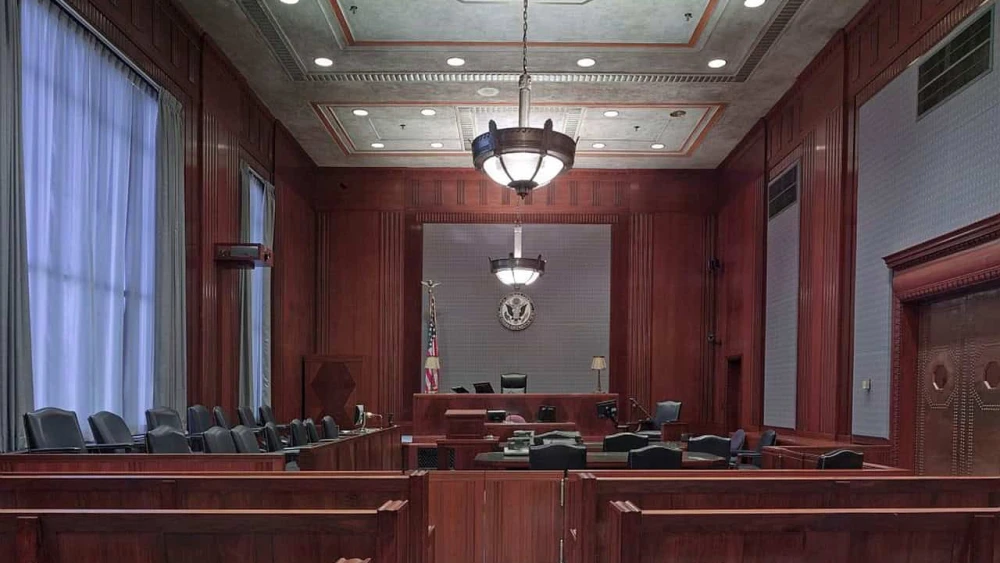
A Yiddish Santa, a former Soviet Jewry activist and a retired prosecutor walk into a courtroom. What sounds like the beginning of a joke is, for a group of Jews in New York City, a routine.
The trio are part of a loose network of Jews, who spend their mornings and afternoons sitting through hearings for those accused of offenses related to Jew-hatred, sometimes waiting hours for a proceeding that lasts just minutes.
They are not lawyers in the cases, relatives of the victims or witnesses to the crimes. Their role, as they see it, is to be present so everyone knows that the Jewish community is watching.
“It began about three years ago with two particular arrests,” Glenn Richter, 81, founder of New York Jewish Community Judicial Watch Group, told JNS.
He referred to the arrests, in November 2022, of Christopher Brown, then 21, and Matthew Mahrer, then 22, who the New York City Police Department said were planning to attack a synagogue in the city. Police officers later recovered a Glock 17, which prosecutors said Brown planned to use in the attack, from Mahrer’s residence.
The gun was stashed “around the corner from Congregation Ohab Tzedek on the Upper West Side, which I attend twice a day,” Richter said. “I realized that had he burst in, I could have been one of the victims.”
Since then, Richter has built a community of “dozens and dozens” of retirees, lawyers, doctors and activists, who have come to know one another through hours spent waiting together in courthouse hallways.
Their goal is to “let the judge know of the intense interest of the Jewish community in this case,” he told JNS.
A strong Jewish presence can encourage the district attorney to devote more attention and resources to a case, according to Richter. It also lets the “perp see that we have eyes on him,” he said.
Born and raised in New York City and a longtime activist, Richter helped lead the Student Struggle for Soviet Jewry, an American Jewish student organization, from 1964 until 1990. The experience taught him that there was an “efficacy to advocacy,” he told JNS.
Though he can no longer, at his age, “take to the streets,” he has found a way to continue that purpose in the courtroom.
“The fact of the matter is that showing up for this, which is a matter of justice, is something I can do and something anybody else can do,” Richter said. “We have not only Jews coming to join us. Sometimes we have very good non-Jews joining us.”
The group operates on a volunteer basis and does not fundraise, according to Richter.
“I don’t have to worry about what I did in the Soviet Jewry movement,” he said, laughing. “How do we get the next dollar. None of that.”
Since Zohran Mamdani took office as mayor of New York City in January, the group’s responsibilities have increased, Richter told JNS.
Many of the defendants, whose cases he follows, appear to have mental health issues, but he believes that the mayor’s inflammatory rhetoric about Israel and Jews may have influenced people already predisposed to antisemitic views.
“He did not light the fire, but he’s throwing gasoline on it,” Richter said, of Mamdani. “I am not a psychiatrist, but I think that people who are predisposed to certain thoughts may heed what Mamdani says about Jews, Israel and genocide and then decide to take action on their own.”
Richter co-founded the group with Lynn Bursky Tammam, of Great Neck, N.Y. Her husband, Nessim, was involved in the Soviet Jewry movement, Richter told JNS.
Bursky Tammam told JNS that she launched her own court-watch efforts after a 2021 antisemitic attack in New York stirred painful memories for her husband, who grew up in Tripoli, Libya.
“This happened there on a regular basis—unprovoked barbaric attacks by savage Jew-haters,” she said. “We couldn’t believe that this was happening in New York.”
Bursky Tammam said that she and Richter soon began coordinating their efforts. “We realized that the judge and the DA’s reps had to see the pain of the Jewish community,” she said. “What resulted was a wonderful partnership.”
She called it “incomprehensible” that the “savage behavior in Libya from which Nessim’s family escaped was imported to the streets of New York.”
“In Libya, there was no means of seeking justice,” she said. “But here we have our judicial system, which we still depend on to mete out sentences which will hopefully be deterrents to future attacks.”
The group has no formal membership rolls, but Richter’s email list, through which he alerts members to upcoming court dates and developments in cases they are following, includes “dozens and dozens” of people, he said.
Sometimes only a handful show up to a proceeding. About 30 attended one recent hearing, he said.
Over the past three years, members have appeared at “dozens and dozens” of cases, with some weeks bringing multiple hearings and other stretches passing without any, Richter said.
He spoke to JNS at length about several of them, from subway assaults to the recent stabbing of Moshe Grunhaus, allegedly by Raul Morales, to the trial of Skiboky Stora, 42, who represented himself after being accused of attacking several people, including Jews.
“These are the cases,” Richter said. “Some of them are more mundane. Some of them are wild.”
Brian Chenensky, 70, a retired accountant who grew up in Queens, has been attending the group’s court appearances for about two years. Unlike many of the regulars, Chenensky is not religious, he said.
He is known around New York as the “Yiddish Santa,” a persona he created and promotes through his website.
“I come to support the Jewish community, to let the judges know that there are people keeping an eye on them and just to get a hands-on feeling for what’s really going on in the criminal Jew-hate world,” he told JNS.
Chenensky said he attends one or two cases weekly, or “about as many as Glenn Richter goes to.”
“Sometimes months go by without any, but this week there’s going to be many, and in September there’s a lot of activity,” he said.
Chenensky told JNS that he has noticed an uptick in cases since Mamdani took office.
“It’s a sad state,” he said. “It’s not going to get any better, and it’s just the beginning.”
When JNS attended the first oral arguments in a lawsuit brought by a journalist over Mamdani’s delays in releasing records related to his decision to rescind several of his predecessor’s executive orders combating Jew-hatred on his first day in office, Serena Smulansky was seated in the front row of the state Supreme Court courtroom.
A retired finance attorney, Smulansky told JNS that she has been attending such hearings for more than two-and-a-half years.
She first became involved while attending proceedings in the case of Joey Borgen, a Jewish man who was beaten, kicked and pepper-sprayed by a group of assailants near Times Square in May 2021 while he was on his way to a pro-Israel rally.
The attack, which was ruled a hate crime, drew widespread attention and resulted in prison sentences for six offenders.
At one hearing, Smulansky was asked to take notes and tried to record nearly everything that was said.
“By the end I had a huge stack of illegible notes,” she recalled.
Richter later asked her to read them aloud over the phone while he transcribed them, before adding her to his email list.
“I have not been asked to take notes since,” she joked.
JNS asked how many cases she has attended since joining the group. “Dozens, unfortunately,” she said. “It is not so unusual to have multiple cases each week.”
She has not yet seen an increase in the cases reaching court since Mamdani took office. Such prosecutions can take years to resolve and many of the proceedings she now attends stem from incidents that occurred last year or even earlier, she told JNS.
“Given the surge in antisemitic crime, I imagine, sadly, there will be even more to attend in the coming years,” she said.
Some of the moments that have stayed with Smulansky the most have been less about whether the group changed the outcome of a case than about what she witnessed in the courtroom.
She recalled one case with so many pretrial hearings and such a lengthy trial that members of the group became friendly with both the appointed defense attorney and the assistant district attorney.
In another, she approached the mother of a defendant who had traveled alone from Florida to watch her son plead guilty to stalking and terror threats.
“I wanted her to know I understood it could not have been easy to see her son up there under such circumstances,” Smulansky told JNS. “She wanted me to know she stands with our community and did not condone his acts.”
The case of Tarek Bazrouk, who pleaded guilty to three violent attacks on visibly Jewish men, was another experience that stayed with Smulansky.
More than 100 people packed the courtroom to support him, many of them “young people wearing keffiyehs, headscarves or sweatshirts with anti-Jewish slogans,” she said.
“This was important for me to see,” Smulansky told JNS. “How many people blindly hate Jews in New York City.”
The long waits and occasionally boring proceedings have not deterred her.
“I refuse to accept the current state as a normal part of Jewish life,” she said. “So long as I am in New York City, where these crimes are so frequent, I will keep showing up. I hope to one day live somewhere else where antisemitic hate crimes are not part of everyday life.”
Over time, Smulansky said, the group’s members have become a community to her.
“They are my buddies,” she said. “Whenever I see any of the regulars, I feel relief. Here are my people and I am not alone.”