


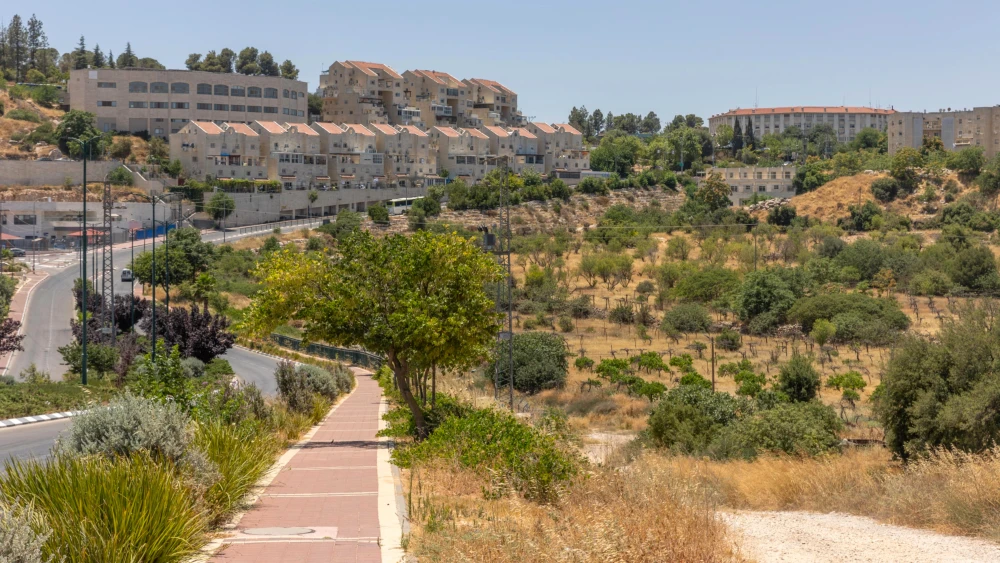

The three highest priorities in Israel today are: security, security and security. On Yom Hazikaron—Israel’s Independence Day—during a tour of the Judean Hills around Kiryat Arba, I had an experience that clarified the urgent need to populate Judea with Jewish communities to help create security for Judea and all of Israel.
It was a tale of two hilltops.
The first hilltop, designated Hill 1 by Kiryat Arba, is a Jewish community started by the Tzion Development Initiative (TDI) a little more than a year ago, in collaboration with the mayor of Kiryat Arba, the Israeli Ministry of Settlement and National Missions, and the Israel Defense Forces.
Hill 1 is officially a part of Kiryat Arba, but when it started working on that, it was barren and dangerous. When areas in Judea that are designated for Jewish residency aren’t populated, Arabs, funded by the European Union, build elaborate illegal settlements on Jewish land and make the areas unsafe for Jews to visit. Only nine months ago, we needed armed guards to visit Hill 1. Last week, we were able to drive up in a civilian car.
When we arrived, we saw a beautiful new community. Twenty families live there now, in spacious, comfortable and modern caravan-homes—four blocks of five houses. When we arrived, dozens of children were playing in front of one of the houses, singing and dancing in anticipation of Yom Ha’atzmaut. We met some of the families living there, toured one of the houses and ate some local fruits grown in the area. It was amazing to see how much Hill 1 had matured over the course of the year.
Following our visit to Hill 1, we drove through a few more new communities on our way to an upcoming hilltop project. The entire time, we were driving through Kiryat Arba. We got off the highway to go up a hill to get a better view of the area. On our way up, our path was blocked by some rocks. The security team guiding us had cleared a way up the hill the day before, removing whatever rocks were in the way. To our chagrin, someone had put them back in our path, preventing our ascent.
As our security detail went up the hill to see if they should remove the rocks or if we should proceed on foot, some older Arab boys appeared at the top of the hill and started yelling at us. As our security team started communicating with them, one of them picked up a large rock and threw it at one of the security officers. We quickly got out of our cars into a protected position, so our security team could deal with the elevated threat.
While our two security guards were engaging with the boys, unbeknownst to any of us, a dozen or so men started approaching us from behind, presuming that we were no longer defending ourselves. Luckily for us, we had two other men who were trained soldiers in the remaining group, and they quickly mobilized to secure our unprotected flank, so we were not vulnerable to this new potential danger. We remained pinned down behind our cars while the two sets of security guards engaged with the Arabs who had ambushed us. The IDF soldiers who were called when the first incident began arrived after about 30 minutes, and we were escorted to safety by them.
In retrospect, the soldiers explained to us that once our security detail cleared the path the previous day in anticipation of our ascent up the hill, the local Arabs had been waiting for us to return. If we didn’t have two sets of security in our group to defend against both groups—men and boys—we probably would have been a cautionary tale on the Israeli news the next day, as well as probably being accused of “settler violence” in the European press.
This tale of two hilltops explains the mission of TDI better than any PowerPoint, website or tour could do. Regardless of the political designation of these areas on the map (both hilltops are in Area C, according to the Oslo Accords), security is determined by Jewish residency. If no Jews are living in an area, Arabs feel free to attack without fear of consequences.
However, once there are even a few families on a hilltop, it becomes a safe haven for vibrant communal life. We need to support the Tzion Development Initiative’s work in Judea to provide more opportunities for developing our Israeli birthright and to create security in the land, as well as to fulfill the mitzvah of making the land holy.


