


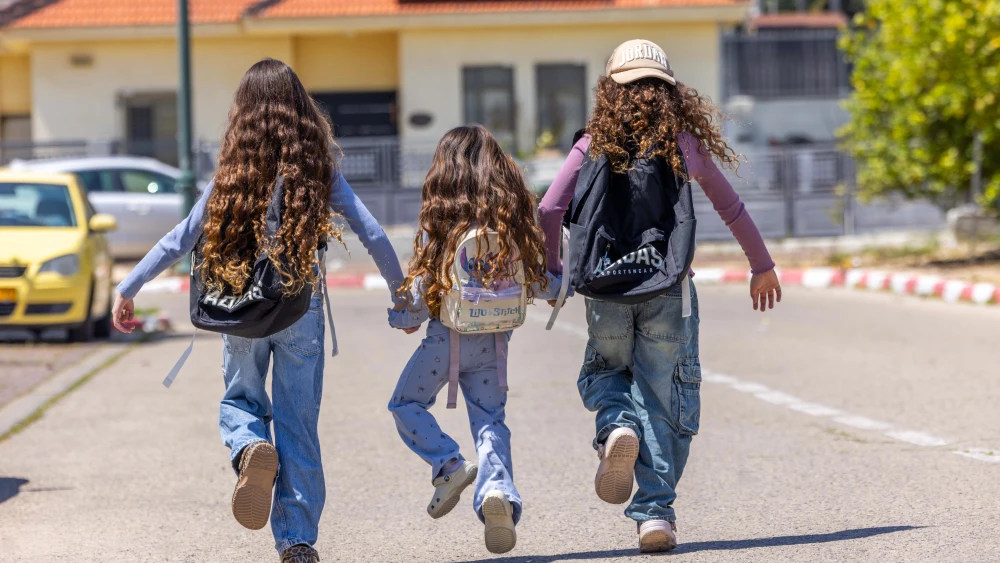

Some 2.6 million Israeli children have returned to school in Israel. For the first time since Oct. 7, 2023, the academic year will begin without a major war defining every aspect of Israeli life. Yet this is hardly an uncomplicated normal. Family members are still serving in the reserves; families continue to absorb the consequences of years of war; and Israel remains surrounded by enemies whose intentions have not changed.
The obvious task facing the education system is considerable: repairing lost academic ground; addressing trauma; and restoring stability to children whose formative years have contained experiences that previous generations would have considered extraordinary.
There is also another task—less immediate but ultimately more consequential. Israel must decide what its children need to know to understand the country they inhabit and the reality in which it exists.
One temptation after national catastrophe is to locate failure entirely within the institutions that failed operationally. Intelligence misread information, military planners underestimated the enemy and political leaders misunderstood deterrence. But the conceptzia that collapsed on Oct. 7 was not created inside the intelligence services alone. It reflected assumptions that had permeated Israeli society for decades, and many unfortunately remain with us, perhaps most visibly in how parts of the security establishment continue to interpret the threats developing in Judea and Samaria.
The problem was that we had developed a framework that prevented us from properly interpreting information already before us. We viewed our enemies through categories we had constructed for them: economic improvement would moderate ideology, prosperity would overcome religious conviction, and rational actors would ultimately prefer stability to sacrifice. Explicit statements of intent were translated into motives more comfortable to Western minds, rather than understood within the historical, religious and ideological worldview of those expressing them.
That failure cannot be separated from the way Israelis have been educated.
A society that loses fluency in its own history, texts and civilizational language also loses the ability to understand how deeply history, faith and collective memory can shape the actions of other peoples. If children are taught that ancient texts are largely relics and religious conviction is something that modern people outgrow, then why should we be surprised when adults struggle to comprehend enemies for whom scripture, history, land and collective memory remain intensely real?
Jewish education after Oct. 7 is therefore not a narrow religious concern; it is a question of national competence. The Israeli Ministry of Education has recently presented as a significant reform the introduction of a minimum of one weekly Tanach lesson throughout the school system. That this can be regarded as a major advance should itself shock us. One hour a week devoted to the foundational text of Jewish civilization in the Jewish state is now treated as an ambitious corrective, and many children still do not receive even that consistently.
It’s difficult to imagine clearer evidence of how far the baseline has fallen. Nor can one weekly lesson repair the deeper problem. A child can encounter biblical stories without understanding the architecture connecting Abraham to Exodus, exile to return, Jerusalem to sovereignty or Modern Hebrew to the texts from which so much of it emerged.
Jewish literacy is not a collection of references. It is the ability to locate oneself within a historical continuum.
We scrutinize matriculation scores, mathematics tracks and English levels while paying far less attention to the ideas through which our children are taught to understand themselves.
Israeli schools are also hardly ideologically neutral spaces. Ideas about identity, society, gender, citizenship and culture enter classrooms from the youngest ages, often with little parental scrutiny. Schools inevitably transmit values, yet deep Jewish civilizational literacy is frequently treated as an intrusion while newer ideological frameworks are presented simply as education.
Parents should ask harder questions. We scrutinize matriculation scores, mathematics tracks and English levels while paying far less attention to the ideas through which our children are taught to understand themselves. Oct. 7 demonstrated that identity is not an extracurricular concern. The stories through which a society understands itself eventually shape its ability to understand reality.
Perhaps some of the clearest evidence came from the darkest places imaginable. The Israelis dragged into Gaza revealed extraordinary reserves of courage, dignity, faith and human strength under conditions impossible to comprehend.
The accounts that have emerged include hostages fasting on Yom Kippur despite extreme hunger; trying to observe Shabbat; reciting Shema and Tehillim; improvising Kiddush and Havdalah; and holding tightly to fragments of Jewish practice and memory.
When almost everything else was taken from them, they reached for belonging, memory, faith and the words of generations that preceded them.
These gems had been living quietly among us—their brilliance revealed under unbearable pressure. What emerged from them illuminated something our society urgently needs to see.
For decades, parts of Israeli society treated that inheritance as something a modern state could gradually afford to leave behind. The experience of captivity exposed the poverty of that assumption: When almost everything else was taken away, belonging, memory and faith remained sources of strength.
That should shape what happens with Israeli children’s return to school.
The remarkable Israelis who emerged from the darkness of captivity showed us what can happen when that light already exists within. If we can kindle the same depth of identity, memory and purpose in our children, they will not merely inherit the Jewish story; they will be equipped to carry it forward.
And perhaps then Israel can move beyond simply defending its place in the world and more fully fulfill the ancient purpose of Jewish sovereignty: to build a society whose inner light can truly become a light unto the nations.


