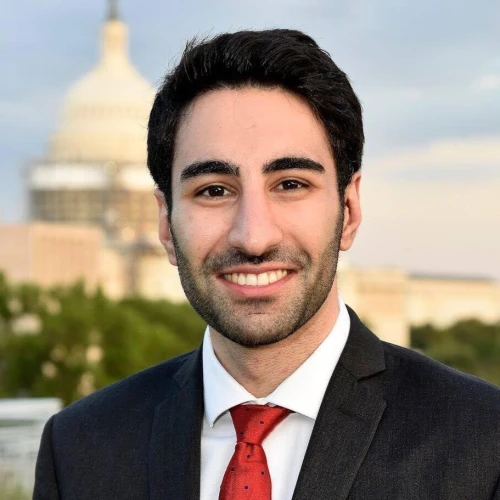

Dr. Abdul El-Sayed’s victory earlier this month in Michigan’s senatorial Democratic primary has left many American supporters of Israel unnerved. Should they be?
Well, he has appeared happily in public alongside Hasan Piker (who has shared antisemitic sentiments and support for terrorism), and he answered a reporter’s question, “Do you think [Israel is] just as evil as Hamas?” with a “Yes.”
At an event that El-Sayed held shortly after the death of Iranian Supreme Leader Ali Khamenei on Feb. 28—the first day of the joint U.S.-Israeli war on Iran—the candidate told his staff that he wasn’t going to comment on the death of the mullah, who was responsible for the murder of thousands of Iranian citizens.
He shared his feeling that the dictator’s demise had resulted in “a lot of people in Dearborn who are sad.”
And the day after the recent election, he called Israel “bloodthirsty.”
But even more disturbing than El-Sayed’s hobnobbing with an antisemite or harsh judgment of Israel’s actions in Gaza is his refusal to acknowledge that Israel even has a right to exist.
Asked if it does, he responded: “I often struggle with the question that people ask in this particular scenario, because what they now ask is, ‘Do you believe in the right of Israel to exist as a Jewish state,’ which, to me, forces the question of a definition of what a Jewish state means.”
“I need folks,” he continued, “who want to ask me that question [to explain] what it is that they mean by that, and how that is consistent with any form of liberal values that we say we believe in here in the United States.”
It’s a reasonable ask. And there is a reasonable answer.
Israel defined itself as a Jewish state when it declared its independence in May 1948; the following year, it was formally admitted as an official member nation of the United Nations.
The “Jewish” in Israel’s self-definition meant that it would be a homeland for any Jewish person who wishes to become a citizen. That is the legacy of the fact that persecuted Jews were turned away from numerous countries during the Holocaust. Part of Israel’s raison d’être was to offer sanctuary to any future threatened Jews.
Anyone, though—no matter his or her race, religion or ethnicity—can also become an Israeli citizen through a normative naturalization process or by marrying an Israeli citizen. Entirely consistent with “liberal values.”
Israel’s Jewish identity does inform its laws and culture. Its workday calendar respects the Jewish Sabbath and holidays; in Jerusalem and other large Israeli cities, an almost tangible calm descends each Friday as the Jewish Sabbath arrives. Retail stores are generally not permitted to open during the Jewish Sabbath. But that is akin to the “blue laws” that exist in parts of the United States.
Arab citizens of Israel—Muslims and Christians alike—have the right to vote, run for office, and serve in the Knesset and as judges, even on the country’s highest court. As they have indeed done.
The fact that the country’s official language is Hebrew also telegraphs its Jewishness. But Arabic and English are also widely spoken, and official street signs are in all three languages.
Kosher food is served at government functions and in the military. But non-kosher food is widely sold and available to anyone who wants it.
And, obviously, the majority of Israelis are Jewish, and so that, too, reflects the state’s connection to the Jewish faith.
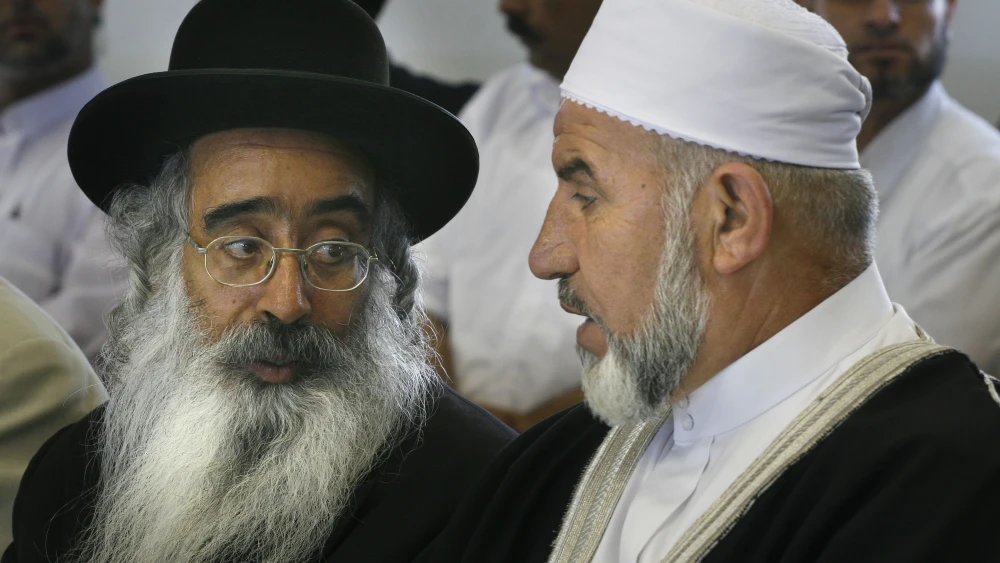
There is an official state rabbinate, but its purview is limited to things like personal religious status, marriage, divorce and burial. And the very same religious autonomy and authority are granted to Christian and Muslim communities in the state. Ten distinct Christian denominations (including Greek Orthodox, Roman Catholic and Armenian) run independent church courts. The Israeli government pays the salaries of selected Muslim imams and provides operational budgets for major non-Jewish houses of worship.
The Israeli Ministry of Education funds the country’s school system, including both secular and religious schools: Jewish, Muslim and Christian. Universal healthcare in Israel is accessible to all Israeli citizens, regardless of religion.
Likewise, national insurance benefits and pensions. Muslims and Christians in Israel enjoy the same equal employment rights and legal protection against workplace discrimination provided to Jews. Muslims and Christians work across diverse sectors—healthcare, high-tech, education and law—often alongside Jewish co-workers. All in keeping with “liberal values.”
There is, in fact, unfettered freedom of religion in the country – for all citizens. Including for Jews, some 45% of whom self-identify as “secular.” They are able to violate Jewish religious laws without legal repercussions.
In very religious neighborhoods, modest dress is expected, out of the local social norm and respect for the local population—just as a modest dress code is in place for all visitors entering Vatican museums and the Sistine Chapel. But in the end, there are no legal restrictions on dress anywhere in Israel. Because Israel hews to “liberal values.”
Israel maintains the institutions, too, of a liberal democracy, including regular and competitive elections, a free press and an independent judiciary. Arab citizens of Israel—Muslims and Christians alike—have the right to vote, run for office, and serve in the Knesset and as judges, even on the country’s highest court. As they have indeed done.
All that should hopefully satisfy El-Sayed’s concern about the “Jewish state.” He may wish, however, to ask what countries whose constitutions explicitly name Islam as the state religion are like.
Countries like Algeria, Bahrain, Egypt, Iraq, Jordan, Kuwait, Libya, Morocco, Oman, Qatar, Saudi Arabia, Somalia, Tunisia and the United Arab Emirates. And Afghanistan, Bangladesh, Brunei, Malaysia, Maldives and Pakistan. Not to mention Mauritania and Djibouti.
Curiously, El-Sayed has not, at least publicly, expressed any angst about any of those nations’ religious identities, which actually do inform their often onerous laws. Many, if not all of them are openly rejective of “liberal values.”
Only Israel’s Jewish identity seems to trouble him.
And so that is why El-Sayed’s designation as the Democratic candidate for a Senate seat rightly concerns those who appreciate Israel and care about her security.
Originally published in “Ami Magazine.”