
As India and Israel foster stronger ties these days, it’s worth examining some of the key history between these two nations.
Lt. Gen. Jack Farj Rafael Jacob, a Bene Israel Jew, stood at the center of India’s 1971 victory and the largest military surrender since World War II. Few events in modern military history reshaped a region as swiftly as the 1971 India-Pakistan War. In just 16 days, India’s Eastern Command broke the Pakistani military’s hold over East Pakistan, clearing the way for the birth of Bangladesh.
At the heart of this campaign was Jacob, whose strategic clarity and moral resolve shaped the outcome of the conflict. On Dec. 16, 1971, in the city then known as Dacca, Pakistan’s forces capitulated in what remains the largest military surrender since World War II.
Jacob’s life began far from the battlefield. Born on May 2, 1923, into a Bene Israel Jewish family in Calcutta, he grew up in a community that had lived in India for centuries without persecution. He attended synagogue, learned Hebrew prayers and absorbed the rhythms of Jewish life. India’s long tradition of tolerance allowed Jews to flourish, and Jacob would later say that he never encountered antisemitism in his homeland. His Jewish identity shaped his moral compass, but his military career defined his public life.

That career emerged from a broader tradition of Jewish service in India. Thousands of Indian Jews served in the British Indian Army during both World Wars, fighting in the Middle East, North Africa and Burma. After independence, Jewish service in the Indian Army continued, and Jacob became its most distinguished Jewish officer.
India’s military connection to the Land of Israel also runs deep. More than 900 Indian soldiers who fought in World War I are buried in cemeteries across Israel, including in Haifa, Jerusalem and Ramle, a reminder of a shared history long before formal diplomatic ties.
The strategist: The plan to win a war
History turns on the rare occasions when a single strategist understands the moment more clearly than the forces shaping it, and Jacob was one of those figures. He joined the British Indian Army during World War II, serving in the Middle East, North Africa and Burma—experiences that exposed him to the complexities of modern warfare. After India gained independence in 1947, he chose to remain in the Indian Army, rising steadily through the ranks until he became chief of staff of India’s Eastern Command in 1971, responsible for planning operations against Pakistani forces in East Pakistan.
The crisis that erupted in East Pakistan in March 1971 was one of the worst humanitarian disasters of the century.
History turns on the rare occasions when a single strategist understands the moment more clearly than the forces shaping it, and Jacob was one of those figures.
The Pakistani military launched a brutal crackdown on Bengali civilians, sending millions of refugees into India and creating immense economic and social strain. As India weighed its options, it found itself increasingly isolated on the world stage.
The United States and the United Kingdom tilted toward Pakistan, and arms supplies to India were restricted. In this moment, Israel quietly provided India with emergency military equipment, including artillery shells and ammunition, when others would not. It was a discreet but meaningful gesture, remembered in Indian strategic circles and later acknowledged by Jacob himself.
Jacob understood that a prolonged conflict risked drawing in outside powers, destabilizing the subcontinent and worsening the humanitarian catastrophe already unfolding. His plan was therefore not only a military blueprint but a political calculation designed to achieve victory before external actors could reshape the battlefield. He recognized that speed was not merely a tactical advantage but a strategic necessity, allowing India to control the tempo of events and prevent the crisis from spiraling into a wider regional confrontation.
The surrender and the legacy of a Bene Israel general
Against this backdrop, Jacob crafted a plan built on speed, maneuver and psychological pressure. Rejecting the conventional doctrine of slow, sequential advances, he believed that bypassing Pakistani strongholds, advancing on multiple axes and driving straight toward Dacca would collapse the enemy’s command structure. When India launched its offensive on Dec. 3, 1971, Jacob’s plan unfolded with remarkable precision. Indian forces advanced rapidly, isolating Pakistani units and overwhelming their ability to regroup. Within days, Indian troops had encircled Dacca.

The Pakistani commander expected negotiations, but Jacob arrived with a concise document outlining the terms of capitulation. Attempts to delay acceptance were met with firm insistence that the conflict would resume if agreement was not immediate.
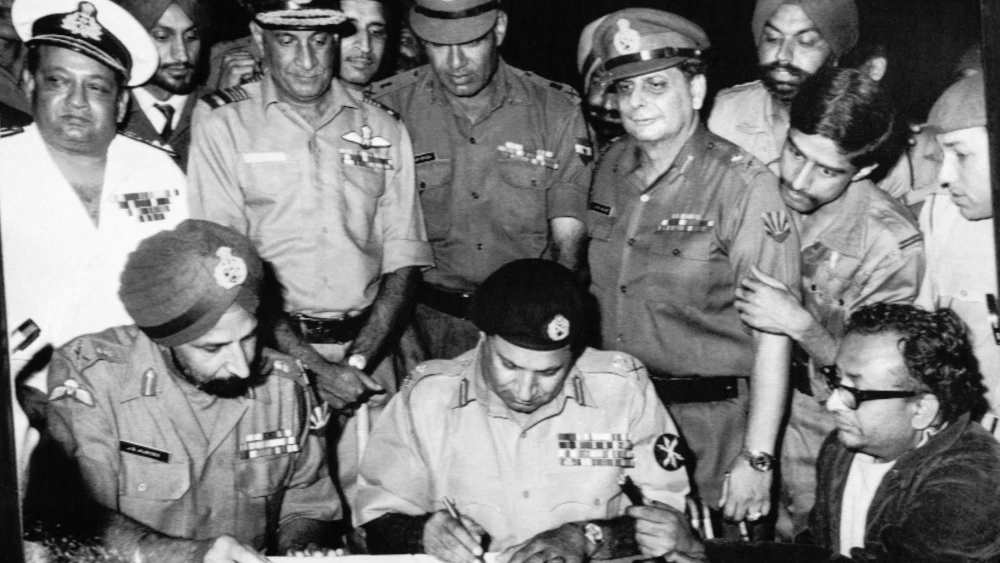
That afternoon in front of thousands gathered at the Ramna Racecourse, the Pakistani military formally accepted the terms, and Bangladesh emerged as a new nation. It was the largest military surrender since World War II, and Jacob stood at its center.
Marking 55 years since that moment, his achievement remains one of the most decisive and humane military outcomes of the 20th century.
In the years that followed, Jacob continued to serve India with distinction, later becoming governor of Goa and Punjab. He visited Israel several times, met with Israeli leaders, and was honored for his service and heritage.
Israel continues to remember the Bene Israel general who stood at the center of that historic moment. On that afternoon in Dacca on Dec. 16, 1971, Lt. Gen. A. A. K. Niazi of Pakistan and Lt. Gen. Jagjit Singh Aurora of India placed their signatures on the instrument of surrender, but it was Jacob who drafted the document, delivered the terms, and ensured that the capitulation was unconditional and immediate.
Seven years ago, on April 30, 2019, Israel installed a permanent plaque honoring him on the Wall of Honor at Jerusalem’s Ammunition Hill, the national memorial dedicated to Jewish soldiers who served with distinction in foreign armies. His name now stands among heroes who carried the weight of history with courage and clarity, alongside the graves of more than 900 Indian soldiers buried across Israel from World War I, a quiet reminder of the long and intertwined story between the two nations. It is a fitting tribute.
Credit goes to Dr. Kenneth Robbins, whose scholarship on Indian Jewish history helped inspire this piece.