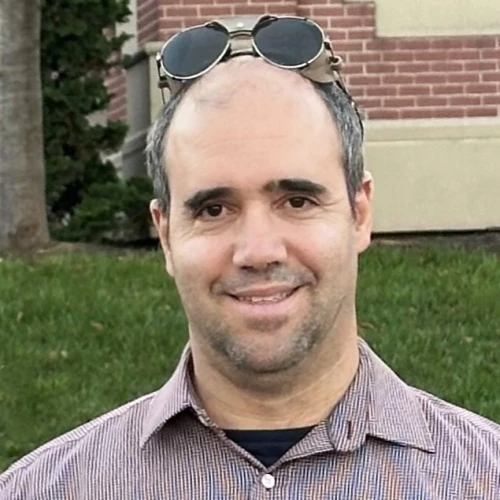
Several Israeli researchers are scrutinizing the reporting of Israeli journalist and filmmaker Yuval Abraham, as well as his relationships with Palestinian figures alleged to have ties to Hamas.
Abraham and co-director Rachel Szor have drawn international attention since their documentary “NAZA” won the Special Jury Prize at the 83rd Venice International Film Festival on Sept. 12.
The film, whose name is derived from the Hebrew military acronym for “collateral damage,” alleges that the Israel Defense Forces systematically targeted Palestinian civilians during the war in Gaza.
The IDF has rejected allegations made in the documentary, saying it could not verify the identities of the anonymous military and intelligence sources featured in the film.
In response to the film, Israeli Culture and Sports Minister Miki Zohar this week called for Abraham and Szor’s Israeli citizenship to be revoked and asked authorities to examine such a move.

Questions over Gaza language center
The Regavim Movement, an Israeli NGO dedicated to preserving and enforcing the rule of law and sovereignty, released previously unpublished research this week examining Abraham’s portrayal of a Gaza teacher who murdered an Israeli civilian, reenacted the killing in an interview and publicly defended violent “resistance.”
Moran Tal, Regavim’s Arabic-language open-source intelligence researcher, told JNS that the investigation exposes what she said the international media must understand about Abraham.
“Yuval Abraham is not a journalist, but a radical left-wing activist who presents false portrayals and distorts facts in order to promote an extremist agenda,” she said.
Tal said Abraham’s reporting presented the Gaza-based “Gaza Studio—Nafha Center” as a Hebrew-language learning initiative promoting peace and coexistence.
Regavim, however, says the center was operated by Ahmed al-Falit, whom it identifies as a convicted terrorist affiliated with Hamas’s Izz ad-Din al-Qassam Brigades and a former prisoner released in the 2011 Gilad Shalit exchange.
Regavim also takes issue with Abraham’s description of al-Falit as having killed a “soldier his own age,” arguing that the wording obscured the fact that his victim was 32-year-old Israeli civilian Shimon Biran, who was murdered in a 1992 stabbing attack outside Kfar Darom in Gush Katif.
The organization further alleges that the Nafha center was not simply a language-learning initiative but was used to glorify terrorists, teach military terminology and disseminate messages of hatred and incitement against Jews.
Regavim says al-Falit has repeatedly glorified his actions, praised terrorists involved in his release, appeared alongside Hamas figures, including former terrorist commander Ahmed Jabari, and publicly celebrated the Oct. 7 massacre. The organization argues that these details were omitted from Abraham’s portrayal of the center and its founder.
Tal said she believes Abraham’s reporting was neither journalism nor an innocent mistake.
“Yuval Abraham selectively sifted through information that fit his fantasy and narrative, while completely concealing and ignoring the terror and incitement connections that were there for all to see,” she said.
“This is propaganda and the romanticization of terrorism. It is time for everyone to understand that this is an exercise in manipulating public consciousness, recognize Abraham’s lack of reliability, and stop attributing significance to the lies he disseminates.”
‘Across the Wall’
At the same time, independent American-Israeli researcher Eitan Fischberger posted a heavily sourced thread on X this week alleging that Abraham has a longstanding relationship with Palestinian journalist and activist Ahmed Alnaouq, whom Fischberger describes as having ties to Hamas.
According to Fischberger, Abraham and Alnaouq, whom Abraham called a “close friend and colleague,” co-founded the Gaza-based media project Across the Wall in 2019.
Across the Wall served as a media platform where personal stories written by young Palestinians living in the Gaza Strip were translated into Hebrew. It is unclear whether the project remains active, as its website is no longer accessible.
Fischberger said Abraham went further, describing Alnaouq as his “partner, not only in establishing [Across the Wall], but also in a political path.”
According to Fischberger’s research, Alnaouq is also vice president, treasurer and outreach officer of Euro-Med Human Rights Monitor, which Fischberger describes as a Hamas front group.
Israel first banned Euro-Med Monitor’s predecessor entity, the Euro-Mid Observer for Human Rights, as an “unauthorized association” in March 2015. The organization was subsequently designated under Israel’s 2016 Counter-Terrorism Law.
More recently, in May, Israel’s Ministry of Diaspora Affairs and Combating Antisemitism released a report alleging that the Geneva-based Euro-Med Human Rights Monitor maintains ties to Hamas and plays a central role in promoting anti-Israel legal and media campaigns worldwide.
One of Euro-Med’s projects is We Are Not Numbers, which Alnaouq leads. The initiative says its mission is to help Gazan writers bring their stories to international media. Alnaouq launched the project in honor of his brother, Ayman, whom Fischberger identifies as a Hamas terrorist killed in an Israeli airstrike in Gaza in 2014.
Fischberger told JNS that the relationship raises broader questions about Abraham’s judgment and whether his personal associations could influence his work.
“When an individual considers someone with such strong ties to Hamas a close friend and partner, what does that say about his judgment?” he said. “It’s entirely fair to ask whether the same blind spots and biases carried over into a film like ‘NAZA.’”
Questions over ‘No Other Land’

Also this week, Sela Meir Publications, the publisher of author and journalist Tuvia Tenenbom, posted on social media that its author had exposed what it called Abraham’s falsehoods well before the controversy surrounding “NAZA.”
In the post, which Tenenbom shared with JNS, Sela Meir said his latest book, Excuse Me, Is This Yours?, about life in Judea and Samaria, includes a section questioning the journalism in Abraham’s previous documentary, “No Other Land.”
The film, co-directed by Abraham and Palestinian activists Basel Adra and Hamdan Ballal, along with Szor, won the Academy Award for Best Documentary Feature in 2025.
One of the examples highlighted by Tenenbom, according to the publisher, involves the film’s climactic scene documenting a shooting in the village of At-Tuwani, in which a Palestinian named Harun Abu Aram was shot and left paralyzed.
The film depicts soldiers entering the village to confiscate a generator and Abu Aram being shot during the ensuing confrontation.
According to Tenenbom’s account, however, the footage was misleadingly edited. In the seconds preceding the shooting, the camera “jumps” and shifts, he says, cutting out what he describes as a key part of the incident: Abu Aram lunging at one of the soldiers, attacking him and attempting to seize his weapon.
Tenenbom argues that the edit removed the alleged assault and the danger faced by the soldiers, turning what he describes as a justified operational response into the portrayal of an arbitrary shooting.
Sela Meir said Tenenbom’s account exposes what it described as a pattern of staging, distortion and omission in Abraham’s work.
The publisher characterized Abraham not simply as a filmmaker with “a complex narrative” or a documentarian with “a different perspective,” but as “a serial liar caught red-handed while staging, distorting and erasing facts.”