


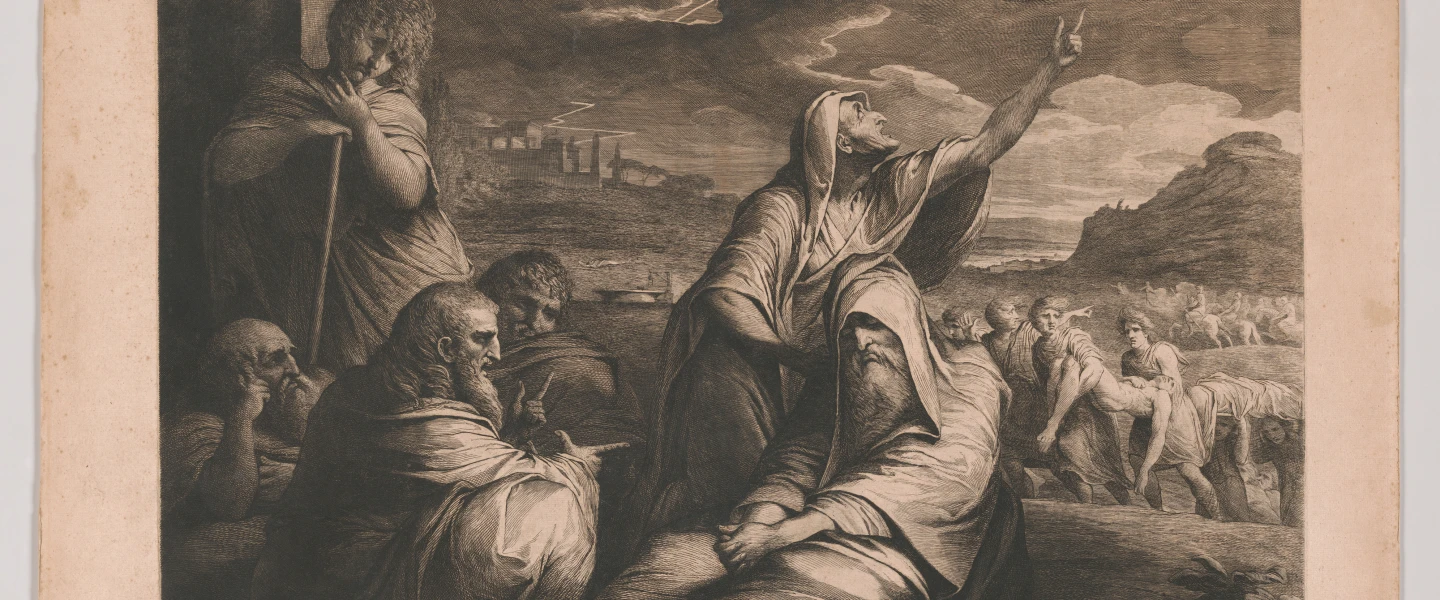
If the High Priest in the Temple in Jerusalem was sufficiently learned, then he would study religious texts all night on Yom Kippur, when he was supposed to pull an all-nighter; if he wasn’t, then priests would read to him. The anti-bedtime stories they would read, according to the Mishnah in Yoma 1:6, came from Job, among other texts.
The biblical text, which has some of the most difficult Hebrew and Aramaic in scripture, tells of an eponymous God-fearing man, who was the wealthiest in the east and had seven sons and three daughters. After telling God that Job would regress if things went badly for him, Satan secures the right to torment Job apparently without cause. The devil isn’t allowed to take Job’s life but afflicts him with boils and kills all 10 of the titular character’s children and impoverishes him.
The rest of the book centers on Job’s conversations with his ostensible friends, his wife and finally God. An expression has subsequently emerged—the “patience of Job.”
That phrase appears to come from the King James Version translation of James 5:11, in the New Testament. According to the “Oxford English Dictionary,” it has been used at least since English novelist and playwright Henry Fielding wrote in “The History of Tom Jones, a Foundling” in 1749, “You would provoke the patience of Job.”

Some two centuries prior, English scholar and judge Thomas Wilson highlighted a different quality of the figure—“thou art as poore as Iob”—in his 1553 work “The Arte of Rhetorique,” and in 1822, Lord Byron wrote in “Werner” that “he’s poor as Job, and not so patient.” Some 62 years later, English novelist William Edward Norris wrote in “Thirlby Hall” that “My uncle bore it with the patience of Job,” per the dictionary.
In the 19th century, references to the biblical Job took a more zoological flavor. One could be “as poor as Job’s cat,” as American humorist Seba Smith wrote in 1854 in “Way down East, or Portraitures of Yankee life.” Job’s “tears” and “drops” also surfaced in expressions about the devastated biblical figure.
In 1824, the newspaper the Microscope recorded that “We have seen fit to say ‘the patience of Job’s turkey,’ instead of the common phrase, ‘as patient as Job,’” according to the “OED.” The avian and economic expressions subsequently merged. “Don’t I remember when he was poorer nor Job’s turkey,” Edward Eggleston, an American historian and clergyman, wrote in 1871 in “Hoosier Schoolmaster: A Story of Backwoods Life in Indiana.”
Some 80 years later, the Publication of the American Dialect Society referred to something being “poor as Job’s Turkey” in 1951.
Rabbi Stu Halpern, senior adviser to the provost at Yeshiva University and senior program officer at Yeshiva’s Straus Center for Torah and Western Thought, told JNS that Job’s “patience,” like many images from the Bible, has found its way into American politics.
“George B. McClellan, who served as commanding general of the U.S. Army from November 1861 to March 1862, complained in a letter to his wife about Lincoln’s administration by lamenting, ‘There are some of the greatest geese in the cabinet I have ever seen—enough to tax the patience of Job,’” Halpern said.

Then-U.S. President Richard Nixon wrote to congressional leaders on Dec. 17, 1969, that “while restoring order in an economy racked by inflation for over five years requires the patience of Job, the fact is that some results have already been showing up.”
And, Halpern told JNS, King Hussein of Jordan praised then U.S. President Bill Clinton’s efforts in 1998 to fulfill what Clinton called his “personal journey” toward peace in the Middle East “by noting that the American president has ‘the tolerance and the patience of Job, and you are the subject of our admiration and respect.’”
Jews can take pride in Job becoming a catchphrase and see some of their own situation in the biblical figure’s story, according to Halpern.
“During this moment of spiking antisemitism, Jews can take a measure of comfort in recalling to ourselves and to all Americans how Hebraic ideas have helped shape American political language,” he told JNS.
“Jewish characters and themes have indelibly impacted our national character—an important fact to remember proudly as we wait for better times, like Job,” Halpern said.
Alan Brill, professor of Jewish-Christian studies at Seton Hall University in South Orange, N.J., told JNS that Jews and Christians have understood Job differently.
“Jews portray Job as mourning, angry, cursing his life, challenging God or someone who learned a lesson and became a wise man,” Brill said. “‘Patience of Job’ is a New Testament phrase.”
Brill directed the attention of JNS to a blog post by Stephen Cook, a scholar affiliated with the University of Sydney’s Hebrew and Jewish studies department.
The book of Job records the main character protesting “that he has every right to be impatient,” Cook wrote. “He constantly protests his innocence, complains that he is suffering without cause and demands justice.”

The only time the Greek word “patience” appears in a version of Job “is to say that God is wearing out Job’s patience, like water wears down rocks,” Cook writes. “So where did James get the idea that Job was a model of patience or endurance?”
Cook thinks that a scholar’s argument is convincing—that James was referring to a different, non-canonical text about Job, in which the biblical figure was indeed patient.
The Rev. Billy Graham, who was known as “America’s pastor” and who died at 99 in 2018, saw Job’s “patience” in the canonical text.
“Patience is one of the many attributes of God, and He wants to perfect this in His people,” according to Graham’s evangelical association. “Patience in our lives springs from God’s power based upon our willingness to learn it.”
Ed Greenstein, professor emeritus of Bible at Bar-Ilan University and author of the 2019 book “Job: A New Translation,” told JNS that Job’s “initial submissiveness to the torments he suffered at the hands of the deity transformed into a protest against what he perceived to be divine injustice.”
God didn’t defend or explain that “injustice” to Job in a “dramatic theophany” that occurs at the end of the book from within a windstorm, according to Greenstein.
“The deity tested Job with severe afflictions in order to determine whether Job was exemplary in his conduct and piety because he was blessed or just for the sake of being upright,” he told JNS. “In the narrative that opens the book of Job, the hero accepts his afflictions. This is the stage in Job’s development in which he is known for his ‘patience.’”
But after Job’s friends sit silently with him for seven days and nights, and Job has “had ample time to brood,” the latter “wishes he had never lived, maintaining that the deity should not give life to someone if it is replete with suffering,” Greenstein said.
“Job’s companions, and the tradition they share, believe that in the end, the good are rewarded and the wicked are punished,” he told JNS. “Job begins to think like his companions, expecting justice from the deity, and he challenges the deity to cite for him what he has done that could warrant his suffering.”
Some modern interpretations differentiate between the “patient” and “impatient,” protesting Job by “separating the poetic dialogues at the core of the book from the framing narrative,” Greenstein said. “I do not do that. I understand that Job has evolved.”

Almost every translation of Job but his own, “and most commentaries throughout history, understand Job to repent of his protests and accusations of divine injustice,” the scholar told JNS.
“I argue that this is a complete misinterpretation of Job’s final words,” he said. “Rather, Job expresses his chagrin and his pity for ‘dust and ashes,’ used in the Bible as a figure for abject humanity, who must live in a world in which one cannot expect fairness.”
Since God compliments Job for his “honesty” after the character’s final statement, most interpretations don’t see Job in the same way that Greenstein does.
“Job is honest to a fault. He will only say what he believes to be true,” he told JNS. “The deity does not endorse or demur from Job’s claims. But the great poet of Job has for the first time in history placed a person’s honesty and integrity above doctrine and dogma.”
Many other scholars might not see Job’s final words as Greenstein does, but he told JNS that one of the poetic prayers, piyutim, in the evening service of Yom Kippur follows his understanding of Job.
The prayer calls on God to “take pity on dust and ashes.”
“Namely us,” Greenstein told JNS.


