
In a preposterous article in The Jerusalem Report, the Israel Democracy Institute’s Daphna Aviram-Nitzan extrapolates Israeli Prime Minister Benjamin Netanyahu’s view that Israel needs to become self-sufficient in arms into a claim involving economy-wide self-sufficiency.
“Behind the prime minister’s insinuation that Israel might have to supply all its needs domestically lies the assumption that Israeli industry will be completely self-reliant and meet every need as a substitute for imports,” she writes.
Aviram-Nitzan alludes to a litany of ills that will befall Israel should Netanyahu fully pursue autarky—a closed economy—including credit rating downgrades, stock market setbacks and reduced living standards.
The loss of the defense export sector alone would be economically catastrophic, she writes: “The potential damage from halting defense exports is therefore enormous—in terms of economic growth from exports and of employment, since the defense industries employ tens of thousands of workers directly and indirectly.”
Except that her claims of Netanyahu’s intentions for the economy are imaginary. He never suggested a halt to defense exports, let alone to exports more generally. He never assumed that “Israeli industry will be completely self-reliant and meet every need as a substitute for imports.”
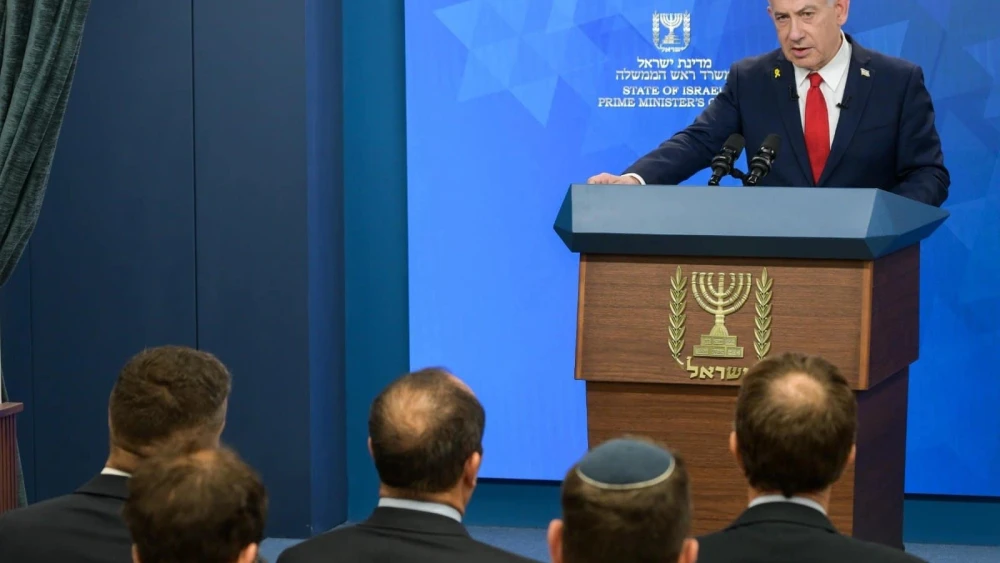
What Netanyahu did say is that “Israel is in a sort of isolation” due to anti-Israel policies that have led European countries to block arms shipments to Israel.
“If there’s one lesson from this war, it is that we want to be in a situation where we are not limited. We want to defend ourselves by ourselves and with our own weapons. We are going to produce an independent arms industry that is very strong, that can withstand any political constraints.”
Netanyahu likened the move away from a free-market economy in the defence sector to “an economy with autarkic characteristics ... We will need to be Athens and super Sparta,” ancient states that were on a war footing. In doing so, Netanyahu would not only be protecting the Israeli homeland; he would be protecting the Israeli economy.
Contrary to Aviram-Nitzan’s assumption, as Israel’s arms industry grows in size and scope in its drive to become militarily self-sufficient, so too would its export of arms. Even during the Gaza war, when countries were condemning Israel’s conduct and thwarting its ability to obtain arms, some of those same countries were simultaneously increasing their purchase of Israeli arms.
All told, although a few did cancel arms deals with Israel as symbolic statements, because foreign militaries are dependent for their own countries’ security on Israel’s superior military technology, Israel’s overall arms exports have been on an ever-increasing upward trajectory, from $11.3 billion in 2021 to $12.5 billion in 2022 to $13 billion in 2023, to an all-time high of $14.8 billion in 2024.
In the short term, becoming self-sufficient in arms would increase costs to Israel’s economy since many types of arms would cost less to import than to produce domestically. But if Israel doesn’t become militarily secure, it will have no long-term economy to protect. Credit rating agencies would downgrade Israel, as they have in the past, because of its perceived military vulnerability; its stock market would suffer and living standards would weaken.
For that reason, Netanyahu said, “We have no choice. At least in the coming years, we will have to deal with these isolation attempts. What worked until now will not work from now on.”
Netanyahu’s comments on the need to become militarily self-sufficient drew wide condemnation from the Israeli left, which believes that Israel should instead rely on diplomacy to win back the good graces of European countries.
But the left has no rebuttal to Netanyahu’s explanation that “limitless migration” has made Muslims a “very vocal, very, very belligerent” minority that has been successfully pressuring European governments to adopt anti-Israel policies.
“It’s a process that’s been at work for the last 30 years, and especially in the last decade, and that changes Israel’s international situation. Clear as day,” Netanyahu said.
Also clear is the antisemitic tide that has swept over much of the United States, calling into question the willingness of future U.S. administrations to sell arms to Israel.
The Israeli left’s twisted view of Netanyahu’s prudent proposal for Israel’s defense is what’s unclear.