



Several Western countries, France, Great Britain and Canada among them, announced that they are considering recognizing a Palestinian state at the U.N. General Assembly meeting in September. There’s just one problem: The Palestinians don’t want a state. If they did, they would have had one by now. They have turned down numerous statehood efforts over the years, starting in 1947 when the United Nations voted on a partition plan for Mandatory Palestine. Instead, they started a war against the yishuv, the Jewish settlement.
PLO leader Yasser Arafat could have worked toward a state after he signed the Oslo Accords in 1993. Instead, in a radio address in Arabic, he reassured his followers that this was only a step, part of his “phased strategy,” toward the elimination of the Jewish state. In 2000, he walked away from the offer of a state at Camp David and started the second intifada. His successor, Palestinian Authority leader Mahmoud Abbas, turned down the offer of a state in 2008. Since then, the Palestinians have made no serious moves toward statehood.
What the Palestinians do want is to eliminate the Jewish state and impose an Arab hegemony “from the river to the sea,” aka from the Jordan River to the Mediterranean Sea. Unable to accomplish this feat by force, they are employing the demographic threat of the so-called “right of return.” And the United Nations is complicit in their effort.
During Israel’s War of Independence, some 700,000 Palestinians fled or were expelled from what is now the State of Israel. After the war, the United Nations formed the U.N. Relief and Works Agency for Palestinian Refugees (UNRWA) to manage the welfare of the refugees. Its original mandate was to resettle the refugees in their host countries, which, under international law, was the established practice at the time.
However, Arab states and Palestinian leaders demanded recognition of the refugees’ right to return to their homes. At the same time, they made clear that this would mean the destruction of Israel. As Palestinian American historian Rashid Khalidi has noted, “The concept of a right of return was thus fostered by the early Palestinian organizations and later by the PLO as a central mobilizational slogan.”
In the face of Arab opposition to any resettlement, UNRWA began advocating for the refugees’ rights to their former homes. The U.N. agency then took the unprecedented position that the original 1948 refugees, and all their descendants, are entitled to refugee status. That now amounts to approximately 5 million people who, the United Nations agency maintains, have a “right of return” to what is now the State of Israel.
It’s important to be clear on this point: The “right of return” is not actually about a return. It is about the mass immigration into Israel by millions of Palestinian people who have never lived there. Nothing is more central to Palestinian identity today than this supposed right. It has come to dominate Palestinian nationalism and politics. It also dominates the thinking of Western pro-Palestinian activists, particularly the “anti-colonial” movement.
It also got a boost from the United Nations back in the 1970s.
As the Non-Aligned Movement (NAM), states that wanted to be independent from the world’s major powers, gained steam in the 1960s, American influence at the United Nations declined. Cuban leader Fidel Castro and Libya’s Muammar Qaddafi, having competed for leadership of NAM in September 1973, agreed to work together to take control of the United Nations to further weaken the role of the United States and end the existence of Israel. To achieve that goal, Qaddafi enlisted the support of the Organization of the Islamic Conference, while Castro enlisted the Soviet bloc. They also gathered support from sub-Saharan African states.
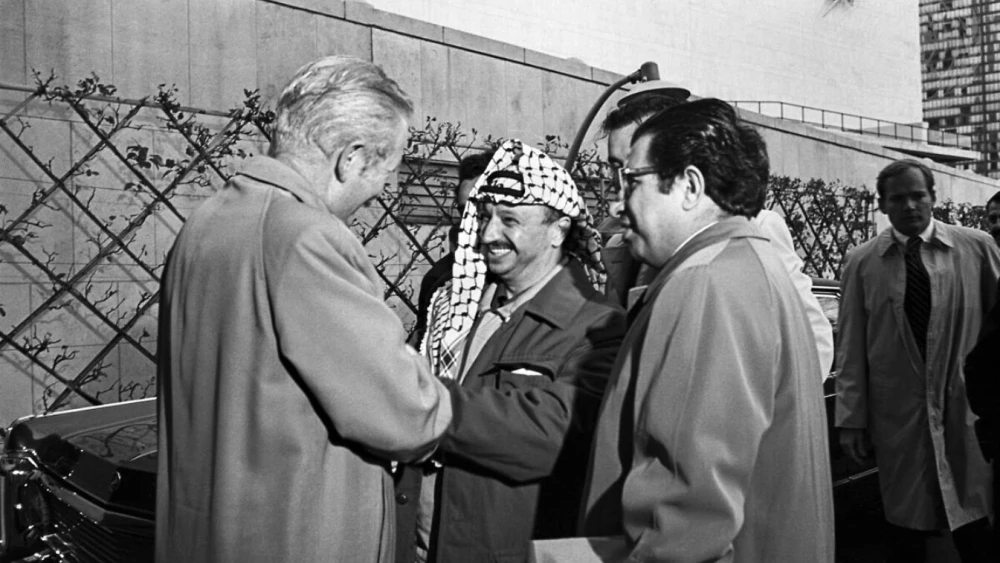
The U.N. General Assembly then granted observer status to the Palestine Liberation Organization and invited its leader, Yasser Arafat, to address the international body in 1974. There, he declared that “Zionism is an ideology that is imperialist, colonialist [and] racist.” Referring to Israel, Arafat used the words “racist” or “racism” more than a dozen times. Most importantly, he asked the United Nations to aid the Palestinian “people’s return to its homeland.”
Nine days later, the General Assembly adopted U.N. Resolution 3236, which “reaffirmed” the so-called “inalienable right of the Palestinians to return to their homes and property from which they have been displaced and uprooted, and calls for their return.” It gave no indication of where or when such a right might have been previously “affirmed.”
Yet the resolution went on to provide for the Palestinians’ “right to self-determination” and “right to national independence and sovereignty.” (The same anti-Israel cabal convinced members of the United Nations to adopt the infamous “Zionism is racism” resolution a year later. It was eventually revoked in 1991.)
Any argument that U.N. Resolution 3236 establishes a right of return must contend with the issue of Israeli sovereignty. As international law scholar Kurt Rene Radley has written, “At the very least, [Resolution 3236] proposes that the displaced Palestinians have an absolute right to return to Israeli territory despite any objections that that state might interpose. Such a proposition would alone render meaningless the concept of ‘sovereign equality’ of states upon which, according to Article 2 (1) of the Charter, the United Nations is based. But Resolution 3236 goes even further to state that the displaced Palestinians have not only an absolute right to return to the Israeli state, but also have the right to do so to pursue their separate nationalist identity. It is difficult to imagine how much closer the General Assembly could have come to endorsing the destruction, in part or whole, of a member state.”
That destruction, though, is exactly what the proponents of Resolution 3236 had in mind.
As Radley and others have demonstrated (see, for example, The War of Return by Adi Schwartz and Einat Wilf), the claim that Palestinian refugees have a right to return to what is now the State of Israel is a legal fallacy. Unfortunately, it is a fallacy that the West has indulged and failed to debunk. As a result, for decades, the claimed right of return has been the major stumbling block and the root of Palestinian intransigence in peace negotiations.
Thus, the biggest obstacle to the creation of a Palestinian state is of the Palestinians’ making.


