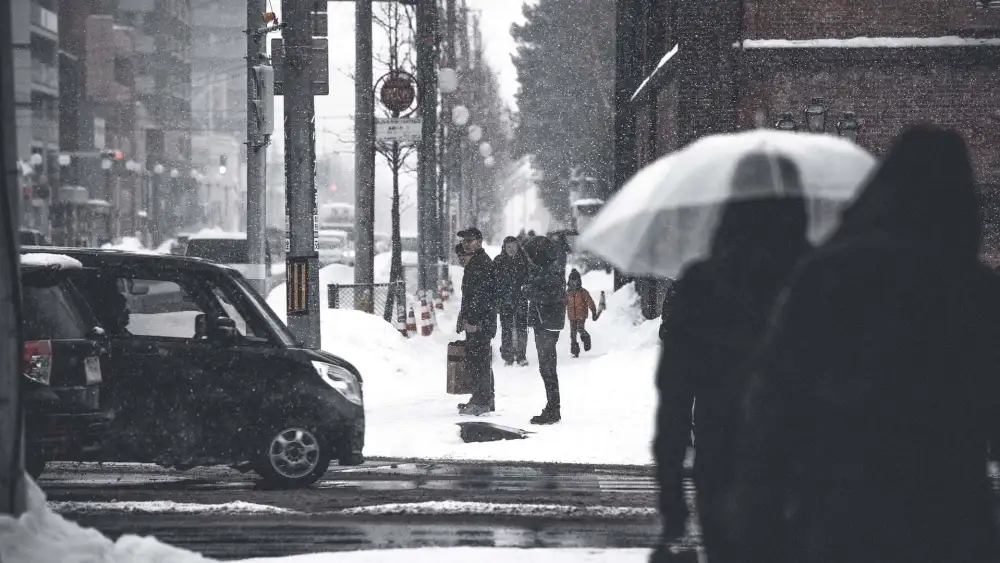

For centuries, at least for two millennia, so many great European Torah scholars memorialized their thoughts on sunless and snowy days. Perhaps some did so by daylight, but more likely, those who also had to work did so by flickering candlelight. They must have been cold as well, and living in crowded or even noisy rooms.
I am indebted to them for their perseverance, no matter what the weather may have been: politically, economically or in terms of the temperature. I simply do not know how they did this. I admire them tremendously.
Lately, it has been very cold in New York City, and then snow began to fall. Too dangerous to venture out for the likes of me. But here I sit, for better and for worse, relatively comfortable in the 21st century—a space heater at my feet, a fake fur throw on my lap, a bright LED light at my right, surrounded by a blessed silence. And these thoughts came to me.
The first book of the Torah, Bereshit, has so quickly drawn to a close. Our stories are so fast-paced; they speed by like spacecraft. Lessons abound via these family stories. In synagogue, some weeks ago, my rabbi, Ben Skydell, rather passionately clarified the difference between making a difference in and for one’s time and having a role that is meant for all times. The idea would not let go of me.
The first thing I thought had nothing ostensibly to do with Bereshit. It was this: The brave Esther of Shushan saved the Jews in that time and place, as well as allowed the endangered Jews to slaughter all those who meant to kill them. (They acted like the Maccabees). But Esther herself remained in Shushan. She could never leave, and the price she paid—her sacrifice, as it were—is that she had to marry the king, a non-Jew. Was she the Divine light of Chanukah? (I have never truly understood why so many little Jewish girls love to dress up as Esther at Purim.)
Her fate was hardly an “approved” one. In fact, her heroism was transgressive. And yet, we celebrate her deeds every year; we bring her along with us on our never-ending story.
Then there is Ruth. What Ruth did was very similar to Abraham, and she did so without any prompting from God. She left her father’s house—the land where she was born—and followed her Jewish mother-in-law to an unknown place and into another religion. She fed Naomi along the way, a great tikkun (“corrective”) for what her people once did to the Hebrews traveling through their land—namely, Moab refused them food or water. (This wonderful point was made to me many years ago by Nechi Sirota). Further, Ruth married Naomi’s kinsman, Boaz; the son they had went on to become the ancestor of King David and the Messiah (who has, alas, yet to come). What Ruth did was for all time, or at least for all the time before our ultimate redemption.
As to the book of Bereshit: Where does one start? Isaac, Abraham’s son served as a bridge between his father and his own son; he maintained the tradition despite the obstacles he faced. Rebecca left her homeland, as did Leah and Rachel, as did Jacob, all for the sake of Heaven. Jews wander; Jews live in exile; Jews belong everywhere and nowhere; and, for a really long time, Jews could only dream about living in Israel.
Joseph, too, was forced to leave his family—driven by God so that one day, Joseph would be in a position to save his family and his people from famine. Joseph never leaves Egypt; he remains there forever. And we descend into slavery. Joseph was also a necessary bridge to the continuing story. Moses, like Joseph, is a prince of Egypt. Moses does flee, but he returns to save our people from slavery and lead us in the desert toward Sinai and then toward the Promised Land.
Still, Moses, perhaps our greatest prophet (or so it is said), is not allowed to continue on with us; God denies him entry into the Holy Land. He remains outside in exile from it, if you will, yet his entire life has been devoted to getting his people to that point. Joshua, next in line, continues the journey, the story.
Each figure in Bereshit is a bridge. Each figure is a link in the destined chain. As we all are.
One of the lessons we must bear is that none of us can necessarily realize all, or at least, every one of our deepest or earthly desires. We are all part of something still in process, forever underway.
Thus, we all still have a part to play. We cannot end the story. We can only do the best we can in our time, and hope and pray that it will lead our story to a magnificent ending.
I mentioned this idea to Rabbi Ben, and he said that his rabbi, Simon, once told him that some books (Torah commentaries) are meant for their own time while others are meant for all times.
Ah, the Torah seems to have been written for all times. Spooky. Wondrous.
Somehow, the mood that poet Robert Frost captured in this poem is the proper mood for this offering. We all have many “miles to go before we sleep.”
‘Stopping by Woods on a Snowy Evening’
By Robert Frost
Whose woods these are I think I know.
His house is in the village though;
He will not see me stopping here
To watch his woods fill up with snow.
My little horse must think it queer
To stop without a farmhouse near
Between the woods and frozen lake
The darkest evening of the year.
He gives his harness bells a shake
To ask if there is some mistake.
The only other sound’s the sweep
Of easy wind and downy flake.
The woods are lovely, dark and deep,
But I have promises to keep,
And miles to go before I sleep,
And miles to go before I sleep.