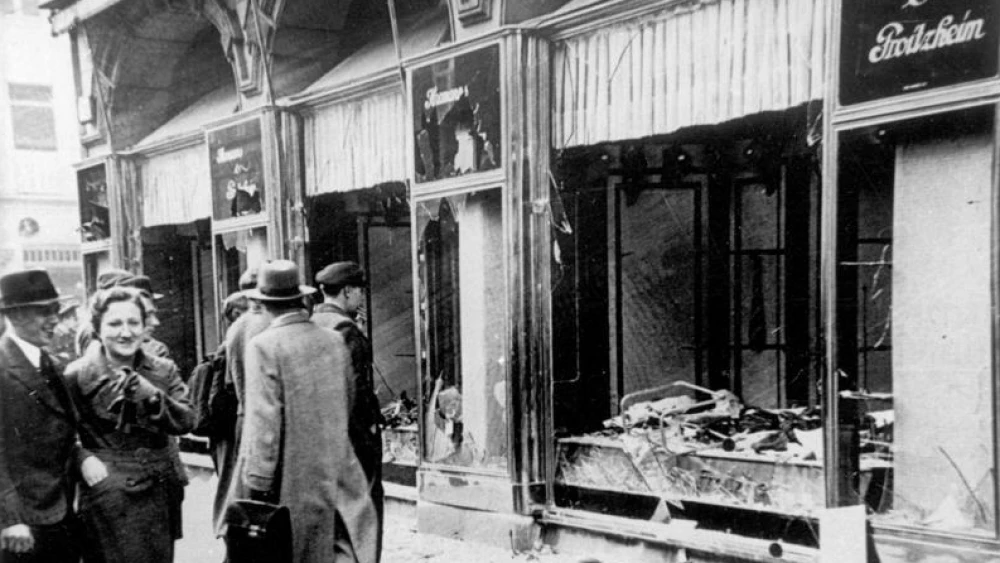

On the night of Nov. 9-10, 1938, the world shifted. In Germany, Austria and the Sudetenland, Nazis vandalized, torched and demolished Jewish homes, businesses and synagogues. The shattered storefront windows that littered the streets gave this night its name: Kristallnacht (“Night of Broken Glass”).
More than 1,400 synagogues were set on fire. As many as 7,500 Jewish-owned shops were destroyed. Some 30,000 Jewish men were arrested and sent to concentration camps. These were not isolated acts of rage; they were coordinated and sanctioned. They were the announcement that hatred had stepped out of the shadows and into official policy.
Kristallnacht marked a turning point. Persecution transformed into active extermination. And the world, for the most part, watched silently.
Each year on Nov. 9, Jews remember what complacency toward hatred can yield. We remember the glass, the flames, the terror, and the absence of intervention. And we say that sacred promise: “Never Again.”
But “Never Again” means little if it is merely recited. It must be lived.
Eighty-seven years later, we are forced to ask a grave question: Are we witnessing conditions that, left unchecked, lead to the same moral failures of the past?
Antisemitism is rising in the United States at levels unseen in modern memory. The political party once viewed by American Jews as a safe home is now tolerating, and in some cases celebrating, open hostility toward Jewish identity and the State of Israel.
The election of New York state assemblyman Zohran Mamdani to mayor-elect of New York City represents more than victory. It signals a shift. Mamdani has actively supported the BDS movement. He helped launch a Students for Justice in Palestine chapter at Bowdoin College in Maine. He has vowed to remove New York City’s adoption of the International Holocaust Remembrance Alliance’s (IHRA) working definition of antisemitism, a definition recognized by more than 40 countries as the global standard for identifying anti-Jewish bigotry.
Since his election, the ripple effects have not been subtle. Jewish leaders in the United States and Israel have expressed deep concern, seeing his win as a troubling indicator of changing American attitudes toward Israel and Jewish identity. Historian Michael Oren, former Israeli ambassador to the United States, called it a dark day, warning that antisemitism is being normalized and even popularized.
Mamdani has supported boycotts targeting partnerships with Israeli institutions, including Cornell-Tech, a joint program between Cornell University and Technion-Israel Institute of Technology on New York City’s Roosevelt Island, and is pushing to replace the IHRA definition with a weaker alternative that many experts believe enables anti-Jewish hostility to be disguised as political critique.
Meanwhile, student governments and campus movements across the country are embracing this worldview, including a recent Columbia College student referendum where roughly 76% voted to divest from Israel. The message is unmistakable. The next generation is being taught that delegitimizing the Jewish state is not only acceptable but virtuous.
This is not 1938. The context is different. The scale is different. The mechanisms of hatred have evolved. But the rhythm of history is audible. Hatred that is permitted to seep into the mainstream does not remain symbolic. It grows. It hardens. It acts.
If we respond to this moment with hesitation or denial, we risk repeating a catastrophe whose memory we invoke precisely to prevent recurrence. We must recognize hatred when it appears. Challenge it before it spreads. Speak when silence becomes complicity.
“Never Again” is not a slogan to honor the past. It is a command for the present. “Never Again” must mean “Never Again” now.