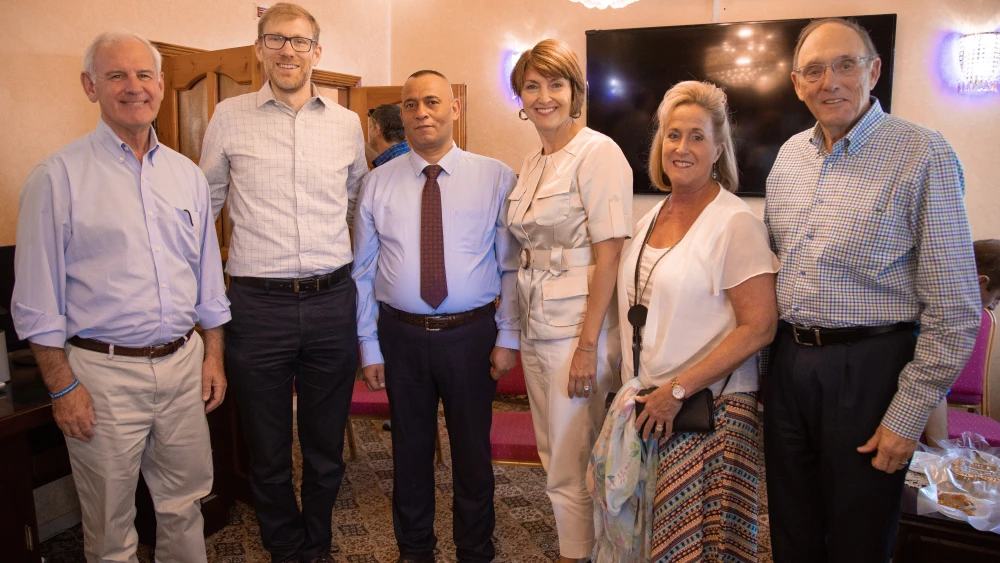
The U.S. Israel Education Association (USIEA) brought Reps. Cathy McMorris Rodgers (R-Wash.), Ann Wagner (R-Mo.), Phil Roe (R-Tenn.) and Bradley Byrne (R-Ala.) to Israel last week. Focusing their visit on Judea and Samaria, they met with Israeli and Palestinian business leaders to discuss financial threats against the Jewish state and the potential for solutions and cooperation.
USIEA Executive Director Heather Johnston reported that she had witnessed a “paradigm shift” in the senior members of Congress over the course of the mission. “Speaking to Israeli and Palestinian members of the Judea and Samaria Chamber of Commerce, they got a totally different narrative from the one in the news or the one told by political leaders who have taken sides,” Johnston told JNS, referring to Reps. Rashida Tlaib’s (D-Mich.) and Ilhan Omar’s (D-Minn.) pro-BDS, anti-Israel narrative.
Spending two days in Judea and Samaria, the group investigated economic development and partnerships between Israelis and Palestinians, witnessing the “[positive] direction that the grassroots business development is going” in and learning about “the unstoppable people’s business movement that is well underway and is not going away,” according to Johnston.
During visits to Hebron, Ariel’s Industrial Park and the Judea and Samaria Chamber of Commerce, the group met with Palestinian business leaders and employees who voiced their concerns about BDS.
Johnston said that the visiting representatives learned that 90 percent of the Palestinian population wants to work with Israel, but are unable to speak about this desire freely due to the Palestinian Authority’s anti-normalization policy.
BDS “hurts Palestinians and their opportunities perhaps even more than the Israelis because through this cooperation Palestinians are having opportunities they’ve never had before—jobs that are paying three to four times what they could get anywhere else,” delegation leader McMorris Rogers told JNS.
Hearing that “an overwhelming number of Palestinians are excited to create joint economic opportunities” was especially compelling, she said, adding, “we need to be encouraging this economic opportunity as part of the peace solution.”
To ensure this support, McMorris Rogers, who is the acting Republican representative to the United Nations General Assembly, said, “I will be talking to my colleagues and urging them to see first-hand what is happening in Judea and Samaria [in terms of] economic cooperation.”
Since her first trip to Israel five years ago, Wagner, who currently serves as Vice Ranking Member of the House Foreign Affairs Committee, said there had been an “explosion” of changes in Judea and Samaria, including job creation, “a couple hundred [Israeli and Palestinian] businesses working together in the same manufacturing facilities” and “the growth of the high tech arena.”
Rep. Roe, who leads the Republican party in the House Committee on Veterans’ Affairs and has consistently stood up for Israel and against a nuclear-armed Iran, similarly noted that “at the end of the day, the Palestinian people want a good job and better life for their children.”
The cooperation promoted by the Judea and Samaria Chamber of Commerce “is just getting its legs,” he told JNS, and “will become a very useful force in this country.”
Each member of Congress expressed hope in the future of the U.S.-Israel relationship, as well as Israeli-Palestinian economic partnerships in Judea and Samaria.
Johnston posed that despite the small number of “strong yet antagonist voices in Congress,” the U.S.-Israel relationship has never been stronger. The Palestinian businessmen, she said, “want to have the backing and support of the United States,” declaring that the U.S. administration will continue its efforts “to support these endeavors that are integral to American interests.”
McMorris Rogers said that “Israel has been our long-time greatest ally within the Middle East, cooperating on defense, technology, innovation and agriculture, and Israel must remain our greatest ally—our support must be bipartisan, staunch and unequivocal.”
Wagner noted that the visit bettered her understanding Israel’s expertise in defense, especially regarding “aero” capabilities that are being tested in Alaska. The experience, she told JNS, “reaffirmed our joint goals towards peace and prosperity, safety and security.”