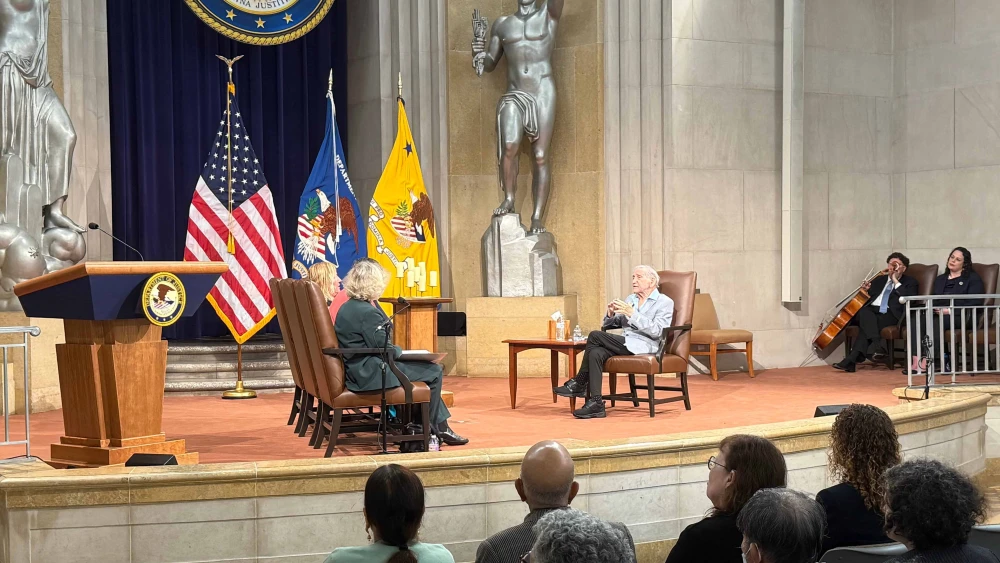
Employees from agencies across the U.S. federal government heard the story of Eugene Bergman’s survival of the Holocaust on Wednesday at an annual event to remember the massacre of European Jews.
A native of Poland, Bergman has been deaf since 1939, when a German soldier struck him in the head with a rifle after the Nazis invaded the country.
Bergman, a retired Gallaudet University professor, spoke in sign language, which his daughter interpreted and voiced to attendees at the U.S. Department of Justice. He told attendees about surviving the Warsaw Ghetto with some of his relatives.
“Someone threw a loaf of bread through the window of our apartment,” Bergman said. “My mother cut the loaf with a knife, and there was a paper there. The paper was written by my father, and the paper said, ‘Sarah, you must leave. Don’t stay in the ghetto. Avoid the trains.’”
Bergman’s father used forged paperwork to stay outside the ghetto until his wife was able to bribe a German soldier to let her, Bergman and his two brothers pass.
As a teenager, he took part in the 1944 Warsaw uprising while pretending to be a non-Jewish Pole. The insurgents surrendered and he was taken to a German prisoner-of-war camp until the Red Army liberated him in May 1945.
Bergman’s mother and younger brother survived, while his father and older brother were shot and killed by the Nazis.
He and his surviving family members resettled in the United States, and he later received a doctorate in English from George Washington University before becoming a professor at Gallaudet.
Ellen Germain, the special envoy for Holocaust Issues at the U.S. State Department, told attendees that in her recent conversations with Holocaust survivors in Europe, many repeated a similar anecdote about their liberation from the Nazis.
“They said to me, ‘When we saw the U.S. tanks coming over the hill, or coming down the road, we knew we were free,’” Germain said.
“One woman held my hand so tightly as she told me this, and she had tears in her eyes 80 years later, because she really wanted me, as an American, to know what it had meant to her to be liberated, to be freed by the Americans,” she said.
The Federal Interagency Holocaust Remembrance Program, which was founded in 1994 to educate federal employees, students and the public, hosted the event.