


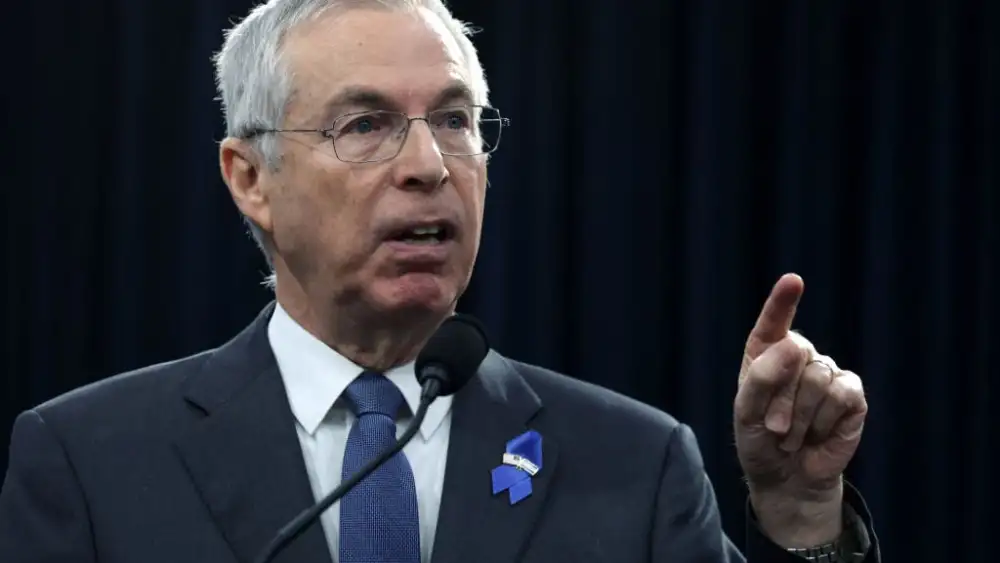
The U.S. State Department has “a great many anti-Israel staff who threw wrenches into the works” of Israel’s war machine after Oct. 7, 2023, Israel’s previous ambassador to Washington, Michael Herzog, said in an interview published Thursday.
In the interview, parts of which were published in Israel Hayom ahead of its publication in full on Friday, Herzog said that former U.S. Secretary of State Antony Blinken had decided to implement targeted sanctions against an Israel Defense Forces intelligence unit colloquially known as Unit 504.
Focused on human intelligence and interrogations, the unit was at imminent risk of sanctions as Blinken “had already made up his mind, but we managed to stop him just in time,” said Herzog.
The State Department also has a team focused on tracking Israel’s use of American weapons, Herzog said. The United States does not apply this level of scrutiny to any other country, he noted.
“There were moments when the Americans were furious,” he said. “More than once, they confronted me directly, saying, ‘You’re insane! How could you do something like this without considering the consequences? You’ll drag us into a war and then expect us to bail you out’.”
Operations in Iran and targeted strikes on Hezbollah, including the one that killed its leader Hassan Nasrallah, had surprised the Americans, Herzog said. This led to intense confrontations with American officials, who accused Israel of risking regional escalation, he added.
Herzog also criticized the Biden administration’s decision to withhold shipments of heavy bunker-busting bombs to Israel ahead of its planned ground offensive in Rafah.
However, despite these issues, U.S. support for Israel remained strong throughout the war overall, he said. “In the grand scheme of things, their approach was more positive than negative. There’s no doubt about it. They sent substantial ammunition, assisted in defense efforts against Iran twice, supported us in international legal battles and vetoed anti-Israel resolutions at the U.N. multiple times,” he said.
The video statement published by Israeli Prime Minister Benjamin Netanyahu in June addressing the delayed weapons shipment was a mistake that caused diplomatic harm, according to Herzog. “More than once, the prime minister chose to air disagreements publicly. Maybe he thought it would help, but it didn’t,” he said.
Herzog also addressed the prospect of normalization between Israel and Saudi Arabia. “Eventually, it will happen, but I don’t know when,” he said.
A senior representative of Netanyahu and a top aide of Saudi Crown Prince Mohammed bin Salman met recently to discuss normalization, he revealed, adding without elaboration that an opportunity for such a deal was “missed” sometime between November and January.
Herzog criticized Qatar, which mediated in Israel’s ceasefire talks with Hamas, for not exerting enough pressure on the terrorist group earlier in the process. “They played a key role in reaching an agreement, but having seen the intelligence, I strongly believe they could have done more. It was only in the later stages that they really leaned on Hamas to comply with demands,” he said.



