Newsletter
Newsletter Support JNS

US official denies interim Iran deal in the works

The United States has conveyed to Iran what steps it can take to “create a more positive context,” according to the official.

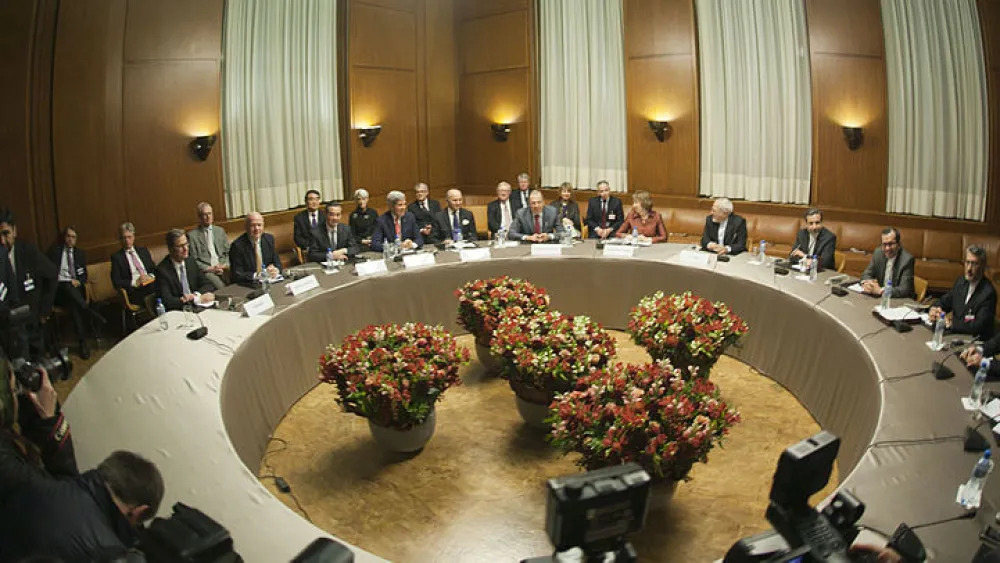
The foreign ministers of Germany, the United Kingdom, China, the United States, France, Russia, the European Union and Iran meet in Geneva on Nov. 24, 2013 for talks on the interim agreement on the Iranian nuclear program. Credit: U.S. Department of State.

Washington is not nearing an interim nuclear deal with Iran, but has relayed to Tehran steps it could take to build confidence, according to a U.S. official.

“We have made clear to them what escalatory steps they needed to avoid to prevent a crisis and what de-escalatory steps they could take to create a more positive context,” the unnamed official said on Monday, according to Reuters.

Washington wants greater Iranian cooperation with the International Atomic Energy Agency, the official added.

Last week, the U.S. flatly denied reports that it was close to an interim deal with Iran, referring to them as “false and misleading.”

The official on Monday reiterated that “there are no talks about an interim deal,” contradicting reports last week that American and Iranian officials held such talks in Oman in May.

However, the official continued, the United States has made clear it still favors diplomacy to counter “Iran’s destabilizing influence in the region” and “nuclear escalation,” as U.S. Secretary of State Antony Blinken said during a June 8 press conference in Riyadh.

Israel holds that the most effective way to stop Iran from pursuing its nuclear ambitions is with a credible military threat and the understanding that it will pay a steep price if it crosses red lines.

Israeli opposition leader Yair Lapid said during the AJC Global Forum in Tel Aviv on Sunday that Israel speaks with one voice on the Iran issue, “telling the American administration: ‘Do not sign a bad deal.’ ”

In 2018, then-U.S. President Donald Trump left the 2015 Joint Comprehensive Plan of Action (JCPOA) between Iran and world powers, calling it “a horrible one-sided deal that should have never, ever been made.”

The award “is a personal recognition and does not imply support or opposition to any policy or country,” the U.S. Embassy to the Holy See said.
Rand Paul’s son, William Paul, allegedly told the New York congressman, who is not Jewish, that “you Jews” would be responsible if Rep. Thomas Massie loses his Kentucky primary race.
“Sheikh bin Zayed, his family members and other dignitaries welcomed us and were happy to see the prime minister of Israel on their soil,” Netanyahu’s former spokesman wrote following the UAE Foreign Ministry’s statement.
“Every day the British Parliament fails to vote on this legislation is another day that the IRGC evades the full impact of our nations’ combined sanctions,” the lawmakers wrote.
“The defendant is a hate-mongering menace, who intended to hurt and kill children in the Jewish community and in other minority communities in New York City,” stated the U.S. attorney for the Eastern District of New York.
The U.S. Justice Department said the man moved Iranian nationals through Turkey and Mexico into the U.S., including one who admitted to working for the Islamic Revolutionary Guard Corps.