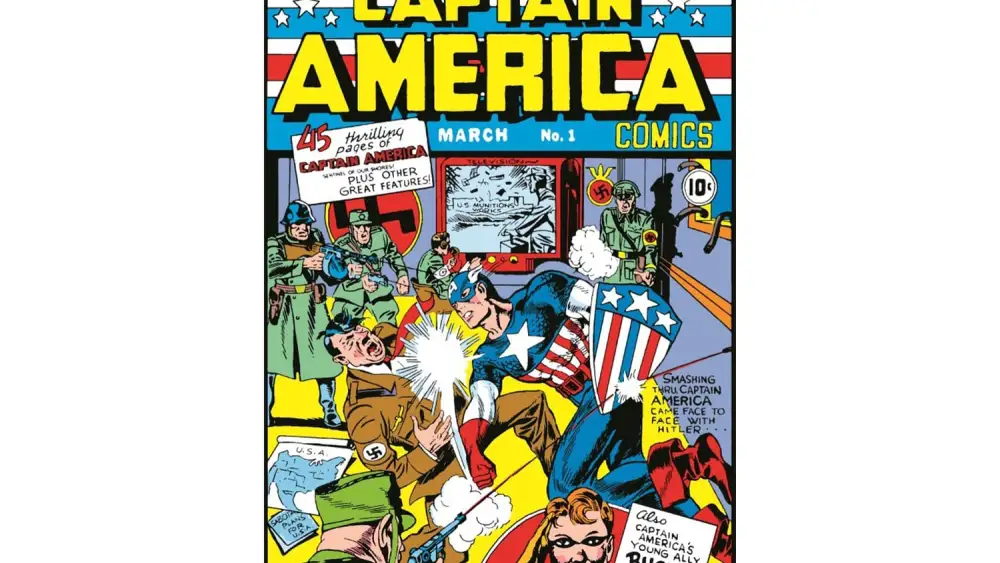
The U.S. Holocaust Memorial Museum acquired an original copy of the 1940 issue of “Captain America Comics,” whose cover shows the superhero punching Adolf Hitler.
Roy Schwartz, a pop-culture historian and board member of the American Jewish Historical Society, told JNS that the issue stands out as more than just a collectible.
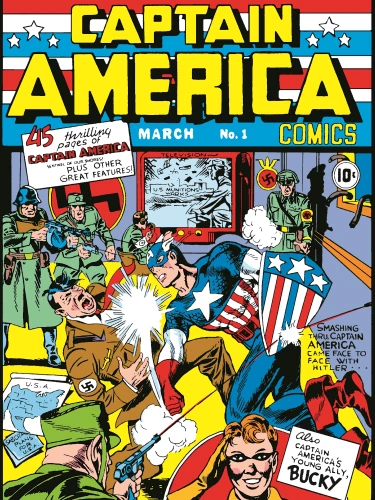
“Old comic books that introduced a popular character are generally valuable,” but the issue that the museum acquired “is also a remarkable historic artifact, and its cover is one of the most iconic images in comics history, if not all of pop culture,” he said.
The comic was donated by Riot Games co-founder Brandon Beck and will become part of the museum’s collection documenting cultural responses to Nazism before the U.S. entered World War II, the museum said.
Schwartz noted that the comic’s creators took a public stand against Hitler months before the United States joined the war.
“Captain America was created by Joe (Hymie) Simon and Jack Kirby (Jacob Kurtzberg), the children of Jewish immigrants,” he told JNS. “For the cover of their first issue, they had him punch Hitler in the face.”
“It’s hard to understand how big of a deal this was,” Schwartz said. “The comic was cover-dated March 1941 but published on Dec. 20, 1940, a full year before Pearl Harbor.”
At that time, “93% of Americans opposed entering the war, and American entertainment was under tremendous pressure to not offend the Nazis and their American supporters,” Schwartz told JNS. “Here were Simon and Kirby sending their star-spangled avatar to deck Hitler right on the cover. It sold a million copies.”
The bold cover sparked backlash from pro-Nazi groups in the United States.
“They got death threats from the German American Bund, which was no laughing matter,” Schwartz said. “22,000 of them had just marched down Fifth Avenue the year prior, eventually requiring New York Mayor Fiorello La Guardia to intervene personally. He was a big comics fan, and secretly Jewish.”
According to Schwartz, Captain America was “particularly personal” for Kirby, who “over the years based the hero’s origin on his own life—a scrawny, artistic, bullied youth from the Lower East Side who always stood up to bullies.”
“Kirby also went on to become a WWII war hero, helping liberate a camp and receiving the Bronze Star,” he said.
Beck also donated a copy of “Captain America Comics” No. 46, whose cover shows the super hero confronting Nazis committing atrocities inside a concentration camp.
Both issues are being evaluated and documented by specialists at the museum, which says that the materials will be digitized and made available to scholars.
“Captain America went on to become one of the most popular superheroes in the world, and my personal favorite,” Schwartz told JNS.
“Simon and Kirby went on to create many more characters. In the 1960s, Kirby collaborated with Stan Lee to create the Fantastic Four, the Hulk, Thor, Ant-Man, Iron Man, Avengers, X-Men, Black Panther and many more,” he said. “It all goes back to this first issue of Captain America.”