Blend the people of the Rainbow Nation together, and the color that emerges is green and gold—that is to say, the colors of our national rugby team: the Springboks. South Africa on a weekend with a Boks game is awash in these colors, replica shirts adorned as a national uniform, the one uniting element in our fractious society.
But for us, the Jewish community, a challenge has always remained: how to support the team and keep Shabbat. It is a challenge that sits at the very core of our identity as both Jewish and South African.
In August, something happened on the streets of Johannesburg that made me fall in love with this city and our Jewish community all over again.
It started, as these things often do, with a plan that sounded simple enough: Walk to the rugby together, so that we could attend a historic game, without breaking the Sabbath. What it turned into was something far more special.

More than 60 observant Jews, kippahs on the men’s heads and Springbok scarves around our necks, set off on foot down Louis Botha Avenue—one of the busiest roads in Johannesburg—and into the historic Yeoville neighborhood on a three-hour walk to watch the match. By the time we arrived, we hadn’t just covered a few kilometers (10, to be precise); we’d taken a walk through decades of memory, identity and unmistakable pride.
There’s something wonderfully absurd and wholesome about a small army of yarmulke-wearing rugby fans strolling down a Johannesburg street on a Saturday in broad daylight, greeting honking horns and thumbs-ups from passing cars.
Nobody tucked their kippah into a pocket. Nobody hesitated. We wore our Jewish and South African regalia openly, unapologetically, the way they should be, and the response from fellow South Africans on the road was, without exception, solidarity, warmth and support.
Strangers waved Springbok flags in our direction. For a couple of hours, walking to a game of rugby became an unspoken but very public statement: We are Jewish, and we are South African, and those two things fit together perfectly.
For the group, the walk was also a trip down memory lane.
As we passed old landmarks along the route, going into areas linked to our communal history but no longer in the geographic “bagel belt.” There was story after story: “That’s where the old bioscope was,” “We used to buy chips from that corner cafe,” and “I had my first date somewhere near here.”
Yeoville, once the beating heart of Johannesburg Jewish life, came alive again for an afternoon—not as a memory but as a living, breathing backdrop to a new generation making its own. Watching the older members of our group light up as they retraced their youth, while the younger ones absorbed everything in wonder, was its own kind of magic. It was Jewish continuity, quite literally, on the move.
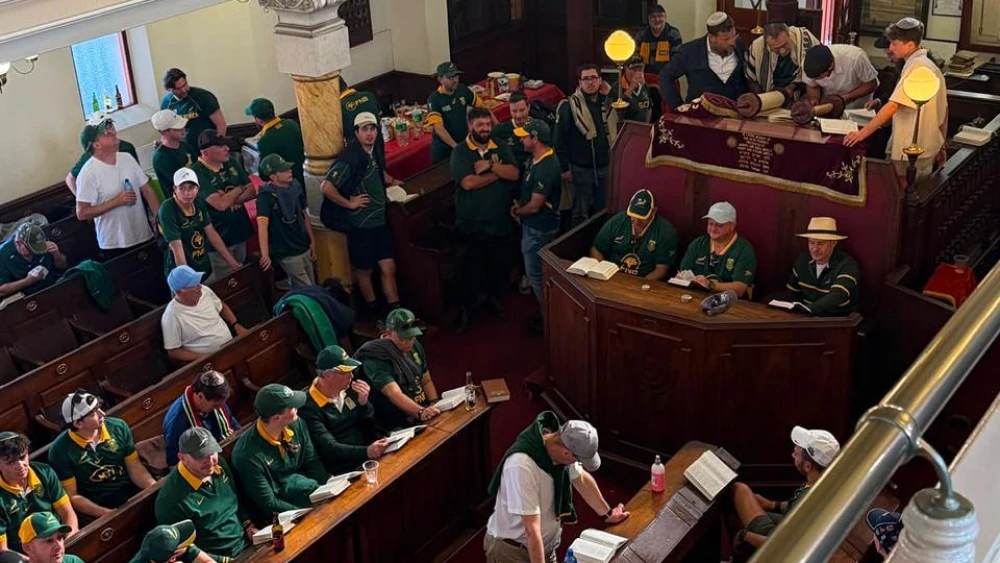
But if I’m honest, the highlight of the day wasn’t the rugby at all. It was the stop we made along the way at the iconic Lions Shul, the oldest operational synagogue in Johannesburg, for Mincha.
Picture it: A crowd of us, still buzzing with pre-match energy, wearing our kits, filing into that historic synagogue for a few quiet, focused minutes of prayer before continuing on to cheer for the Springboks.
There was something extraordinarily moving about pausing our very South African Saturday to daven Mincha together in a building that has anchored our community for generations. The unity in that room was tangible. Voices rose together. Nobody was rushing, even though a rugby match awaited. In that moment, being Jewish and being South African weren’t two separate parts of who we are. They were exactly the same thing.
We made it to the game eventually, and yes, we cheered ourselves hoarse. But what I’ll remember from that Saturday isn’t the final whistle, but the kippahs bobbing down Johannesburg streets, decades-old stories spilling out, and a shul full of proud South African Jews pausing to pray before disappearing back into a very ordinary, very extraordinary Johannesburg afternoon.
There is nowhere quite like this. And there is no community I’d rather walk to the rugby with.
Sheri Hansen is deputy chair of the South African Jewish Board of Deputies.