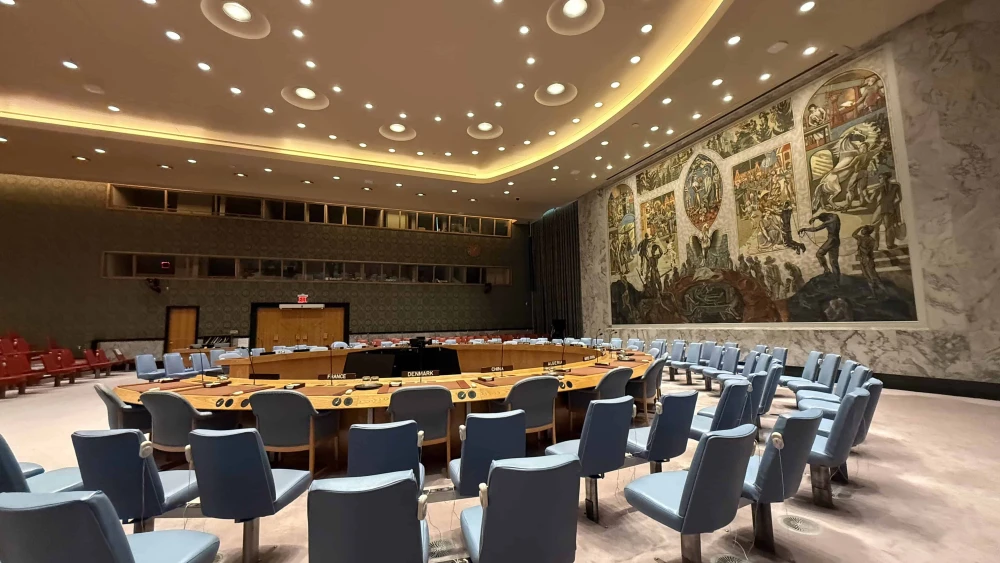
Moments before the U.N. Security Council met on Wednesday to discuss peace between Israel and the Palestinians, Israeli Foreign Minister Gideon Sa’ar strongly criticized the international body as “unfortunately infected with an anti-Israeli obsession.”
Speaking at the United Nations in New York, Sa’ar said that on Tuesday, “85 countries stood here and denied the Jewish people’s right to live in the same places recognized as belonging to a Jewish national home.”
“Amazingly, so many countries say that Jewish presence in our ancient homeland violates international law,” he said. “The opposite is true. No other nation in any other place in the world has a stronger right than our historical and documented right to the land of the Bible.”
The minister’s remarks made clear that the Israeli government opposes a two-state solution, which is backed by most countries. That resolution of the deadly, decades-long Israel-Palestinian conflict would result in an independent Palestinian state in Judea and Samaria and Gaza.
On Tuesday, Riyad Mansour, the Palestinian “permanent observer” to the global body, made a statement while standing in front of dozens of envoys from other countries.
Mansour did not deny the legitimacy of Israel as a Jewish state but said that “we strongly condemn unilateral Israeli decisions and measures aimed at expanding Israelis’ unlawful presence in the West Bank.”
Referring to the Israeli government’s recent decision to designate large parts of Judea and Samaria as official government property, he said that “we underline our strong opposition to any form of annexation.”
Speakers at a Security Council meeting on Wednesday had a lot to say about Israel’s recent steps.
“In the occupied West Bank, the situation is deteriorating rapidly,” said Rosemary DeCarlo, U.N. under secretary general for political and peacebuilding affairs.
There are “home takeovers, mass detentions and repeated displacement of Palestinian families, especially in the north” of Judea and Samaria, DeCarlo said.
“These measures will constitute a dangerous expansion, including in sensitive areas like Hebron,” she said.
The city is particularly important to Israel, as according to Jewish tradition, the graves of the biblical patriarchs Abraham, Isaac and Jacob, and their wives Sarah, Rebecca and Leah are located there.
‘We do not relativize pain’
Almost all of the speakers, who represented a variety of governments from the United Kingdom and France to the United States and Somalia, spoke about the need for Hamas to demilitarize.
Speakers also voiced hope that U.S. President Donald Trump’s Board of Peace will help create a durable future for Israel, Palestinians and the entire region. On Thursday, Sa’ar is scheduled to represent Israel at its inaugural meeting in Washington.
Mike Waltz, U.S. ambassador to the United Nations, said that the Board of Peace meeting will include representatives of 27 nations, including eight Middle Eastern and majority-Muslim countries.
At the Security Council meeting on Wednesday, he stated that “we call on the member states to work with the board and commit to Gaza’s reconstruction.”
“To back the speeches and rhetoric, Hamas must disarm, including tunnels and weapons-production facilities that must be destroyed,” Waltz said. “Reconstruction cannot and will not take place in areas where Hamas has not demilitarized.”
“There will be no more Oct. 7ths,” he said.
Two of the speakers at the Security Council meeting represented Uniting for a Shared Future, a project established in 2024 that has brought together some 550 Israeli and Palestinian leaders to build trust and map steps toward a secure future for both peoples.
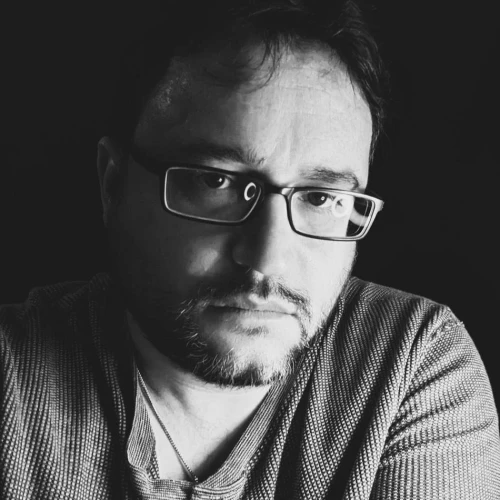
Hiba Qasas, a Palestinian who was raised in Judea and Samaria, created the effort. “Our coalition carries the trauma, fears and aspirations of both peoples. We do not relativize pain,” she said at the United Nations on Wednesday.
“The status quo is not sustainable for either people,” she added.
‘Marginalizing jihadists on all sides’
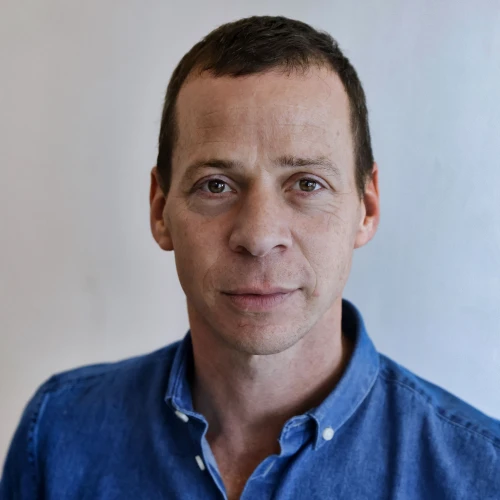
Former Israeli consul general in Boston from 2006 to 2010, Nadav Tamir, now executive director of J Street, also spoke on behalf of Uniting for a Shared Future.
Tamir identified himself as “a dedicated Zionist” and said that “this moment presents a historic opportunity that must not be missed.”
“There is a growing sense of urgency that must be translated into action in a way that integrates both Israel and Palestine into the region while marginalizing jihadists on all sides,” he said.
Qasas concluded her Security Council presentation by saying that “we can either condemn both peoples to a future of trauma or emancipate both peoples.”
Sa’ar told the council that the claim that Jews can’t live in Judea and Samaria is “morally distorted.”
“How can Jews be allowed to live in London or Paris or New York, but not in the cradle of our own civilization: ancient Jerusalem, which you call East Jerusalem, Shiloh, Hebron and Beth-El?” he said.
“There will be peace one day. It won’t be achieved by removing people from their homes—Jews or Arabs,” he said. “The idea that Jewish communities are an ‘obstacle to peace’ is outrageous. It’s disconnected from the current and past reality in Judea and Samaria.”
“With all due respect, we won’t abandon our heritage, security and future, to ease other countries’ domestic political difficulties,” he said.