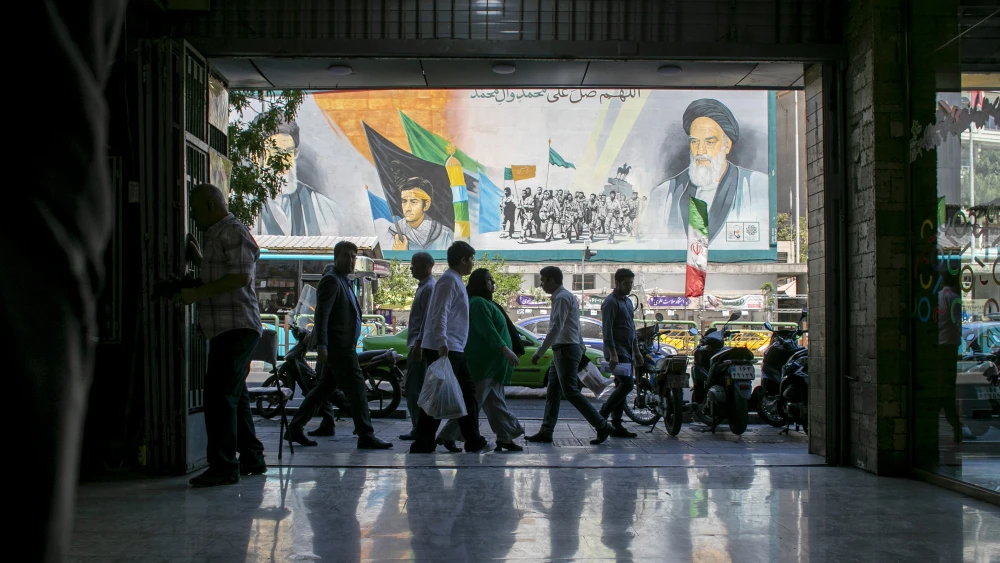

The cafes in Tehran are open. The morality police have eased off. Concerts feature female vocalists, and unveiled women toast the new supreme leader’s health with alcoholic drinks—a tableau the regime would have shut down with batons not even a year ago.
To the casual observer, this looks like a wounded Islamic Republic mellowing under the weight of war. In reality, it is something more deliberate and more dangerous.
In conversations over the past several days with Iranians inside the country—speaking on the condition of anonymity, frustrated and afraid, but still defiant—a consistent picture emerges. Far from broken, the regime is running a coordinated campaign to project normalcy at home, fracture pressure abroad and buy time to rebuild.
Washington is being invited to mistake this performance for capitulation. It should not.
Start with the economy. The rial has lost more than half its value since the 12-day war last June. Households are burning through savings to make ends meet, yet staples remain out of reach. Iranians I spoke with are quick to note that the regime’s scant resources are not flowing to relief, but toward military buildup and proxy networks: Hezbollah in Lebanon, the Houthis in Yemen, the militias in Iraq. The pain is real. But the regime treats it as overhead.
Political executions continue without disruption. According to witnesses, Basij militiamen run checkpoints across the country, demanding to inspect phones for signs of contact with the outside world. Such violations of privacy were once largely reserved for moments of national upheaval, like the “Woman, Life, Freedom” movement or wartime conditions. But these “emergency rules,” paired with a nationwide internet blackout now in its third month, have become the norm.
Meanwhile, the regime’s propaganda and social-engineering machinery has shifted into high gear.
Alongside the now-infamous LEGO propaganda campaign aimed at international audiences, Iranian state media broadcasts nightly loyalist rallies with imagery that appears carefully calibrated for foreign consumption: unveiled women praising Basij militiamen as desirable, others handing flowers to security forces, all intended to project a single message: “We want normalization, too.”
A subtler track targets the Iranian middle class: tech workers, contractors and professionals whose livelihoods pass, somewhere up the chain, through Islamic Revolutionary Guard Corps-controlled holdings. The messaging borrows from the vocabulary of Western anti-war activists. They insist that they are not mourning slain regime officials, but simply opposing regime change through military force. They argue the war was “illegal” and the civilian costs were too high.
Islamic Republic-aligned diaspora figures amplify the same line through international media and satellite television, beaming it back into Iran to demoralize the very people who might topple the regime. State media then recirculates those foreign segments as proof of international sympathy.
Beyond Iran’s borders, and despite the shaky ceasefire with the United States holding, Tehran has continued to strike bases belonging to Kurdish opposition groups in Iraq while launching a new round of attacks on energy facilities in the United Arab Emirates. From Tehran’s perspective, there is no ceasefire—only a redirection.
This brings us to ongoing negotiations and Tehran’s art of the deal: The regime advances incrementally, normalizes each gain and stays below the threshold that forces a decisive response. That strategy allowed Tehran to enrich uranium, build out a proxy empire and pocket sanctions relief for two decades while repeatedly violating the spirit—and often, the letter—of its commitments to the 2015 nuclear deal. Today, the same approach is unfolding in real time.
The United States and its partners should judge progress not by the existence of a deal, but by the absence of ambiguity. Anything short of total capitulation on the regime’s core threat architecture risks becoming another mechanism for delay and recovery. Verification, sunset clauses and snapback provisions deserve front-loaded scrutiny, not deferred attention.
The regional implications are equally direct. Gulf partners should prepare for renewed risk to maritime corridors and energy infrastructure. Israel should expect a return of ballistic missiles and proxy threats once Tehran has rebuilt its stockpiles and operational networks.
Recent strikes inside Iraqi Kurdistan and against the UAE, paired with threats to choke the Strait of Hormuz and hold the global economy hostage, offer a revealing glimpse into Tehran’s strategic mindset. The regime does not view the current moment as a pause in hostilities, but as an opportunity to recover strength, probe for weakness and expand pressure without provoking a decisive response.
The hardest question is what comes next for the Iranian people themselves. Despite the repression, fear and uncertainty, the individuals I spoke with were strangely hopeful, predicting the regime’s collapse within months—an optimism that sharply contrasts with most external analyses.
But they also warn, with a clarity that lingers long after our conversations end, what happens if they are wrong: mass arrests and executions on a scale not seen since the 1980s, when thousands of political prisoners were summarily executed and buried in mass graves.
As one source put it: “The Islamic Republic has turned into a wounded beast. If there is a deal, the regime will direct its rage at the Iranian people. Look at how they butchered us in January. If they remain standing, the mass killing of January will pale before the violence they will unleash.”
That is the cost calculation Western policymakers should keep at the center of their thinking. A settlement that leaves the regime intact will not end the crisis. It will merely postpone it while condemning millions of Iranians to live through the regime’s next phase of repression.