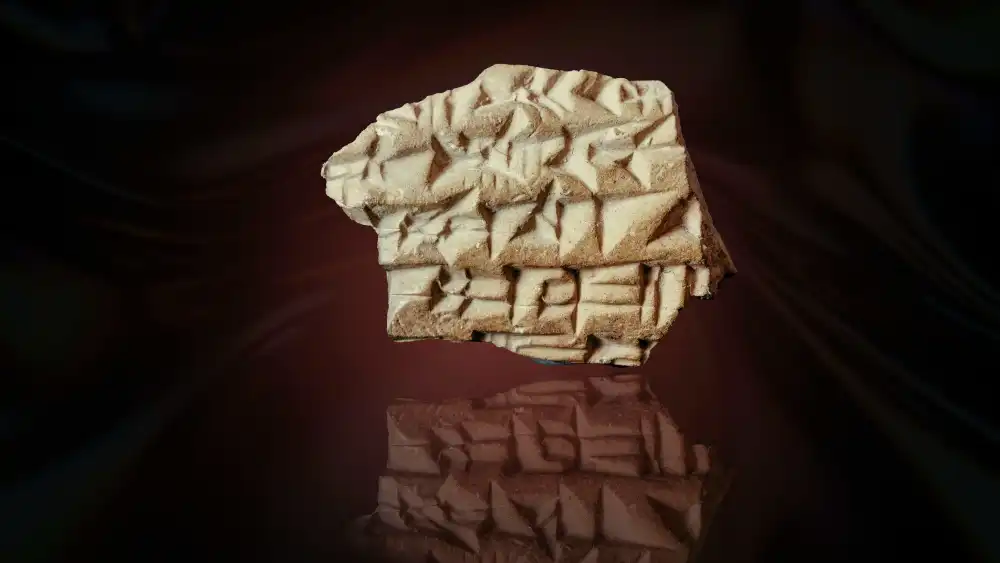
An Assyrian inscription on a pottery sherd over a possible tax revolt from the First Temple period about 2,700 years ago has been uncovered near Jerusalem’s Temple Mount, the Israel Antiquities Authority announced on Wednesday.
The tiny fragment, about 2.5 cm (1 inch) in size, was uncovered six months ago during an excavation in the archaeological garden adjacent to the Western Wall, the state-run archaeological body said. It is the first such inscription in the Akkadian language ever found in the city from the First Temple period (eighth to seventh centuries BCE).
Assyria was a major ancient Mesopotamian civilization that existed as a city-state from the 21st century BCE to the 14th century BCE and eventually expanded into an empire from the 14th century BCE to the seventh century BCE.
“I was sifting through the dirt and suddenly noticed a sherd with a strange decoration,” recounted Moriah Cohen, who works at the “Archaeological Experience” in Emek Tzurim and was carrying out a wet-sifting process as part of the excavation. “For me personally, the thought that after 2,700 years, I am the first person to actually touch this pottery with my hands is a very exciting thought. This is a once-in-a-lifetime find.”
The unique piece was discovered in dirt that had been swept to the edge of the city’s central drainage canal, dating from the Second Temple period about 2,000 years ago, the IAA said.
“The inscription provides direct evidence of official correspondence between the Assyrian Empire and the Kingdom of Judah,” said Ayala Zilberstein, excavation director for the Israel Antiquities Authority. “The discovery strengthens our understanding of the depth of the Assyrian presence in Jerusalem, and the extent of its influence on and involvement in the conduct of the affairs of the Judean kingdom.”
Analysis of the inscription, which specifies a due date—the first of the Hebrew month of Av—in a calendar shared between Mesopotamia and Judah reinforces the hypothesis that the sealed document deals with a delay in paying a tax or another obligation, the IAA said.
At the time, items of this type served as a means of communication between the envoys of the Assyrian government and the rulers of Judah, conveying official instructions and tax demands.
A possible scenario now under investigation: a deliberate tax revolt, such as the Bible describes regarding King Hezekiah rebelling against the Assyrian King Sennacherib.
“The discovery of the Assyrian inscription from the First Temple period in the very heart of Jerusalem is impressive evidence of the city’s status as the capital of the Kingdom of Judah some 2,700 years ago and of the depth of its ties with the Assyrian Empire, just as described in the Bible,” explained Rabbi Amichai Eliyahu, Israeli Heritage Minister. “This rare discovery illustrates, once again, our deep roots in Jerusalem, which is the spiritual and national center of the Jewish people.”