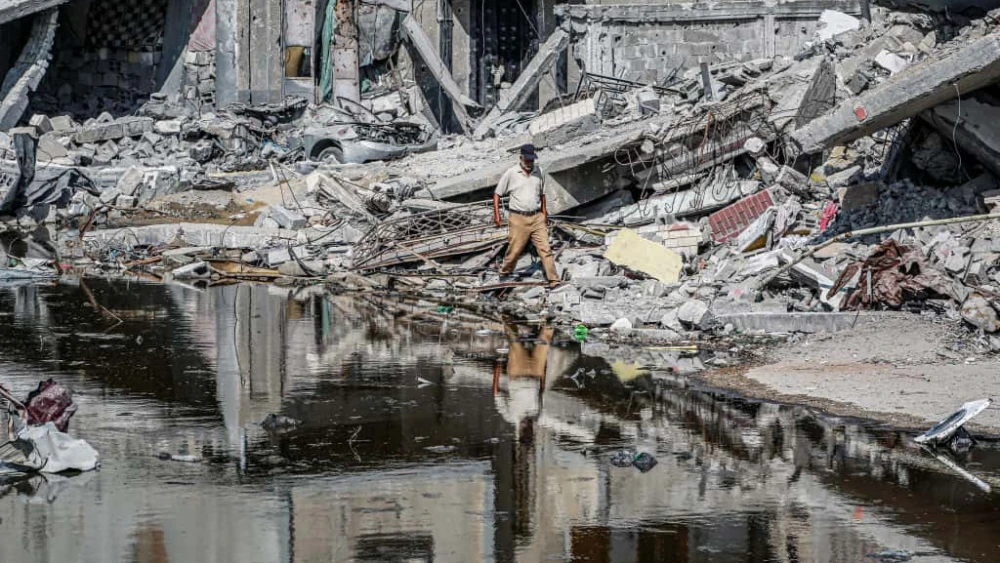
About 65% of the structures in the Gaza Strip were destroyed during the year-long Israel-Hamas war, littering the enclave with hundreds of millions of tons of scattered debris, Hebrew media reported on Tuesday.
Experts estimate reconstruction would take at least 10 years and cost tens if not hundreds of billions of dollars, according to Israel’s Channel 12 News.
The outlet commissioned Adi Ben-Nun, a Geographic Information System (GIS) specialist and technical manager of the GIS center at the Hebrew University in Jerusalem, to analyze satellite imagery of the Strip.
According to that analysis, approximately 84% (25,927) of the structures in northern Gaza were destroyed (25,927), while in Gaza City the figure was about 72% (35,722). In the central camps some 33% (10,375) of the buildings were destroyed, while the figures for Khan Yunis and Rafah in southern Gaza were 73% (32,908) and 52% (15,434),” respectively.
Three other areas stood out with regard to the level of destruction. In Jabaliya, located some 2.5 miles north of Gaza city, about 19,000 buildings were destroyed, or about 100% of the structures in the city.
Four thousand buildings within a mile of the Gaza-Israel border with Israel were also destroyed, also amounting to 100% of the structures in that area.
There was also total destruction for several miles to the north and south of the Netzarim Corridor separating northern and southern Gaza, according to the report.
Satellite images also show that a buffer zone between Israel and Gaza has been completed, according to Channel 12.
On Feb. 4, U.S. Mideast envoy Steve Witkoff, after visiting Gaza, said that the damage he witnessed had convinced him it is currently too dangerous to inhabit.
“There are 30,000 unexploded munitions. It’s buildings that could tip over at any moment. There’s no utilities there whatsoever—no working water, electric, gas. Nothing. God knows what kind of disease might be festering there,” he said.
Moreover, terrorist groups in Gaza had undermined the territory, he noted.
“They’ve dug tunnels underneath there that have basically degraded the stone that would form foundations. We have to examine that, and you do it with borings. You do it with subterranean surveys,” he said.
The effort would take “years on top of years,” he stressed, with the disposal effort alone requiring an estimated three to five.
“The president is intent on getting it all done correctly, so for me it is unfair to explain to Palestinians that they might be back in five years. That’s just preposterous,” said Witkoff.
He backed U.S. President Donald Trump’s proposal to relocate Palestinians from Gaza, arguing that a better life is not necessarily tied to a given piece of land.
In an interview with Fox News, Witkoff emphasized that peace means improving financial conditions and opportunities.
“Peace in the region means a better life for the Palestinians. A better life is not necessarily tied to the physical space that you are in today,” he said.
“A better life is about better opportunity, better financial conditions, better aspirations for you and your family. That doesn’t occur because you get to pitch a tent in the Gaza Strip and you’re surrounded by 30,000 munitions that could go off at any moment,” he added.