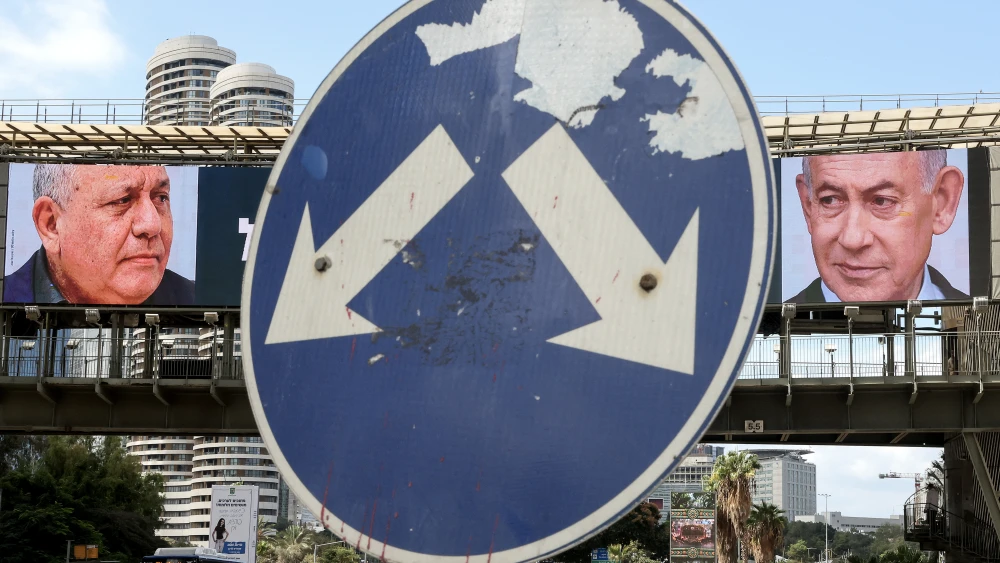

Israel’s opposition enters Tuesday’s election with a potential parliamentary advantage over Israeli Prime Minister Benjamin Netanyahu, but no assured path to replacing him. Israel’s Channel 14 television has consistently predicted a clean win for Netanyahu’s bloc; however, most other polling companies have shown a slight lead for the opposition. Channel 12 News’ Oct. 23 poll projects a combined 56 seats for Gadi Eisenkot’s Yashar, Naftali Bennett’s B’Yachad, Avigdor Liberman’s Yisrael Beiteinu and Yair Golan’s The Democrats, five short of a majority.
In September, the opposition leaders declared a political alliance aimed at replacing Netanyahu; however, they failed to agree on a candidate for prime minister, and have sparred politically since their alliance was declared.
Professor Gideon Rahat, a senior fellow at the Israeli Democracy Institute, cautioned against treating the vote as the conclusion of the political contest. “I think the bottom line is, if you think that the elections are the last word, it’s probably not,” he told JNS.
The straightforward victory
The most straightforward path to replacing Netanyahu would be for the four principal opposition parties to secure at least 61 seats between them, allowing them to form a government without relying on Arab parties, Haredi factions or defectors from Likud.
Even with such a majority, however, coalition negotiations would present significant challenges. Both Eisenkot and Bennett have ambitions to become prime minister, potentially requiring a rotation agreement similar to the one Bennett negotiated with Lapid in 2021.
Beyond leadership, the parties would need to reconcile their competing priorities. Liberman draws support from a right-wing base, while Golan’s Democrats represent the far left of the Israeli electorate. The four parties have several agenda items that they agree on, but there is also broad disagreement on everything from Palestinian statehood to security doctrine to social policy. These ideological disagreements are likely to complicate the distribution of senior ministries.
Even in domains with relative agreement within the bloc, such as establishing a state commission of inquiry into the Oct. 7, 2023, massacre, reforming Haredi conscription and reversing elements of Netanyahu’s judicial legislation, translating these objectives into legislation would require agreement on their precise contents, implementation and financing, particularly ahead of the 2027 budget negotiations.
The independent parties
If the opposition falls short of a majority, its next opportunity would be to recruit smaller parties operating outside the two principal blocs. However, their support would depend on significant political and policy concessions.
The most promising candidate is the joint Reservists–Economic Party, led by Yoaz Hendel and Yaron Zelekha. Its demands for universal military or national service, expanded reservist benefits, and economic reform overlap with the priorities of several opposition factions. On Oct. 20, Hendel declared: “We are calling for universal conscription as a condition for forming a government.”
The party also opposes governing alongside Haredi or Arab factions, meaning that their joining the coalition would close the door on other potential partnerships. Furthermore, Hendel’s insistence on sweeping conscription reform could complicate negotiations even with Eisenkot and Bennett. Zelekhas’s sweeping economic reform agenda would also likely clash with the Democrats’ socialist economic priorities.
Another potential source of seats is Ofer Winter’s Amcha Yisrael. Although Winter shares the opposition’s demand for Haredi enlistment, he remains firmly identified with the political right and has previously pledged to recommend Netanyahu to form a government. He has also explicitly rejected an Eisenkot-led government, declaring: “That government, a narrow government, would be a disaster for Israel.”
Martin Sherman, a senior researcher at the Israeli Defense and Security Forum, sees Winter’s political identity as an obstacle to joining the opposition, but suggested that Liberman could offer a route across. “I have a feeling that Winter would have a very difficult time going over to the left wing. Although if he joins up with Liberman, he might be able to rationalize that to himself,” he told JNS.
Even if both parties enter the Knesset, their parliamentary seats would not necessarily secure a governing majority for the opposition. An Oct. 20 poll from Channel 16 showed a coalition including the opposition parties and the two minor parties at 60 seats, one short of the majority.
Breaking Netanyahu’s bloc
If independent parties cannot provide the necessary seats, the opposition could attempt to recruit lawmakers from Netanyahu’s existing political bloc, primarily Likud or the Haredi parties.
One route would be to exploit divisions within Likud itself. Liberman has openly advocated such a strategy, declaring: “Likud without Netanyahu can be a significant partner.” He has also claimed to know Likud lawmakers willing to support an alternative coalition, although none have publicly committed to doing so.
Gayil Talshir of the Political Science Department at the Hebrew University expects potential negotiations with figures on the right to focus on individual lawmakers rather than entire factions. Describing that route, she told JNS it was “more likely that it is going to be individuals and not parties.”
Such a move could involve a change in Likud’s leadership or a parliamentary breakaway. Under Israeli law, a recognized factional split generally requires at least one-third of a party’s MKs, with a minimum of two. Individual defectors face restrictions on ministerial appointments and participation in future electoral lists, complicating efforts to recruit them through political concessions.
An alternative would be to negotiate with Shas and United Torah Judaism. Both parties have expressed frustration with Netanyahu over his failure to deliver legislation protecting military exemptions for yeshiva students, and neither has categorically ruled out cooperation with Eisenkot.
Asked whether UTJ would join an Eisenkot-led government, party candidate Moshe Rosenthal told Kol Barama radio on Oct. 11: “We will go with whoever commits to passing a conscription law that can withstand High Court scrutiny. After the elections, the leading rabbis will decide.”
However, these demands directly contradict the opposition’s conscription agenda. Furthermore, Liberman has categorically ruled out governing alongside either Haredi faction, making such an arrangement incompatible with his current coalition conditions.
The parliamentary offensive
Even if the opposition fails to form a government, a parliamentary majority could allow it to seize control of the Knesset while Netanyahu remains prime minister. Talshir expects the opposition to seek parliamentary control even before resolving the composition of a government. Its immediate objectives, she said, would be “to take hold of the Knesset, to replace the speaker of the Knesset, to build the different committees.”
On Oct. 17, Liberman declared: “Immediately upon the convening of the 26th Knesset, we will act to replace Knesset Speaker Amir Ohana.”
Opposition representatives have reportedly begun coordinating the move, potentially relying on Ra’am and the Joint List to secure the necessary votes. Control of the temporary Arrangements Committee could facilitate the speaker’s election and the establishment of parliamentary committees, while the new speaker would wield considerable influence over the Knesset’s legislative agenda.
From this position, the opposition could pursue several major initiatives without first forming a government.
One priority would be an Oct. 7 state commission of inquiry. Ordinarily, such a commission requires a government decision, although the Knesset’s State Control Committee can establish one following a qualifying State Comptroller report. Alternatively, opposition lawmakers could pass legislation establishing a dedicated investigative mechanism.
More directly threatening to Netanyahu would be proposed legislation barring politicians under indictment from becoming prime minister, alongside Bennett’s proposed eight-year term limit. However, their application to Netanyahu would depend on their precise wording and could face constitutional challenges.
Consequently, a majority sufficient to replace Ohana would not necessarily support every legislative initiative. Even successful parliamentary action would leave executive authority with Netanyahu’s outgoing government.
To replace him without securing 61 coalition seats, the opposition would have to explore a more complicated possibility: a minority government.
The minority-government gamble
If the opposition cannot assemble a parliamentary majority, Eisenkot has proposed establishing a minority government with less than 61 seats and subsequently expanding its coalition.
Under Israeli law, a new government does not necessarily require 61 affirmative votes to take office. It needs only a majority of votes cast in its initial confidence vote. For example, 53 lawmakers voting in favor, 51 against and 16 abstaining would be sufficient to establish a government.
Securing those abstentions would present the principal obstacle. Ra’am joined Bennett and Lapid’s governing coalition in 2021, establishing a precedent for cooperation with an Arab party. Alternatively, Ra’am or the Joint List could support or abstain on the confidence vote without formally joining the government.
However, Bennett opposes relying on Arab-party support, while Liberman has categorically rejected the entire proposal, declaring: “We will not support any minority government, not even a temporary one.”
Without Liberman’s affirmative votes, Eisenkot would need alternative supporters or a different parliamentary configuration. Meanwhile, Golan’s The Democrats have expressed openness to cooperation with Ra’am, further exposing the opposition’s internal divisions. However, Talshir offered a different reading of the opposition leaders’ resistance to a minority arrangement, suggesting that their declarations also serve a bargaining purpose. “I think that it’s supposed to give them leverage for the negotiation after the election results are out,” she said. On that interpretation, the election results could reopen a question that some leaders have publicly presented as settled.
Sherman also considered such an arrangement possible, although he doubted its durability. Asked about a minority government or one involving Arab parties, he said: “It won’t be long term, but I think it can emerge.”
Even if established, a minority government would face significant governing challenges. Although it would assume executive authority, appoint ministers and control government departments, passing legislation would require assembling parliamentary majorities on individual votes. Rahat noted that “it would be very hard for them to function.”
The 2027 budget would present a more immediate danger. Without an approved budget on January 1, government expenditure would be restricted under temporary spending rules based on the previous year’s budget. The ordinary deadline for passing the budget is March 31, although a newly established government may receive up to 145 days from its formation, if that produces a later deadline. Failure to approve the budget by the applicable date automatically dissolves the Knesset and triggers another election.
Thus, securing enough abstentions to establish a minority government would be only the beginning. Sustaining it would require negotiating continued parliamentary support, particularly for the budget.
The grand compromise
If a minority government proves impossible, another option would be a national unity government bringing together Netanyahu’s Likud and major opposition factions.
Such an arrangement could provide a broad parliamentary majority, potentially avoiding another election. The negotiations would involve substantial concessions. Opposition parties would likely demand an independent Oct. 7 state commission of inquiry, changes to haredi conscription policy and the reversal of judicial legislation. Netanyahu, meanwhile, would seek to preserve his premiership and central elements of his security and political agenda.
Removing the haredi parties or the more hard-line right-wing factions could facilitate an agreement with opposition leaders, but would require Netanyahu to abandon established coalition partners. Distributing the defense, finance and justice ministries would present additional challenges.
A rotation agreement could theoretically resolve competing leadership ambitions, as it did in the Netanyahu-Gantz unity government of 2020. However, Eisenkot explicitly rejected serving under Netanyahu, even through rotation, on Oct. 21. Bennett, Liberman and Golan have likewise ruled out joining a Netanyahu-led coalition.
These objections leave a second possibility: a unity government involving Likud under a different leader, an arrangement Liberman has explicitly endorsed. Alternatively, a third compromise candidate could emerge from negotiations between the opposing camps. Neither arrangement would eliminate the need for substantial political compromises.
If all attempts to establish a government fail, Israel will return to the polls. Once the statutory coalition-building process is exhausted, the Knesset is dissolved, and another election is called.
Netanyahu would remain caretaker prime minister until a successor takes office, even if the opposition had succeeded in securing control of the Knesset and advancing selected legislation. Ultimately, the opposition could succeed in denying Netanyahu a parliamentary majority without securing one for itself, leaving voters to resolve the political deadlock in another election.