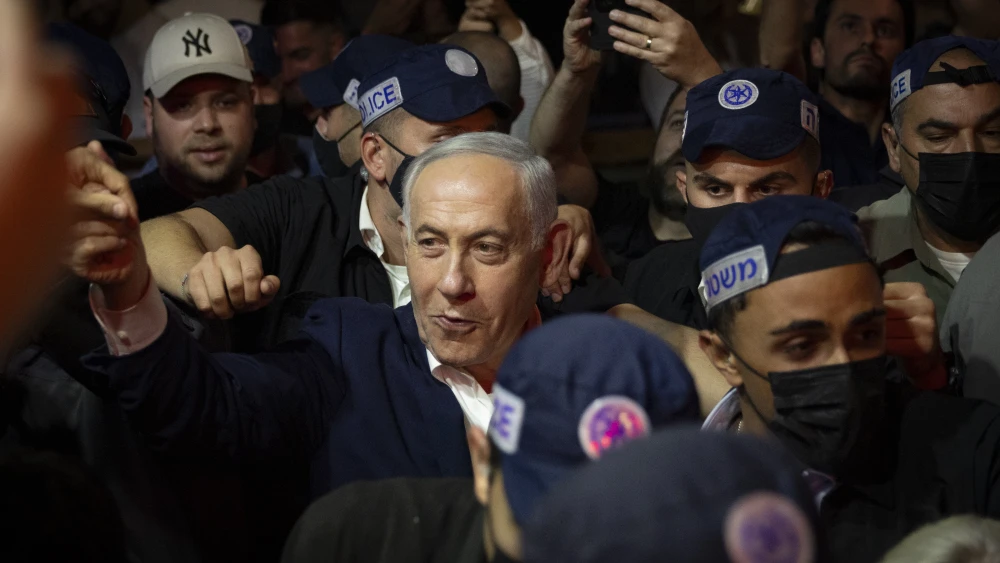

Israel votes on Tuesday, and the election is at the top of the global agenda. Paradoxically, one of the world’s smallest countries commands such attention. When major newspapers and television networks cover the vote, they describe it as fateful, decisive and fundamental.
The translation is: They hope Benjamin Netanyahu’s long tenure as prime minister—19 years in all—will come to an end.
If we try to understand why, we encounter the familiar accusations: “criminal,” “genocidal,” “corrupt,” “fascist.” They are part of the antisemitic campaign that has poisoned much of the world. But the hostility goes deeper and is rooted in the fears of our time.
Inside Israel, too, the battle is fierce. Polls vary according to their source, but the country remains divided between two blocs, neither of which can take for granted the 61 seats needed for a Knesset majority.
The opposition camp is held together above all by one conviction: Netanyahu must go.
It includes former Prime Minister Naftali Bennett, Yair Lapid, Yair Golan and former IDF Chief of Staff Gadi Eisenkot, whose Yashar party has sought to occupy the political center. Their positions on security, the Palestinians, religion and the economy differ considerably. Opposition to Netanyahu is what binds them.
Netanyahu asks Israelis to judge him differently.
Israel has fought on seven fronts since the Hamas-led massacre of Oct. 7, 2023. Hamas has been devastated militarily in Gaza. Hezbollah has suffered enormous losses. Iran’s regional network has been weakened, and Israel has demonstrated its ability to strike the Islamic Republic itself.
For Netanyahu, this is the vindication of a strategic worldview he has advocated for decades: Iran is Israel’s central strategic threat; Palestinian statehood would endanger Israel rather than bring peace; and the Jewish state must retain the power to defend itself by itself.
His opponents blame him for the failures that preceded Oct. 7 and accuse him of deepening the divisions within Israeli society. They say the country needs new leadership.
That is the argument Israelis will settle at the ballot box.
Netanyahu recently set out four principles for the government he hopes to form after the election: no Palestinian state; Israel as the nation-state of the Jewish people; a proactive security doctrine that strikes threats rather than waiting to be attacked; and a free economy.
These are not secondary issues. They concern the identity and future of the country.
Netanyahu also faces challenges on his right. Smaller parties could determine whether he can assemble a majority, including Amcha, led by former senior IDF officer Ofir Winter.
The election therefore cannot be reduced simply to a referendum on one man, however much the international press may portray it that way.
For much of the Western political and media establishment, Netanyahu has become more than an Israeli politician. He represents a concept of national sovereignty that many find unacceptable: borders defended by force, terrorism confronted rather than accommodated, and a refusal to accept international formulas that Israel believes threaten its survival.
That helps explain the extraordinary attention devoted to an election in a country of fewer than 11 million people.
Former Prime Minister Ehud Barak has been among Netanyahu’s fiercest critics, repeatedly attacking his leadership and warning about the future of Israeli democracy. Netanyahu, in turn, has accused his opponents and powerful interests at home and abroad of trying to remove him from office.
Behind this struggle lies another phenomenon: the enormous influence of Qatar and the increasingly visible red-green alliance between radical Islamism and the far left, which has helped transform anti-Israel activism throughout the West.
But they do not have a vote.
Israelis do.
On Oct. 27, they will decide not simply whether Netanyahu remains prime minister, but whether Israel continues along the political and strategic path forged through three years of war or chooses another direction.
The world will be watching.
The decision belongs to Israel.