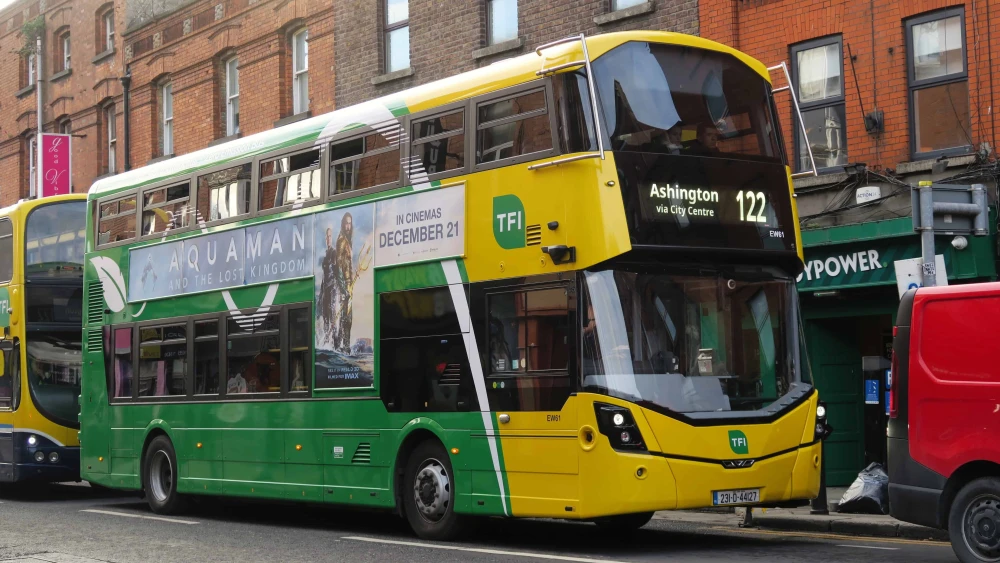
Police in Ireland have arrested a suspect in his thirties following “reports of a disturbance on a bus” involving the harassment of a Jewish man, a police spokesperson told JNS on Sunday. In video of the incident, the suspect is seen calling another person “genocidal Jew,” and slapping away a camera filming the exchange.
The man was brought to a police station in the Dublin Region and “was later released without charge,” the police spokesperson said. “Investigations into all of the circumstances of this incident are ongoing,” he added, but declined to divulge any additional information.
The incident, which was not reported on in major Irish media, generated a debate on social media, where critics of Ireland’s anti-Israel policy pointed to the video as evidence linking that bias to antisemitism. Others disputed this, pointing out that the man appeared inebriated, and that passengers or the driver called the police.
One of the passengers confronted the man, telling him his actions were “hateful” and urging him to be “better than this.”
The mask comes off... A drunken antisemite attacked a Jewish man today on the bus in Dublin.
— DSH 🎗🇮🇱🇺🇦🇮🇪 (@dsh_ie) July 19, 2025
No provocation, simply came up to a guy who helped him pay for his bus ride and said "you are a Jew, right?" and then...
Gardai got him, but there is no antisemitism in Ireland... pic.twitter.com/HmFrIVW3Sy
Irish Chief Rabbi Yoni Wieder told JNS that even if the man was drunk, his conduct was nonetheless revealing.
“The man was clearly too drunk to remember the usual script—to say ‘Zionist’ instead of ‘Jew.’ Normally, those who peddle this kind of hate are more careful to mask it. This time, the mask slipped,” said Wieder.
He credited the woman who confronted the suspect, but added that “it’s impossible to ignore the link between the distorted rhetoric against Israel in media and politics and the sense of license it gives people to act like this in public.”
Incidents like the one recorded Friday “continue to be ignored, and our concerns consistently dismissed,” said Wieder, “despite repeated warnings about antisemitism here.”
In May, an Israeli government ministry accused authorities in Ireland, along with Spain and South Africa, of enabling antisemitism through inflammatory rhetoric on Israel.
The accusations appeared in the “State of Antisemitism Report for 2024,” published by Israel’s Ministry for Diaspora Affairs and Combating Antisemitism.
Ireland, Spain and South Africa, which have accused Israel of committing genocide in Gaza, were said to be “Countries that enable antisemitism through their selective criticism of Israel and abuse of the language of human rights,” as the report’s authors phrased it.
Israel has accused Dublin of singling out the Jewish state and aligning with extremist narratives, as bilateral relations have grown increasingly strained in recent months.
In December, Israel closed its embassy in Dublin, accusing Ireland of double standards and dehumanizing Israelis. Israeli Foreign Minister Gideon Sa’ar at the time denounced Irish President Michael D. Higgins as an “antisemitic liar” after Higgins during a Holocaust Remembrance Day speech criticized Israeli actions.
Ireland last month joined eight other member states—Belgium, Finland, Luxembourg, Poland, Portugal, Slovenia, Spain and Sweden—in asking the European Commission, the E.U.’s executive arm, to see how Israeli goods “can be brought into line with international law.”
On July 5, a senior academic from the University of Limerick was filmed allegedly assaulting a student for displaying an Israeli flag at an off-campus event. The university and the education ministry have not replied to queries on the incident.
Ireland’s parliament is preparing to vote on a bill that outlaws the import and sale in Ireland of Israeli-made products from Judea and Samaria. If passed, the law would make Ireland the first E.U. member state with such a ban.