“It is a great honor to welcome home a New Yorker who fought and died for our country, and the freedom and rights we have today,” said New York Gov. Kathy Hochul.
Calls are mounting for the University of Portsmouth to act after a history professor posted on social media that “blowback is bad, but it is also inevitable.”
“It is unbelievable that in the 21st century, arguments worthy of the dark ages are being used to blame the victims of their own Holocaust,” the Jewish Association of Peru stated.
Since Oct. 7, 2023, the Toronto Police Service has made “over 517 arrests and laid over 1,275 charges in connection with demonstrations, protests and hate‑motivated offenses,” its chief said.
“I assume this is a different Zarah Sultana MP to the one who was recently filmed clapping along to loudspeaker chants for intifada, on a street in Surrey,” Rowling wrote.
“We’re not seeing any indication that a large part of the Jewish community supports anti-Zionism,” Jonathan Schulman, of Jewish Majority, which conducted the survey, told JNS.
“If we had produced anything like this, I would have been fired the next day,” Benny Polatseck, who worked in the creative communications department at City Hall under the former mayor, told JNS.
“People shouldn’t think that, ‘Oh this is not going to happen to me,’” the 32-year-old Judaic studies teacher told JNS. “It can happen to anyone walking the streets, anyone with their groceries.”
The growing distaste for the Jewish state isn’t the fault of Netanyahu or Israeli behavior. It’s driven by forces seeking the destruction of the West and beyond the control of Jerusalem.
Given enough time, a combination of economic and military pressure may be enough for Trump to topple the Islamist terrorists. The question is whether he has it.
Israelis with contradictory views on crucial matters are never going to cease battling one another ideologically, and no constellation of musical chairs in the Knesset is going to alter that reality.
America’s pro-Israel lobby has been written off before. The next chapter—built on technology, defense industrial integration and shared strategic competition—should be its most consequential.
Waves of unemployment, poverty, repression and are forming a mass of the dispossessed and the enraged, who can challenge the foundations of the government amid turbulence and chaos.
“It is a great honor to welcome home a New Yorker who fought and died for our country, and the freedom and rights we have today,” said New York Gov. Kathy Hochul.
Calls are mounting for the University of Portsmouth to act after a history professor posted on social media that “blowback is bad, but it is also inevitable.”
“It is unbelievable that in the 21st century, arguments worthy of the dark ages are being used to blame the victims of their own Holocaust,” the Jewish Association of Peru stated.
Since Oct. 7, 2023, the Toronto Police Service has made “over 517 arrests and laid over 1,275 charges in connection with demonstrations, protests and hate‑motivated offenses,” its chief said.
“I assume this is a different Zarah Sultana MP to the one who was recently filmed clapping along to loudspeaker chants for intifada, on a street in Surrey,” Rowling wrote.
“We’re not seeing any indication that a large part of the Jewish community supports anti-Zionism,” Jonathan Schulman, of Jewish Majority, which conducted the survey, told JNS.
“If we had produced anything like this, I would have been fired the next day,” Benny Polatseck, who worked in the creative communications department at City Hall under the former mayor, told JNS.
“People shouldn’t think that, ‘Oh this is not going to happen to me,’” the 32-year-old Judaic studies teacher told JNS. “It can happen to anyone walking the streets, anyone with their groceries.”
The growing distaste for the Jewish state isn’t the fault of Netanyahu or Israeli behavior. It’s driven by forces seeking the destruction of the West and beyond the control of Jerusalem.
Given enough time, a combination of economic and military pressure may be enough for Trump to topple the Islamist terrorists. The question is whether he has it.
Israelis with contradictory views on crucial matters are never going to cease battling one another ideologically, and no constellation of musical chairs in the Knesset is going to alter that reality.
America’s pro-Israel lobby has been written off before. The next chapter—built on technology, defense industrial integration and shared strategic competition—should be its most consequential.
Waves of unemployment, poverty, repression and are forming a mass of the dispossessed and the enraged, who can challenge the foundations of the government amid turbulence and chaos.
“Turkey sees that its old adversaries, Greece and Cyprus, and its new adversaries, Israel and Egypt, are forming a maritime axis that is blocking [it],” Soner Cagaptay, director of the Turkish Research Program at the Washington Institute for Near East Policy, told JNS.
Delivering aid to Lebanon now would signal that the Lebanese government can undermine U.S. interests and trample on rights of the Lebanese people with “total immunity,” says Lebanon expert Tony Badran.
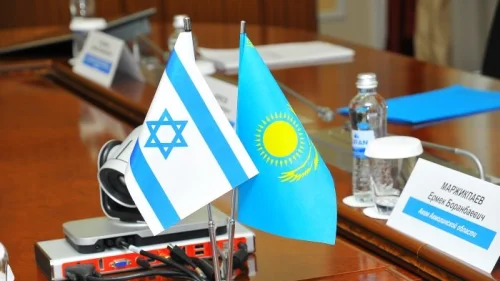
The Central Asian country, former Soviet republic and Muslim-majority country has a history of strong connections with Israel and supports its local Jewish population.
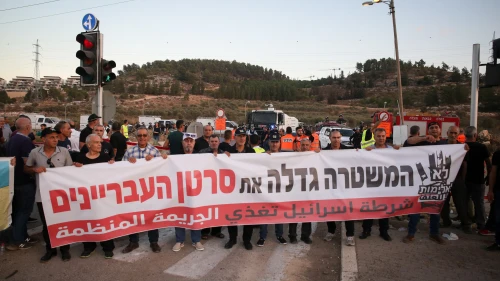
The Joint Arab List announced that it will boycott the swearing-in ceremony for the new Knesset as part of a general strike among Israeli Arabs to protest what they say is the government’s failure to address rising levels of violence in their neighborhoods.
“I finished the two Torah scrolls myself at the place where 75 years ago, our martyrs were brutally shot into the water,” said Rabbi Shlomo Koves in Budapest.
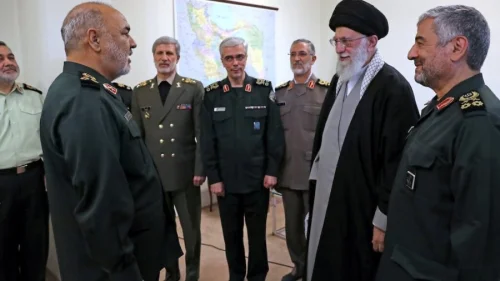
With the economy contracting and Iranians feeling the squeeze, it’s no surprise that Iran has begun to lash at the United States—and now the United Kingdom and Europe.
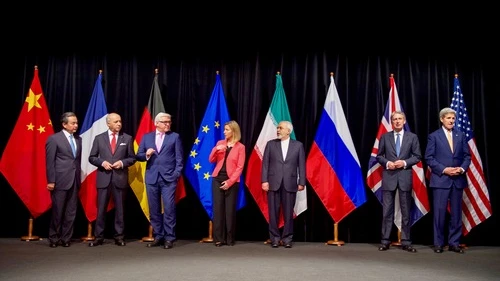
While neither country appears to want a war, Tehran’s graduated nuclear escalation is inherently risky, introducing more variables into an already dangerous equation.
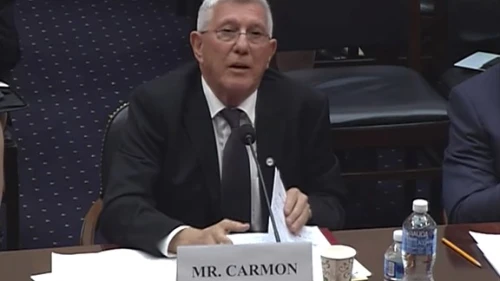
MEMRI head Yigal Carmon sits down with JNS to talk about the dual threats of Islamic extremism and white supremacy in the United States, and the role played in both by the big social-media companies.
Like other politicians in the region the Turkish president may have overstayed his welcome—are the Turkish people now turning against his dictatorial rule?
“Even in the Arab world, Hezbollah is designated as a terrorist organization,” says former deputy head of Israel’s National Security Council Col. (res.) Dr. Shaul Shay, “so the correct policy would be to increase the pressure on the group’s financial sources.”
“Israel finds itself trapped, without any significant change in sight,” said Yoram Meital, professor of Middle East Studies at Ben-Gurion University of the Negev