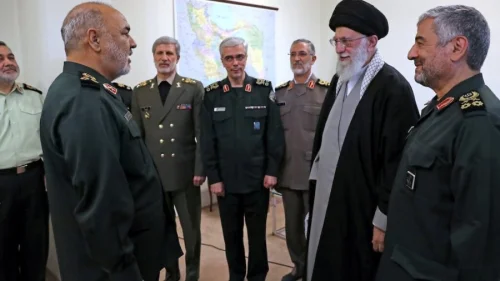
If Iran decides to fight over passage through the Strait of Hormuz, “it will mean a return to hostilities,” a security source said.
 The Israeli consul general in New York told JNS that this year was the first time the Jewish state held an Independence Day celebration in New York City under a mayor who doesn’t recognize it.
 Israel Advocacy Day brings together pastors and rabbis from more than 37 states to the nation’s capital at a time of increasing criticism of Israel on both sides of the political aisle.
 Talks hinge on ceasefire and security deal says Joseph Aoun, as U.S. pushes Israel-Lebanon meeting after rare Washington talks and ongoing clashes.
 “It is disturbing to see some corners of our justice system treat the life of a Jewish American as worth so little,” Alyza Lewin, president of U.S. affairs at the Combat Antisemitism Movement, told JNS.
 “We are more scared than ever,” Jewish activist Jennifer Laszlo Mizrahi told JNS. “Despite the overall reduction in the number of instances, the severity of instances is terrifying.”
 The analysis found that Cole Allen, who faces multiple felony charges for the April 25 attack, had “multiple social and political grievances” and cited his social media posts criticizing the war.
 A spokesman for the New York City Economic Development Corporation told JNS that a Japan page was also taken down.
 Moments after Varsha Gandikota-Nellutla, of the Hague Group, made the admission, Andrew Gilmour, a former senior U.N. official, warned her that “there are 108 people on this call, so just assume it’s not confidential.”
 Nearly four of five French Jews feel unsafe, according to a recent survey.
 Trump says U.S. will guide neutral ships out of Strait of Hormuz in humanitarian move, warns any interference will be met with force.
 The threats targeted a student over his visit to Israel, prompting a college response that critics said was lacking.
 A deadline in the law has yet to pass, but Rabbi Josh Joseph, of the Orthodox Union, told JNS that “we expect the mayor and the NYPD to work in close coordination with the community to ensure that the intent of this legislation is fully upheld.”
Nearly four of five French Jews feel unsafe, according to a recent survey.
A deadline in the law has yet to pass, but Rabbi Josh Joseph, of the Orthodox Union, told JNS that “we expect the mayor and the NYPD to work in close coordination with the community to ensure that the intent of this legislation is fully upheld.”
Nearly four of five French Jews feel unsafe, according to a recent survey. The National Education Association “sends the message to the local and state affiliates that antisemitism is acceptable,” Marci Lerner Miller, of the Brandeis Center, told JNS.
 Jewish families “were met with terrifying signals of hatred and threats of violence,” said Julie Menin, speaker of the New York City Council.
 The president’s call for a national Shabbat “celebrates our religion and it refocuses on our job to become a light unto the nations,” Rabbi Steven Burg of Aish told JNS.
The Israeli consul general in New York told JNS that this year was the first time the Jewish state held an Independence Day celebration in New York City under a mayor who doesn’t recognize it.
The president’s call for a national Shabbat “celebrates our religion and it refocuses on our job to become a light unto the nations,” Rabbi Steven Burg of Aish told JNS.
The Israeli consul general in New York told JNS that this year was the first time the Jewish state held an Independence Day celebration in New York City under a mayor who doesn’t recognize it. Its contemporary manifestation almost always centers on the charge that Jews are more beholden to Israel than their own nation.
 “He informed and entertained generations of fans with a theatrical and unapologetic style that was uniquely his own,” the New York Yankees stated.
 An exhibition in Tel Aviv supports thousands of IDF troops from abroad serving in Israel.
 From Miami suites to Mexico City kitchens, a new generation of Jewish food influencers is using cuisine as a powerful form of cultural diplomacy.
 “There isn’t a moment that I don’t think of what could have been,” her mother told JNS.
 Rare documents, letters and photos on display at the President’s Residence trace a century of engagement between the Chief Rabbinate and American presidents.
 Mainstream support for Senate candidates like Graham Platner and Abdul El-Sayed reflects both panic about Trump and the acceptance of antisemitism.
 Even if Tehran signs a temporary agreement, Israel still faces Hezbollah, Hamas and an Iranian regime determined to survive.
 In foreign policy, clarity matters. When rhetoric drifts too far from reality, the decisions it informs can carry lasting and irreversible costs.
 America has long assumed that its scale, constitution and civic ethos insulate it from hostile religious environments. That’s a fragile assumption.


-
If Iran decides to fight over passage through the Strait of Hormuz, “it will mean a return to hostilities,” a security source said.
The Israeli consul general in New York told JNS that this year was the first time the Jewish state held an Independence Day celebration in New York City under a mayor who doesn’t recognize it.
Israel Advocacy Day brings together pastors and rabbis from more than 37 states to the nation’s capital at a time of increasing criticism of Israel on both sides of the political aisle.
Talks hinge on ceasefire and security deal says Joseph Aoun, as U.S. pushes Israel-Lebanon meeting after rare Washington talks and ongoing clashes.
-
“It is disturbing to see some corners of our justice system treat the life of a Jewish American as worth so little,” Alyza Lewin, president of U.S. affairs at the Combat Antisemitism Movement, told JNS.
“We are more scared than ever,” Jewish activist Jennifer Laszlo Mizrahi told JNS. “Despite the overall reduction in the number of instances, the severity of instances is terrifying.”
The analysis found that Cole Allen, who faces multiple felony charges for the April 25 attack, had “multiple social and political grievances” and cited his social media posts criticizing the war.
A spokesman for the New York City Economic Development Corporation told JNS that a Japan page was also taken down.
-
Moments after Varsha Gandikota-Nellutla, of the Hague Group, made the admission, Andrew Gilmour, a former senior U.N. official, warned her that “there are 108 people on this call, so just assume it’s not confidential.”
Nearly four of five French Jews feel unsafe, according to a recent survey.
Trump says U.S. will guide neutral ships out of Strait of Hormuz in humanitarian move, warns any interference will be met with force.
The threats targeted a student over his visit to Israel, prompting a college response that critics said was lacking.
-
A deadline in the law has yet to pass, but Rabbi Josh Joseph, of the Orthodox Union, told JNS that “we expect the mayor and the NYPD to work in close coordination with the community to ensure that the intent of this legislation is fully upheld.”
Nearly four of five French Jews feel unsafe, according to a recent survey.
The National Education Association “sends the message to the local and state affiliates that antisemitism is acceptable,” Marci Lerner Miller, of the Brandeis Center, told JNS.
Jewish families “were met with terrifying signals of hatred and threats of violence,” said Julie Menin, speaker of the New York City Council.
-
The president’s call for a national Shabbat “celebrates our religion and it refocuses on our job to become a light unto the nations,” Rabbi Steven Burg of Aish told JNS.
The Israeli consul general in New York told JNS that this year was the first time the Jewish state held an Independence Day celebration in New York City under a mayor who doesn’t recognize it.
Its contemporary manifestation almost always centers on the charge that Jews are more beholden to Israel than their own nation.
“He informed and entertained generations of fans with a theatrical and unapologetic style that was uniquely his own,” the New York Yankees stated.
-
An exhibition in Tel Aviv supports thousands of IDF troops from abroad serving in Israel.
From Miami suites to Mexico City kitchens, a new generation of Jewish food influencers is using cuisine as a powerful form of cultural diplomacy.
“There isn’t a moment that I don’t think of what could have been,” her mother told JNS.
Rare documents, letters and photos on display at the President’s Residence trace a century of engagement between the Chief Rabbinate and American presidents.
-
Mainstream support for Senate candidates like Graham Platner and Abdul El-Sayed reflects both panic about Trump and the acceptance of antisemitism.
Even if Tehran signs a temporary agreement, Israel still faces Hezbollah, Hamas and an Iranian regime determined to survive.
In foreign policy, clarity matters. When rhetoric drifts too far from reality, the decisions it informs can carry lasting and irreversible costs.
America has long assumed that its scale, constitution and civic ethos insulate it from hostile religious environments. That’s a fragile assumption.