Washington has been cautious about which arms it provides Kyiv and from where the weaponry arrives. But speaking in Israel today, U.S. Secretary of State Antony Blinken told Israeli counterparties they ought to be doing a lot more.
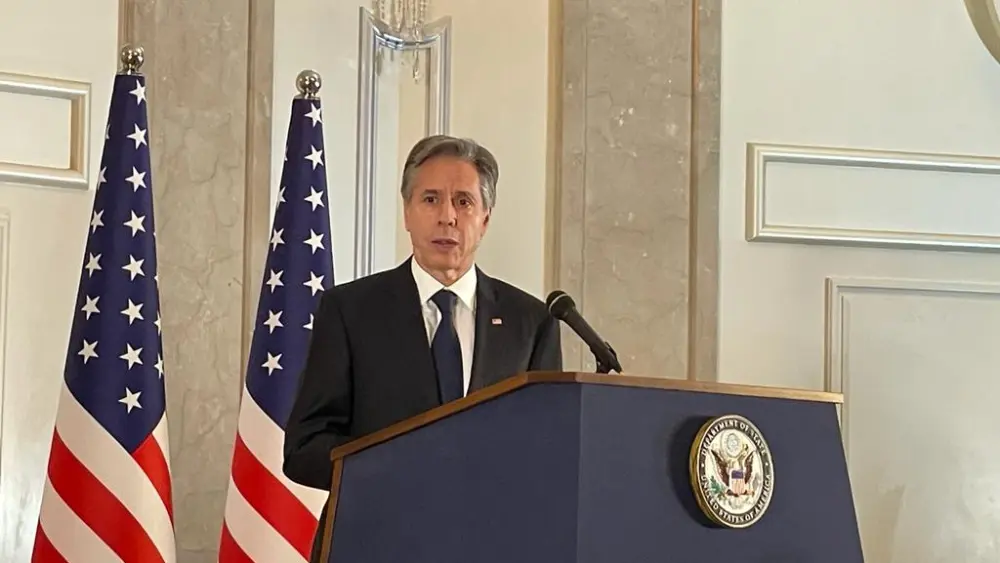
Alongside Israeli Prime Minister Benjamin Netanyahu yesterday, Blinken stated as a matter of fact that “Russia’s ongoing atrocities” underscore the importance of “providing support for all of Ukraine’s needs—humanitarian, economic and security.” He implied that this support was an international responsibility.
Today, he appeared to place that burden squarely on Israeli shoulders.
“Iran’s deepening ties with Moscow and the sophisticated weaponry that they are exchanging to enable one another’s aggression are among the many reasons that we raised with Israel the importance of providing support for all of Ukraine’s needs–humanitarian, economic and security–as it defends its people against Russia’s brutal war of aggression,” Blinken said in a press conference today.
Israel has yet to provide weapons directly to Ukraine, let alone satisfy all of its military requests. Doing so could risk undermining Israeli security, some say. It wasn’t immediately clear from Washington’s top diplomat’s remarks where, if anywhere, Washington draws its new line.
Blinken’s apparent call comes after Israel’s Defense Ministry on Monday transferred three bulletproof ambulances to Ukrainian rescue forces, as the Russian invasion of the European country nears its first anniversary.
The Upper Galillee-based Plasan Re’em company armored the ambulances and equipped them with life-saving medical gear including defibrillators and oxygen systems.
The New York Times reported earlier this month that the U.S. defense establishment was dipping into a store of American ammunition in Israel to help Ukraine replenish its dwindling supply of artillery shells.
“With stockpiles in the United States strained and American arms makers not yet able to keep up with the pace of Ukraine’s battlefield operations, the Pentagon has turned to two alternative supplies of shells to bridge the gap: one in South Korea and the one in Israel,” the Times reported, citing Israeli and American officials.
While intended for U.S. military use in the Middle East, Israel is permitted to access the stockpile during emergencies.
Nevertheless, Israeli officials insisted that Jerusalem had not changed its policy of providing only humanitarian aid to Ukraine.
Israel has shied away from arming Ukraine over fears of upsetting Russia, the leading player in Syria, where the Israeli military has in recent years conducted hundreds of strikes aimed at curbing Iran’s military entrenchment and the transfer of weapons to Hezbollah there and in Lebanon.