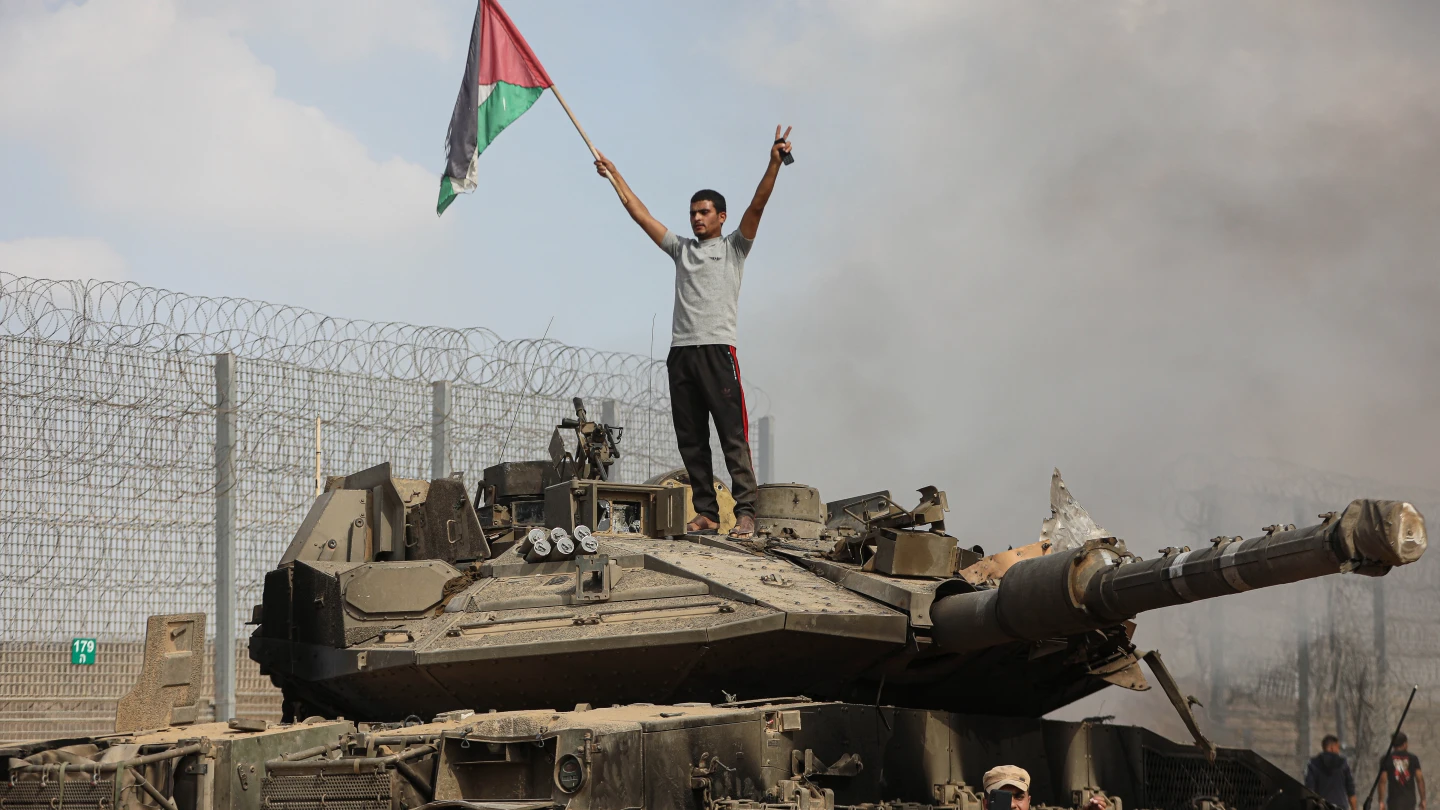
Monday marks a crucial moment in the saga that began on Oct. 7, 2023, with Hamas’s barbaric massacre and has since turned into a war that has raged for almost two years.
Israeli Prime Minister Benjamin Netanyahu is scheduled to meet at the White House with U.S. President Donald Trump for the fourth time—a number without precedent. The American president has cast this encounter in dramatic tones, presenting Gaza as the central battlefield in which his strategy for world peace will be tested.
Trump insists that Gaza is the most decisive front where the flames must be extinguished. And indeed, it is not merely a local conflict—it is a confrontation on the dividing line between Islam and the West.
The word dominating the diplomatic choreography is “respect.” It appears in the 21 points drafted by U.S. Special Envoy to the Middle East Steve Witkoff and former British Prime Minister Tony Blair, in discussion with Netanyahu, Israel’s Strategic Affairs Minister Ron Dermer and moderate Arab representatives.
Netanyahu himself has spoken of possible understandings with Syria and Lebanon, goodwill gestures toward Indonesia and the strengthening of the Abraham Accords. Respect, here, means a rejection of extortion tactics—such as hurling the false accusation of “genocide” at Israel to impose a ceasefire.
Yet no plan can ignore the inherent danger that a Palestinian state could become, in Netanyahu’s words, “a terrorist state within Israel’s borders.” The American proposal acknowledges this, while suggesting that “respect” for the Palestinians could be possible—if, and only if, they renounce terrorism and the hatred embodied by Hamas.
For the first time, the vision laid out does not speak of removing them from Gaza but of demanding a transformation from within.
Still, the most urgent issue is the hostages. Netanyahu, in a deeply personal moment, read their names one by one in his United Nations General Assembly address on Friday. Loudspeakers on Israel’s side of the Gaza border carried his promise into the Strip: they must all return, living and dead. This is the foundation of any deal, Trump insists.
The United States is seeking to involve mediators—Qatar and Egypt among them—who must be pushed to abandon their ambiguity and finally pressure Hamas. Even Turkey’s Erdogan is drawn into the equation, however hostile to Israel he may be. Saudi Arabia and the UAE are asked to advance normalization, a step that could upend decades of religious war that brands Israel guilty merely for existing.
But here lies the paradox: Hamas must surrender power, allow its leaders to leave or “convert culturally”—an absurdity on its face. “Deradicalization” is not an overnight phenomenon.
Israel is asked to walk a tightrope, relying solely on its American alliance, while Europe, awash in antisemitism and clinging to Palestinian Authority leader Mahmoud Abbas—who has not held elections in 20 years and rewards terrorists with “pay-for-slay”—can no longer be considered a guarantor.
The pact under discussion foresees no forced exodus from Gaza, an international group ensuring reconstruction, and the end of Hamas’s rule. But it also demands that convicted terrorists be released back into Gaza and Ramallah, and that Israelis believe promises of peace from those who swore on holy books to kill Jews.
Netanyahu, notably, refrained from speaking about the annexation of Judea and Samaria in his U.N. address. Instead, he invoked peace, recalling Israel’s resilience in overcoming enemies even after the trauma of Oct. 7. But as he himself knows, this is a silk thread. And today, it is the White House weaving it.