
One of the great desires and aspirations of millions of thoughtful humans is to find revelation—to “see the light” and be privileged to understand the meaning and purpose of life, always so elusive.
Many say that “if only I could see the higher reality, it would be life-changing. No more doubts or dilemmas. My vision would be unclouded, and my life journey would be clear.”
How many people over the ages have asked, appealed and pleaded to the Almighty, “Please, God! Give me a sign! Show Yourself to me so I know I am not walking in darkness but am on the right, true path in life.”
“I come to shul week after week, Shabbat after Shabbat—and nothing! They open the Holy Ark, read the Torah, give sermons and still not a glimmer of revelation!” (Whether we actually do any praying, or we just shmooze with our friends and have a few l’chaims at the kiddush, is another question.)
The opening line of this week’s Torah portion, Vayera, is, “And God appeared to him (Abraham) … .” It was three days after Abraham’s brit milah, circumcision, at age 99, and God came to visit the sick. This was not Abraham’s first revelation, but it is the very title of our Torah portion.
The story is told of a little boy who had just been taught this story in his school, his cheder. Little Sholom Ber would later grow up to become a great rabbi, known as the Rebbe Rashab, but at age 4 or 5, he first heard the story of God visiting Abraham. Afterward, he rushed into the study of his illustrious grandfather, the Tzemach Tzedek of Lubavitch, and was literally crying: “Why did God appear to Abraham, but He doesn’t appear to us?”
His grandfather was not at all dismissive of the little boy’s question and answered him very earnestly: “When a Jew, a tzaddik, at the age of 99, decides that it is time to undergo a brit, then he is indeed worthy of revelation.”
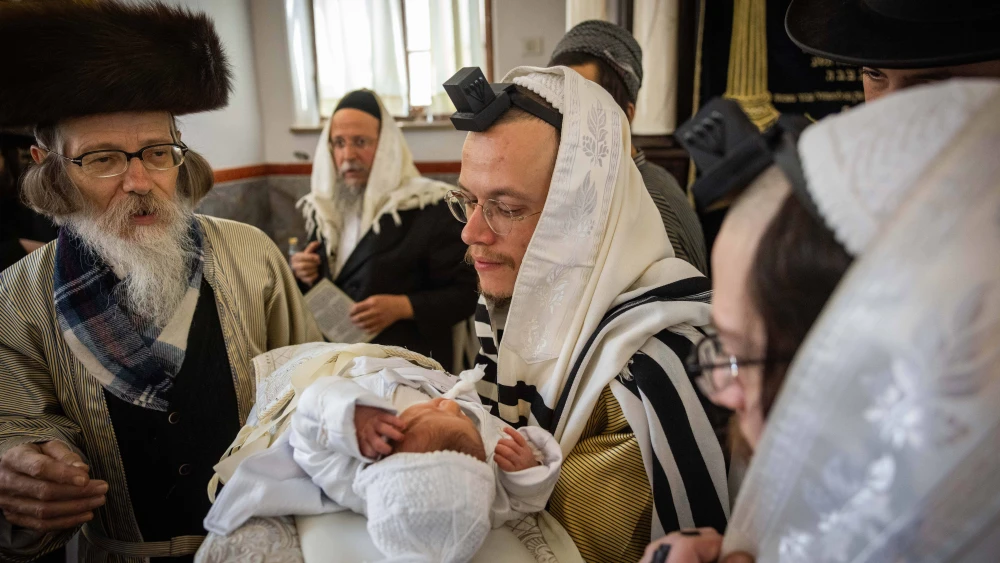
Circumcision is perfecting the body, entering a permanent and eternal covenant with God. It means we acknowledge that we are not there yet and still need to develop ourselves spiritually, morally and ethically. If, at age 99, after having achieved so much in life, Abraham still felt he was lacking and in need of moral improvement, then he was indeed worthy of Divine revelation.
The Lubavitcher Rebbe, Rabbi Menachem Mendel Schneerson, told this story on numerous occasions over the years. His basic message was twofold. First, even a child can demand revelation; it may be a child in years or a child in terms of one’s spiritual awareness. Perhaps he or she only recently discovered their inner faith and has only just begun living a committed Jewish life. They may be adults biologically, but are still “children” spiritually. They, too, are justified in demanding revelation. They, too, have a right to cry out for it.
Secondly, revelation doesn’t come casually out of the blue; one must earn it. Abraham was a legend in his lifetime (not in his own mind). He had, literally, transformed the world from paganism to belief. He had served the Almighty faithfully for a lifetime. He had passed many difficult tests of faith already.
But as much as he had achieved, Abraham appreciated that he wasn’t “there” yet. Circumcision, which spiritually is understood as removing obstacles and facades—and connecting with one’s true, inner essence—is like starting over. Unlike a bar mitzvah or a wedding, a brit milah is normally done at the beginning of a child’s life. Abraham appreciated that, as advanced as he may have been at his age, he was still only at the beginning of a journey. This was a remarkable strength and humility genuinely worthy of Divine revelation.
The Bible begins with the word bereshit and the Hebrew letter bet, the second letter in the Hebrew alphabet. But shouldn’t it have started with the first letter, alef? One traditional answer is that we always need to remember that, as much as we may know, we don’t really even know the alef. God is infinite, and so is His wisdom. How can we mortals possibly grasp the infinite wisdom of God that he placed into His Torah? Impossible.
You think you are a good student, a scholar perhaps? Or maybe you are already a qualified rabbi, even a rosh yeshivah, head of a school of Jewish learning. Do you really think you can grasp the vastness of Torah? As much as we may know, we still know nothing.
And if you think you do know, then you know even less than nothing!
My zayda, grandfather, was a pious Jew, a shochet and a respected Chabad Chasid. He was the gabbai in the Lubavitcher Rebbe’s shul until his passing in 1969. I remember once visiting him in the then-Brooklyn Jewish Hospital when he was not well. I noticed a man with a large yarmulke and a white coat leaving his hospital room just before I arrived. When I came in, I saw that my grandfather was rather agitated. I asked what was wrong. He said that the man who’d just left was the mashgiach (supervisor of kosher food) in the hospital. “He was boasting to me about how many times he had completed studying the entire Talmud. So I said to him, ‘It’s all fine and well that you have studied the Talmud, but what has the Talmud taught you?’ ”
In other words, if his study led him to arrogance and an inflated ego, then he hadn’t really learned much.
No one can say, “I’ve arrived.” No one can claim that they’ve reached the pinnacle and fulfilled the purpose and all the enormous potential they possess. We can always do more. Much more.
The 18th-century Rabbi Yaakov Yitzchak, known as the Seer of Lublin, once said: “Better a sinner who knows that he has sinned than a tzaddik who knows that he is righteous.”
Abraham’s circumcision and God’s subsequent revelation to him remind us that no matter where we are in our spiritual lives, we are still only at the beginning.