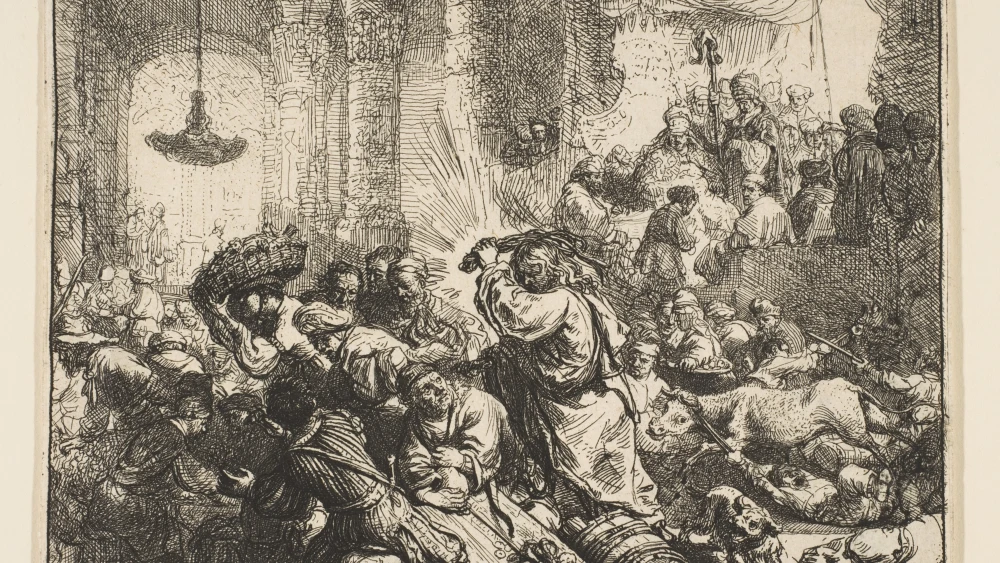
Instead of overturning tables and righteously chasing out those who would have the chutzpah to wheel and deal on sacred Temple grounds, Jesus likely got into a fight with a moneylender because he was hungry and angry about his group running out of funds. That’s according to an article in the peer-reviewed journal Cogent Arts & Humanities.
Haggai Olshanetsky, of the University of Warsaw and lead author of the study, told JNS that historians don’t aim to persuade religious believers but “rather to analyze texts, examine their historicity and to identify the different changes which were made, and why these changes were done.”
“As truth only belongs to the divine, the historian can only attempt to reconstruct events as closely as possible to what occurred,” Olshanetsky told JNS.
Each of the Gospels tells the story of the money-changing tables, but there are differences in the ways that they tell the story, which have led many scholars and religious commentators to question when the event or events happened. John describes the money lending incident occurring on a Passover at least a year before Jesus’s arrest, while Matthew, Mark and Luke record that there was an incident with money changing tables during the Passover when Jesus was arrested.
Olshanetsky said that he and his colleagues, Alan Silverman, an independent researcher in Philadelphia, and Lev Cosijns, of the University of Oxford, are suggesting an explanation of a story that appears in different forms in Christian scripture that, “unlike others, is based solely on what is written in the text.”
Others have suggested that Jesus overturned moneylender tables because he was defending the Jewish Temple’s sanctity and purity. But Olshanetsky and coauthors say that such a motivation isn’t articulated in the Gospels, and further, there are problems with that explanation.
If Jesus actually disrupted the entire moneylending operation in the Temple and chased away all of the animals being sold for sacrifices, that would have amounted to a massive riotous disruption, which would have surely drawn the Temple police, who would have arrested Jesus, they say. It also would have been impossible for one man to stymie such an enormous operation.
Acting alone, Jesus “could only have overturned the tables of a few of the many changers needed to serve the large crowds, and, unlike what is stated in the Gospels, would have certainly been unable to drive all of them out,” the scholars write. “This action was brief and insignificant compared to the activity of tens of thousands of people daily, hundreds of thousands over the week and the extent of trade in the Temple, which was necessary to the sacrificial system.”
The authors of the new article note that a reference to Jesus cursing a fig tree, which was out of season, comes before the moneychanger episode in one Gospel and after it in another. In a third, the fig tree story doesn’t appear.
Instead, the scholars say, Jesus and fellow travelers likely arrived at the Temple late after the money changers had closed up shop for the day, so they went to bed hungry, unable to use their coins to buy food. When they awoke the next day and went to the Temple, Jesus and his group were surprised and disappointed to learn, according to the scholars, that they had arrived with what they thought were fine-silver tetradrachms but were in fact debased billon tetradrachms from Egypt. (Billon is an alloy of gold or silver with less valuable metal.)
The scholars draw their argument on historical understanding of coins that were in circulation at the time, in part based on archeological finds, including ones that would not have been considered legal tender in Jerusalem and would have needed to be exchanged.
When the money changers exchanged the group’s coins for Tyrian silver and local bronze, Jesus and his colleagues, who were already hungry, could have found that they had only about a third of the monies that they thought they did, per the article.
“For such coins, the changer would have offered the Galileans the correct exchange value, and any other changer nearby would have concurred. This value was only around 30% of what Jesus and Judas may have believed was their value,” the scholars write. “The coins looked like the Antiochene tetradrachms with which they would have been acquainted, and perhaps had exchanged at prior festivals, instead of the more common Tyrian coin.”
“The impact on the group’s budget would have been severe, and a shocking and infuriating surprise,” which would explain why Jesus called the money changers a “den of thieves,” they write.
“The violent altercation can be understood as an unsuccessful attempt to pass a Roman currency which, unlike the fine antiochene tetradrachm (or the Tyrian shekel), was not legal tender locally,” they write. They add that Jesus, per scripture, had a tendency to get angry.
“Even according to Christian belief and doctrine, he was both human and divine, and if he was partially human, we can also expect human behavior from him,” Olshanetsky told JNS. “Moreover, the entire issue of whether it was a divine or religious motivation is disproven by the fact that he went to the Temple several times before, and surprisingly and puzzlingly, he also went after the event with the money-changers.”
“However, he never interrupted the businesses there in his visits before and after the event,” he said.

‘Vein of prophetic symbolism’
James McGrath is the Clarence Goodwin chair in New Testament language and literature at Butler University in Indianapolis and chair of the school’s philosophy and religious studies department. His books include “Christmaker: A Life of John the Baptist” and “John of History, Baptist of Faith: The Quest for the Historical Baptizer,” both published in 2024.
McGrath told JNS that the topics addressed in the new article are “absolutely worth exploring” and that the suggestion that “the Gospels and the tradition behind them were taking a hot-headed outburst by Jesus and trying to give it a positive meaning is not at all implausible.”
But McGrath, who has been publishing on Gospel texts related to the money changer episode for about 20 years, told JNS that the episode, which occurred before John the Baptist was arrested, should be read with an understanding that Jesus was still a part of John’s movement.
“The Temple action would thus have been carried out by Jesus as a representative of John’s, and the action would have been understood as a message from John,” he said. “While Jesus was not apprehended in the moment, and some commentators make much of that, I think it is easy to forget that in this time before photography, it was incredibly easy for someone to vanish into a crowd.”
Unless Jesus had some distinguishing facial feature, or unusual hair or the like, only those who spent extensive time with him would have recognized him, according to McGrath.
“But more importantly, this action, perceived as something done by one of John’s disciples, may have prompted Herod Antipas to arrest John, the ringleader of the movement,” he said. “If his followers were willing to do anything for him—as Josephus puts it, without giving an indication of what concrete thing any of his followers had done that might indicate this—and he was criticizing Antipas, he was best eliminated.”
McGrath told JNS that the Gospel of John described Jesus forming a whip out of cords, “which is not a spontaneous hot-headed action.”
“The Gospel of Mark depicts Jesus getting to the Temple and deciding it was too late to engage in a meaningful symbolic disturbance, and so leaving and returning the next day,” he said. “Both are compatible with this having been a planned action, in the vein of prophetic symbolism.”
Jesus’s disruption of the money changers, to McGrath, was probably a smaller-scale incident than the sort that the Gospel authors described.
McGrath said that the Cogent Arts & Humanities article criticizes past studies for their assumptions, but, to him, also chooses “what to view as historical based on what they hope to propose about the whole.” That isn’t a problem necessarily, he said, “but they criticize others for doing the same thing, which is an inconsistency.”
“Despite pointing out that we have incompatible narratives, they blend details from among them without really doing justice to their distinctive stories first,” he told JNS.
“They say that Jesus had been in the Temple previously and not carried out this kind of action, and yet that isn’t true in any of our individual sources,” McGrath said. “In John, we have no story about Jesus being in the Temple previously. In the Synoptics, this is carried out during his only adult visit to Jerusalem that is narrated.”
To McGrath, the authors of the new article also “rule out, without explanation, the possibility of small but symbolic gestures by a prophet.”
“I found their failure to explore this possibility and explain their dismissiveness towards it a weakness that made the article unpersuasive,” he told JNS. “They may be right about this, or I may. I hope that my proposal and theirs will be evaluated and compared. It is wonderful that they have made it.”
But having worked on the text for many years, McGrath said that “the fact that they failed to address any of the key elements in what I understand to be involved in the event means it was inevitable that I would be unpersuaded.”

McGrath added that the article didn’t address descriptions of Jesus’s remarks during the episode coming up at his hearing and becoming “a point of mockery at the crucifixion as well in some versions of that story.”
He is also unpersuaded by the claim in the article that Jesus couldn’t have made a symbolic gesture that would only impact those “just doing their jobs.”
“When people boycott a store or protest at it nowadays, to give an analogy, those most directly impacted are often the lower-level employees, even though they are not usually the focus of the ire of the protesters,” McGrath said. “On the whole, they don’t do justice to the possibility of a historical event that has been exaggerated in its extent/scope.”
McGrath added that John the Baptist preached immersion as an alternative to animal sacrifice to achieve forgiveness of sins. That suggested that “he was critical of the temple and that an action like this would make good sense from his followers,” he said. “Jesus may have been just one of a group of Baptist followers involved, perhaps coordinating it.”
Diverse opinions
Olshanetsky told JNS that questions about the historical Jesus are complicated.
“Issues so close to the heart of religion, especially when considering most who work on this topic are from the three main monotheistic religions, will have diverse opinions both for and against the historicity of Jesus,” he said.
Non-Christian sources “support the existence of a Jewish religious figure named Jesus,” he said. “There is the mention of Jesus and his execution in Josephus, the authenticity of which is hotly debated, alongside rabbinic debates regarding Jesus and Christianity.”
Jewish sources tend to say that Jesus existed as “a man of flesh and blood and, more importantly, as a Jewish man.”
“Furthermore, when looking at the Gospels, Jesus is merely a Jewish religious leader. He is a devout, Jewish man who did not intend to create a new religion,” Olshanetsky said.
“The story of the turning of the tables is so disconnected from anything else in the Gospels appearing before or after it, and is so human in its nature, that it can only be explained as the remnants of an older text,” he added. “This earlier text is probably a biography of Jesus the Jewish religious man and his philosophy, disconnected from the later attempts to portray him as the son of God.”