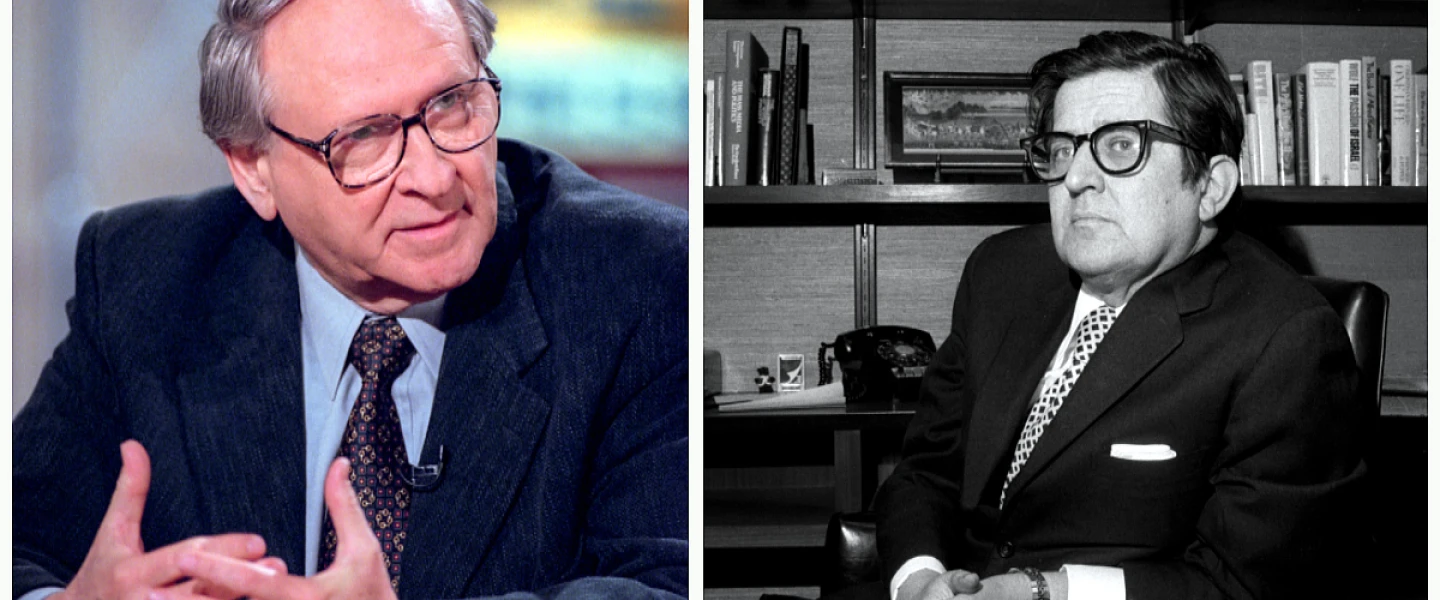
The New York Times is well-known for its criticism of Israel, which is what makes the work of A.M. (“Abe”) Rosenthal and William Safire stand out all the more.
When A.M. Rosenthal arrived at The New York Times in the 1950s, Jewish reporters were instructed not to use their first names if these were “too Jewish.” Its overseas bureaus deliberately limited the number of their Jewish writers, and the paper at times worried about appearing too partial to Jews. This changed when A.M. Rosenthal became managing editor in 1969, and in his subsequent positions as an executive editor and columnist. A determined truth-teller, Rosenthal was unashamed about his Judaism and unapologetic in his support for Israel.
Born in Canada and raised in a secular family in the Bronx, Rosenthal showed his Jewish consciousness with his first famous article, which appeared in 1958: “There Is No News from Auschwitz.” The article exposed readers to the horror of a visit to the death camp.
Over the decades, Rosenthal was a lucid and persuasive pro-Israel voice at The New York Times. In 1999, he presciently saw that Palestinian leader Yasser Arafat was not committed to peace. Whatever his public pronouncements, Arafat, stated Rosenthal, remained bent on “Israel’s defeat or the desiccation of its national will.” His support for Israel never ran dry until his final column.
Rosenthal’s pro-Israel stance helped pave the way for his Pulitzer Prize-winning colleague William Safire, the renowned language and opinion columnist who came to the paper after leaving the Nixon administration in 1973. Possessing a razor-sharp pen, Safire could humble the mightiest for any political or linguistic slip.
Yet he could also defend and praise, and he frequently did so in support of the Jewish state. Indeed, a consistent theme of his columns was the danger that terrorism posed to both America and Israel. On numerous occasions, Safire stridently called on Palestinian leaders to renounce violence and turn to building their society.
Safire enjoyed a decades-long friendship with late Israeli Prime Minister Ariel Sharon, and in many interviews with him, Safire allowed Sharon’s opinions on strategic matters to gain a fair hearing in the most important international venue. The Safire-Sharon friendship proved especially vital during the years of Second Intifada (2000-05), when Safire, often speaking with Sharon, conveyed the grave threat hat Israel faced and the necessity of its self-defense.
These two fixtures at the “Grey Lady”—America’s most prestigious newspaper—consistently made the case that justice was on Israel’s side.