Is the U.S. blockade of the Strait of Hormuz working? It depends who you ask. Conflicting reports have created some confusion.
The Pentagon says that “it’s delivering the decisive impact we intended.” Certain media outlets and shipping analytics firms suggest the opposite, that dozens of Iranian ships are crossing unimpeded. Both can’t be true.
“Turning Tides: U.S. Blockade Enforcement Exceeds Iranian Evasion,” a May 1 report by the Jewish Institute for National Security of America (JINSA), examined the discrepancies. It found that “the truth lies in between though far closer to the Pentagon’s claim.”
In short, the U.S. blockade has proven largely successful.
In an update to its report, JINSA’s review found U.S. forces had redirected 62 vessels that had attempted to breach the blockade as of May 11, and disabled four more. That is up from 44 vessels redirected at the time the report was first issued. The blockade began on April 13.
“The vast majority of ships that are eligible have been turned around or seized under the blockade,” Yoni Tobin, senior policy analyst at JINSA and author of the report, told JNS.
JINSA found that 23 vessels had apparently tried to bypass the blockade. Of those, one-fourth did so on the blockade’s first day, a result of enforcement issues that have since been resolved. One-third were small ships without the capacity to transport large cargo.
“The number one point is, and we’ve tracked literally hundreds of ships as part of this project ... none that we tracked going through were oil tankers,” said Tobin. “It’s very significant because that is really what the blockade is all about. It’s preventing Iranian shipments of oil to the Far East, and to China, primarily, which is responsible for the vast majority of Iran’s revenue.”
It strongly suggests Iran is deterred. It is reflected in the fact, widely reported, that the country is running out of places to put its oil. “They’re not able to move it. They’re not able to store it. We’re seeing them put it on ships that can’t go anywhere,” he said.
On May 8, Iran attempted to send two oil tankers through the blockade. The U.S. fired on and disabled both of them. “There have been several tankers that briefly crossed the blockade line but were then rerouted or disabled by U.S. forces... None have ultimately evaded U.S. blockade enforcement,” said Tobin.
United Against Nuclear Iran (UANI) claimed on May 4 that a single Iranian tanker had run the blockade and made it to to East Asia, possibly en route to China, “but JINSA has not been able to verify that,” he said.
Misreporting about the blockade is due to three main reasons, according to Tobin. The first is terminology. In other words, how an “Iranian-linked vessel” is defined. He pointed to an April 22 Financial Times article with a headline claiming 34 “Iran-linked tankers” bypassed the blockade.
Not only did the text of the article make no such claim, he said, but the report cited Vortexa, a shipping analytics firm that defined “Iran-linked” as any tanker with a connection to Iran going back years, “including just visiting its port, taking cargo a year or two ago.”
“A tanker being abstractly ‘linked to Iran’ is not part of the blockade’s criteria,” he said.
Secondly, there is confusion over the term “shadow fleet” or “ghost fleet vessels.” Lloyd’s List, a shipping data firm, drew considerable attention with an estimate published on April 21 that “at least 26 Iranian shadow fleet vessels” had bypassed the blockade. (U.S. Sen. Chris Murphy, a Democrat from Connecticut, drew criticism when he posted a link to the article on his X account with the caption “awesome,” making it appear he was rooting against U.S. efforts.)
Similarly, The Wall Street Journal on April 16, using Lloyd’s List, reported that “81% of ships that transited the strait since April 13 were affiliated with Iran through ownership, flag, port calls in Iran and other links.”
But in a less publicized update, Lloyd’s List omitted the word “Iranian.” The firm also defined its criterion for a “shadow fleet vessel”—ships involved “in a cargo delivery where at some point over the course of the delivery one party in the chain engages in one or more deceptive shipping practices.”
That is clearly beyond the blockade’s sphere of responsibility, said Tobin.
What’s more, 23 of the 26 ships were ultimately redirected by U.S. forces. Which brings Tobin to his third point, which is that there is a lack of understanding about where the blockade starts. Many reports refer to ships crossing through the Strait of Hormuz. “In reality, that is not where the blockade is being enforced at all,” he said. U.S. Navy vessels are stationed roughly 300 miles away in the Gulf of Oman.
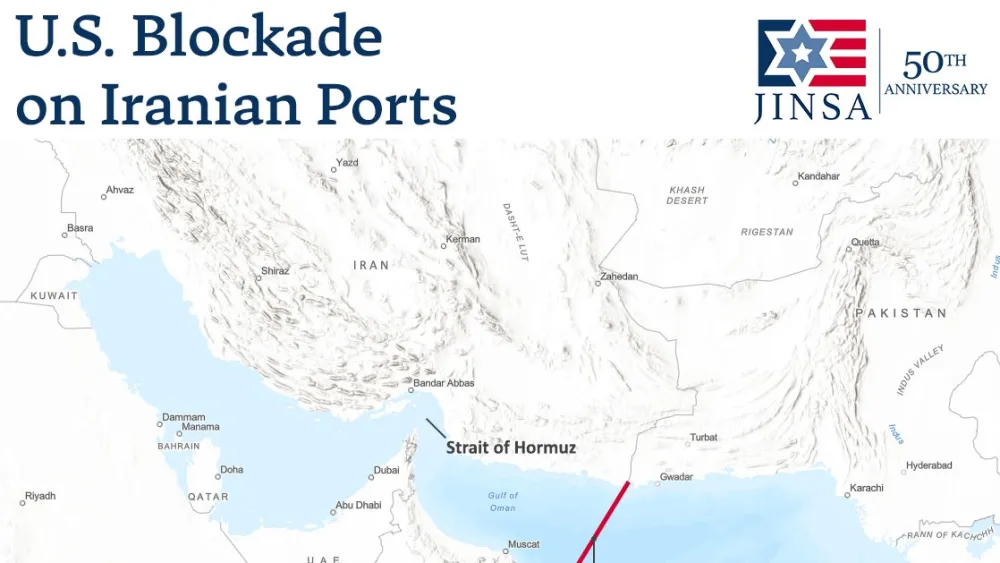
The naval blockade is not just about stopping Iran’s energy trade. As JINSA underscored in its report, the blockade also “constricts the regime’s ability to import weapons components, assembled weaponry, inputs for missile fuel, and cash.”
What is often overlooked is that the blockade is part of a broader effort dubbed “Operation Economic Fury,” said Tobin. It includes sanctions, such as against a major oil terminal and five so-called “teapot” refineries in China heavily involved in trading Iranian oil, and the freezing of Iranian bank accounts and other assets, including cryptocurrency.
Blocked from the U.S. financial system, nobody is going to want to do business with them, he said. On May 7, Bloomberg reported that “China’s financial regulator advised the country’s largest banks to temporarily suspend new loans to five refiners recently sanctioned by the U.S.”
“We’ve seen something that nobody has succeeded at doing under successive American administrations, which is to cut off the world’s leading sponsor of terrorism from its main funding source,” said Tobin. “There have been piecemeal attempts at dealing with it in the past, but this is a monumental step toward that objective.”