Much has been said about the Warsaw Ghetto Uprising and other physical efforts to overthrow the Nazis during World War II. A quieter form of non-violent resistance, however, doesn’t get enough attention, according to Sara J. Bloomfield, director of the United States Holocaust Memorial Museum in Washington, D.C.
“During the Holocaust, Jews resisted in partisan movements as well as uprisings in ghettos, camps, even killing centers,” she told JNS. “One of the least appreciated forms of resistance are the efforts by Jews to maintain cultural and religious traditions while under sustained, brutal assault.”
Emanuel Ringelblum, a Polish Jewish historian who created the clandestine Oneg Shabbat archive in the Warsaw Ghetto, “understood that by gathering evidence of Jewish life and death, he could defy his killers by leaving a record for the future,” according to Bloomfield.
“He was determined that the victims themselves could speak directly to new generations through their secret archive,” she said.
The Nazis murdered Ringelblum and his family in 1944 after finding their hiding place.

Tamar Rabinowitz, senior curator at the Museum of Jewish Heritage-A Living Memorial to the Holocaust in New York City, told JNS that the archive offers a broader understanding of Jewish resistance during the Holocaust, beyond the better-known Warsaw Ghetto uprising.
“Reclaiming your right to tell your own story, what happened to you in your own words, is such a profound, active agency and claiming agency,” she told JNS. “We have these documents of Nazi occupation, Nazi plans, Nazi horrors, but to tell it through the eyes of the people who experienced it is our mission.”
The first cache of the Oneg Shabbat archive was found 80 years ago, on Sept. 18, 1946. The Museum of Jewish Heritage, located in Battery Park near the former World Trade Center site in lower Manhattan, opened an exhibition about the archive today.
The title of the exhibit, which is on view until Feb. 14 and focuses on the “underground archive of the Warsaw Ghetto,” comes from Lejzor Czarnobroda, a young Jewish man who secretly documented life in the ghetto.
“Will these words reach you, faithful friend? Will they ever come to light?” he wrote. “Because for you, I write.
“Lejzor perished during the Holocaust,” Sara Softness, director of cultural affairs at the Museum of Jewish Heritage, told JNS. “He was killed at the Treblinka death camp. So all that remains of his words are those words.”

The writer’s words were part of a broader effort by the Jews in the Warsaw Ghetto to preserve their experiences as they lived through Nazi persecution, according to Softness, who worked with the Emanuel Ringelblum Jewish Historical Institute in Poland, which developed the show.
“They’re doing this work so that it could speak through history, and now it comes to us,” Softness told JNS.
The archive contains nearly 35,000 documents secretly collected and created by Jews living in the ghetto between 1940 and 1943. The materials include diaries, testimonies, letters, underground newspapers, artwork, children’s writings, ration cards and other records of daily life under Nazi occupation.
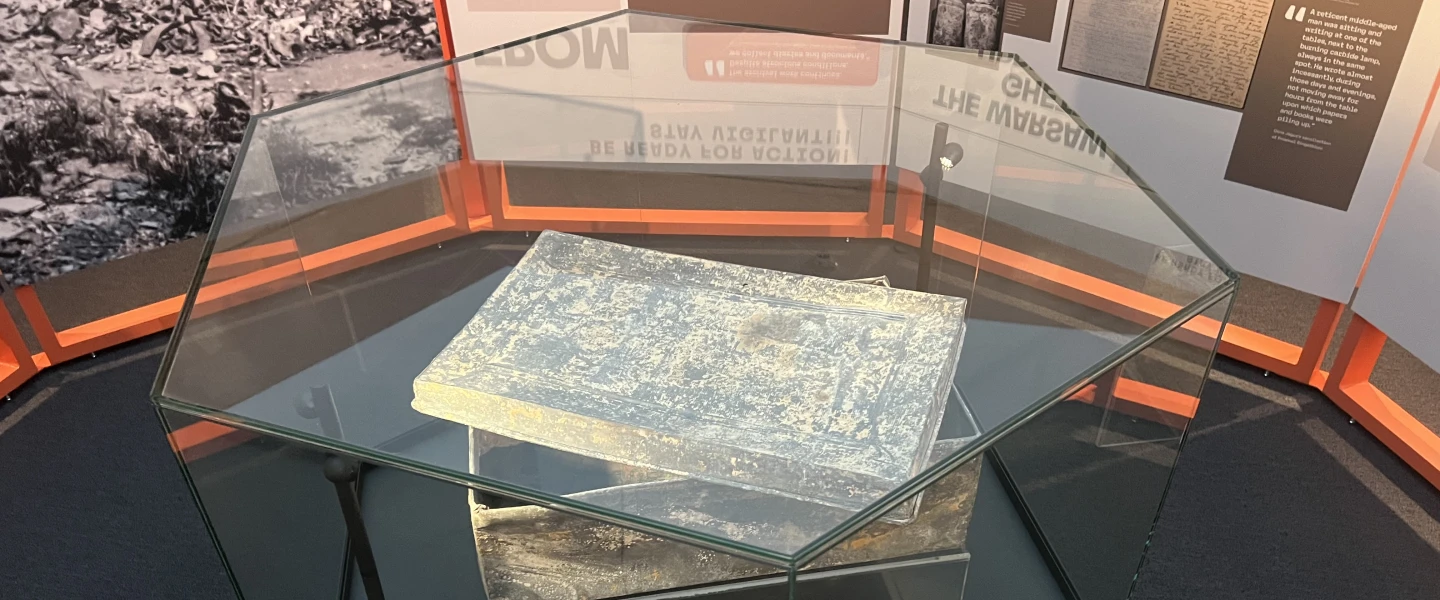
The U.S. debut of the exhibition includes nearly a dozen original artifacts and documents selected from the archive, including one of the 10 metal boxes used to bury materials beneath the ghetto.
Members of the Oneg Shabbat (“joy of the Sabbath”) network, led by Ringelblum, gathered materials as Nazi persecution intensified. Recognizing that they likely would not survive, they hid the archive underground, hoping for its eventual recovery.
Only three members of the group survived, according to Softness. One knew the location of a buried cache and helped lead the excavation that recovered it in 1946. Two large milk cans containing additional documents were found in 1950.


Softness described the collection as an “invaluable record of Jewish firsthand witnessing” and said network members showed “incredible bravery” and foresight by continuing to document their lives, despite knowing they probably wouldn’t survive.
The exhibition includes diary entries, announcements that would have been posted on the ghetto walls, artwork, an invitation to a Passover seder and the metal container that contained part of the archive.
Softness said that the personal writings of the young people, in particular, who were involved in creating and hiding the archive have been among the most meaningful parts of working on the exhibition.
“It shows an amazing deal of maturity and resilience,” she told JNS.
Rabinowitz said that documenting history remains central to the exhibition.
“The most profound thing for me is this act of reclamation of your own voice, of the voices of the people who experience it,” she told JNS, “and the profound importance of documenting our history.”