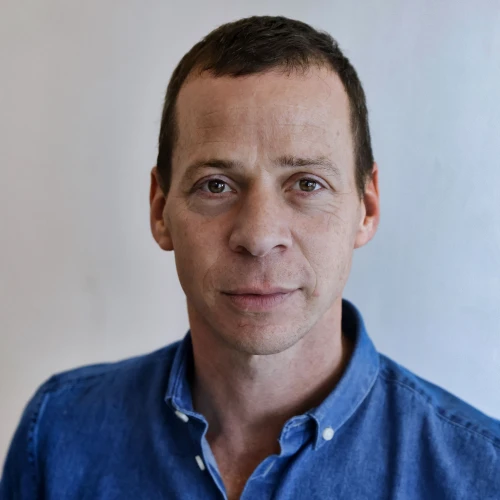
“I was put on a path not knowing where it would take me, and it said walk,” said S. Fitzgerald (“Fitz”) Haney.
And so he did.
The 57-year-old Tennessee-born African-American businessman turned diplomat and “Dancing with the Stars” finalist is not your typical American-Israeli envoy.
But then again, Haney’s life story—from a religious Catholic to a practicing Jew who journeyed from the Volunteer State to Ra’anana via Puerto Rico and Mexico City—is anything but ordinary.
“It is an act of faith,” he said.
‘A little bit different’
Born in Nashville to a devout Catholic family, Haney moved to Illinois, where he grew up outside of Chicago “a little different,” as the only African American in his school in the western suburb of Naperville.
His first connection to Judaism was a Friday-night dinner hosted by a Belgian Jewish family; there were few minorities in the prosperous Midwestern suburb back in the 1970s.
“I was always in the milieu of being the other, and having to thrive being the other,” he recounted in an interview with JNS in Tel Aviv.
Raised Catholic, Haney’s mother coaxed him to attend the prestigious Andover boarding school over the summers during high school, and he went on to study at Georgetown in part because it was a Jesuit school. He studied International Relations and Business at Georgetown.
He had learned Spanish in high school and spent time in Barcelona, realizing that he was “going to do something international” his whole life.
After college, he accepted an offer from Procter & Gamble in Puerto Rico, choosing the beach and sun San Juan offered over an offer to work out of Cincinnati, which, he said, he knew was not for him after landing at the airport for a visit. He later moved on to Mexico for work with PepsiCo and Citibank, doing strategy, branding and acquisitions.
Search for faith in Mexico
It was an urge to reconnect with his faith while in Latin America, where he had grown more secular, that led him to Judaism.
“Ironically, though there was a church on every corner, I couldn’t find a community,” he said. “It would be like not connecting with Judaism while in Israel.”
Haney called a Jewish friend and bewildered him by saying he was interested from an intellectual standpoint in learning about Judaism.
“I grew up knowing the New Testament very well and the stories of the Old Testament,” he said. “I knew the history but not my history.”
Haney’s Jewish friend connected him with an assistant rabbi at an Orthodox synagogue in Mexico City who, after receiving clearance from the country’s chief rabbi (“there’s a black guy in my office asking to learn about Judaism” the assistant told the chief rabbi in Yiddish on the phone, which Haley followed because he understood German), agreed to learn with him.
“So are you dating someone?” the assistant rabbi asked Haney when they began studying. “No, are you my mother now?” the exasperated young financier responded.
After a year of studying Jewish philosophy and practice, Haney felt a deep connection and told the assistant rabbi how he felt.
“I was looking to get back to my Catholicism and getting back to my birth religion, and then this happened,” he said.
The assistant rabbi told him that the feeling had to come from him and that he had a Jewish soul that had been awakened.
Study in Israel
“If I’m going to be Jewish, I have to go to Israel,” Haney decided.
A Jewish friend from Chicago advised him to convert before his trip to ease the bureaucracy, so he went to the only Chicago synagogue he knew—Anshei Emet—where he was stunned to see men and women sitting together in the Conservative congregation; his only experience had been with an Orthodox synagogue in Mexico.
He underwent a Conservative Jewish conversion, with the support of his mother, who, unbeknownst to him, had consulted a priest who said it was better to be a good Jew than a bad Catholic. (“He was unusual,” Haney quipped.)
The successful young financier then dumbfounded his manager at Citibank Mexico when he told them he wanted to take a year off to go to Israel. But the manager, a devout Catholic who had spent a year in Israel himself in his youth, supported his request and got special approval from the New York office.
Landing in the Negev city of Arad on a Jewish Agency program, Haney was often mistaken for a Black Hebrew, especially when he said he was from Chicago (“interesting community but not mine,” he would respond) and then for an Ethiopian when in Jerusalem.
On a weekend in Jerusalem, where he joined a visiting delegation from Anshei Emet at the city’s David Citadel Hotel, he was scouted by John Medved while on the treadmill in the hotel gym. Medved offered him a job with his company, Israel Seed Partners, which Haney was originally determined not to take since he was sure he was returning to Citibank in New York. But he eventually accepted the offer.
“I firmly believe that you meet the people that are put in life for a reason,” he said.
One of those people would be his Arad friend and future wife, Andrea, a Canadian who grew up in America, who was studying to be a Conservative rabbi and with whom he played backgammon for a year and observed Shabbat while their secular friends went to clubs on Friday nights.
After Haney underwent an Orthodox conversion in Israel, the couple were married and then stunned Interior Ministry officials by immigrating in the midst of a Palestinian wave of violence in the 2000s.
To the United States and back, and then to Costa Rica
The couple then spent a decade back in the United States, having returned there after Haney’s mother—who would frequently visit them in Israel—fell ill.
Haney, his wife and four kids returned to Israel when he was appointed U.S. Ambassador to Costa Rica by President Barack Obama, whom he had fundraised for. Haney was the only political ambassadorial appointee kept in his position by U.S. President Donald Trump during his first term.
After a two-year stint followed by a cooling-off period during which he came in second on “Dancing with the Stars,” Haney was back in Israel working in the financial industry.
Right place, right time
Last September, he was asked to join the managerial team at The Genesis Prize as Latin American director after Argentinian President Javier Milei, who was awarded the prize, decided to contribute it toward the formation of the Isaac Accords to further cooperation with Israel and to fight antisemitism in Latin America, in the spirit of the landmark Abraham Accords.
“Sometimes, you are put in the right place at the right time,” he said. His wife coaxed him to take the position that was his “Esther moment for the Jewish people,” he added. “I walked down the path and just went.”
An American cousin asked him if he would have believed years ago that a black boy from Tennessee would end up where he is today.
“No, I would never have written this story,” he said, “but I have been privileged and fortunate to live it.”