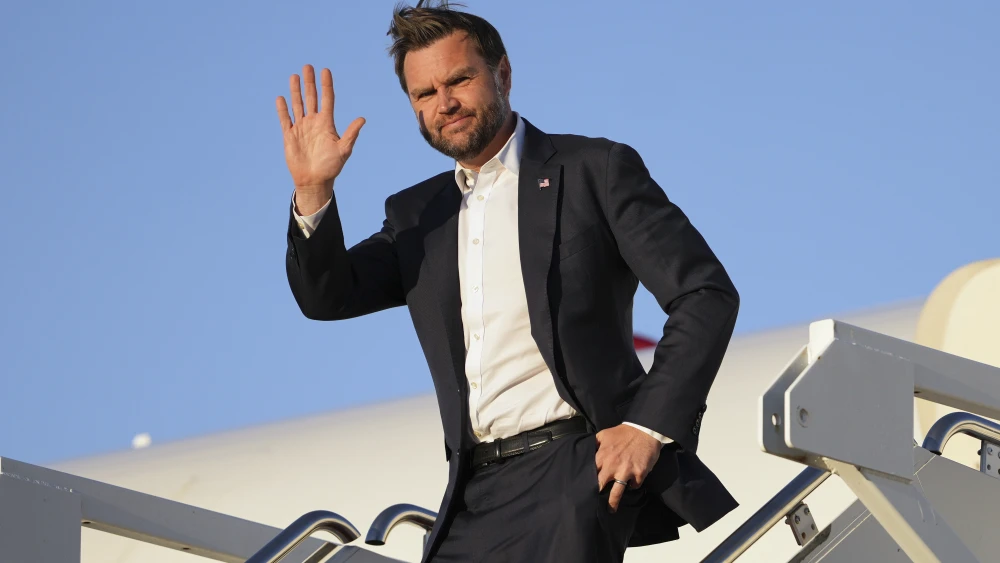
U.S. Vice President JD Vance said in an interview that aired on Tuesday that America cannot allow its Middle East foreign policy to be “subservient” to the State of Israel.
Speaking on the “All-In Podcast,” Vance compared Washington’s relationship with Jerusalem to U.S. President Donald Trump’s approach to America’s “important partnerships” with NATO countries. “That doesn’t mean that we’re going to completely make our European foreign policy subservient to NATO,” he said.
“We’re going to work with people when we work with them. We’re going to disagree when we disagree. And we’re going to pursue America’s interest,” he continued. “That’s the only way to have a rational foreign policy.”
The Jewish state “has been an important partner when it comes to military technology, when it comes to intelligence sharing,” he said, but “the United States doesn’t always agree with Israel.”
Trump, more than “any president in the last 40 years,” he continued, has shown that he is willing to break with Israeli Prime Minister Benjamin Netanyahu.
“Rooting this relationship like all relationships in America’s interest is the way to actually have a rational conversation here,” Vance said.
That, he continued, “allows us to rationally focus and force ourselves to have a conversation about when something that maybe sounded good or maybe has become a cliche or a slogan for the past 20 or 30 years,” adding, “Well, maybe we have to do something different now.”
Vance also said in the interview that an American pullback from the Middle East would cause a worldwide energy crisis as long as Iran keeps attacking shipping.
While Trump returned to office wanting to keep the United States “out of foreign entanglements,” he was also “committed to Iran not having a nuclear weapon,” he said.
“Wanting to keep the United States out of foreign entanglements does not mean that you can never use the military in order to accomplish the American people’s objectives,” he added.
The alternative to Trump’s approach is that “the United States effectively says to the Middle East: you’re on your own,” he said.
That would mean an energy crisis “so long as the Iranians keep on shooting at shipping, which we know that’s exactly what they would do,” the vice president said, adding that the attacks have continued “even in the midst of peace negotiations.”
“So, I think the president is taking the responsible course of action. He’s protecting America’s assets in the region while also ensuring that world energy markets continue to get a supply of oil and natural gas” despite “Iranian terrorism,” he continued.
The United States had achieved “a substantial destruction, not just of their nuclear program, but also of the Iranian conventional military,” according to Vance.