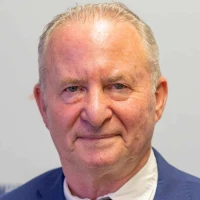
According to Michael Fertik, a pioneer in digital reputation management, the Israeli tech scene has matured into one of the world’s most dynamic—and, despite regional challenges, now is the right time to invest in the Jewish state.
“The internet is a wonderful tool, but it also has a long memory,” Fertik told JNS during his recent visit to Israel, his eighth since Oct. 7, 2023, in a studio interview on Oct 30. “People deserve second chances—and so do countries. Israel’s reputation as a tech powerhouse remains strong, but I believe its next chapter will be written by those who are willing to invest now, not later.”
Fertik, 46, a Jewish American internet entrepreneur and privacy advocate, is the CEO of Modelcode.ai and founder of Heroic Ventures, a Silicon Valley-based venture capital firm. A serial entrepreneur and early-stage investor, his portfolio includes several Israeli unicorns, and this year, he deepened his connection to Israel by opening Modelcode Chai, the Tel Aviv office of Modelcode.ai and his first Israeli subsidiary.
“It felt like a natural next step,” he said. “Israel’s ecosystem is brimming with talent, creativity and determination. Modelcode Chai represents my belief that the future of artificial intelligence—and of technology more broadly—runs straight through Tel Aviv.”
Fertik, who considers himself a fervent Zionist, also spoke passionately about the responsibility of American Jews to stand up for Israel and speak out against the surge in antisemitism.
“Silence is complicity,” he said. “If Jewish Americans don’t stand up for themselves and for Israel, they can’t expect others to do it for them.” Fertik emphasized that the Jewish community has long contributed to American civic life and must continue to do so “with confidence and courage.”
He argued that the rise in antisemitic rhetoric on campuses and in public discourse should not intimidate, but instead galvanize Jewish voices across generations.
Fertik linked this message to the upcoming New York City elections, urging Jewish voters to engage actively in the political process and support candidates who “draw a clear moral line” against hatred and extremism.
“New York has always been a moral bellwether,” he said. “How its voters respond to antisemitism will send a message far beyond the city’s borders. This is a moment to choose clarity over cowardice.” He added that combating antisemitism should not be a partisan issue but “a shared cause for anyone who values decency and democracy.”
Fertik is best known for Reputation.com, the company he launched in 2006 that pioneered the field of online reputation management. Based in Redwood City, California, it helps individuals and businesses improve their digital presence, take down defamatory content and promote accurate and positive information in search results.
During his latest visit to Israel, Fertik met with Israeli venture capitalists, startup founders and government officials to explore opportunities for deeper collaboration between Silicon Valley and Israel’s innovation sector. Despite the war in Gaza and global uncertainty, he said, Israel’s entrepreneurial resilience remains “unmatched.”
“Some investors see risk,” he said. “I see courage. Israel has been through harder times and always emerged stronger. The combination of world-class talent, intellectual intensity and a culture that thrives on problem-solving makes it one of the best places in the world to build technology with global impact.”
The Harvard-educated entrepreneur, who also taught cyberlaw and internet privacy at Harvard, has long advocated for what he calls “ethical innovation.” His career has been defined by a dual commitment to technological advancement and moral responsibility.
As a pioneer in online privacy and digital rights, Fertik has warned for years about the dangers of “surveillance capitalism”—companies profiting from users’ personal data without consent. He believes Israel, given its unique understanding of security, can be a global leader in building responsible AI and data governance frameworks.
“This is a country that knows how to balance innovation with vigilance,” he said. “If Israel can set the standard for ethical AI—protecting privacy while pushing the boundaries of what’s possible—it won’t just lead economically, it will lead ethically.”
Fertik’s decision to establish Modelcode Chai in Tel Aviv, he said, was driven by the talent pool. “There’s a level of technical sophistication and creative problem-solving here that’s hard to find anywhere else,” he noted. “We’re building a team that reflects the same spirit that built the Israeli tech miracle—ambitious, bold, and mission-driven.”
Modelcode.ai, his current venture, develops AI-driven tools designed to make large-scale computation more efficient and interpretable. Fertik envisions AI as a force that should empower human creativity, not replace it. “Artificial intelligence should enhance human potential,” he said. “That’s a value Israel understands deeply.”
During his visit, Fertik met with founders from startups in AI-driven healthcare, cybersecurity and green technology. Many of them, he noted, are continuing to innovate despite wartime conditions. “These are entrepreneurs who show up to work even as sirens sound,” he said. “That’s a kind of determination you can’t teach.”
He also stressed the importance of Diaspora engagement, encouraging investors to “look beyond the headlines.” “It’s easy to be discouraged by what you see in the news,” he said. “But if you spend time here, you see something different—you see creativity, optimism and grit.”
Asked whether his public support for Israel might raise eyebrows in Silicon Valley, Fertik smiled. “It’s always easier to criticize than to build,” he said. “I’m interested in building. If you care about democracy, human rights and progress, this is a country worth supporting.”
Fertik said his time in Israel reaffirmed his belief that the country remains a vital partner in shaping the world’s technological future. “Investing here isn’t just about returns—it’s about resilience,” he said. “When I look at Israel, I see a nation that keeps transforming tragedy into tenacity, conflict into creativity.”
As he prepared to return home to the United States, Fertik reflected on the decision to open his first Israeli subsidiary. “This isn’t a symbolic gesture,” he said. “It’s a commitment. Modelcode Chai is here to stay—and to grow alongside the incredible talent that makes Israel what it is.”
For Fertik, who has a massive following on social media, the message is clear: “Now is not the time to hesitate. Now is the time to invest.”