


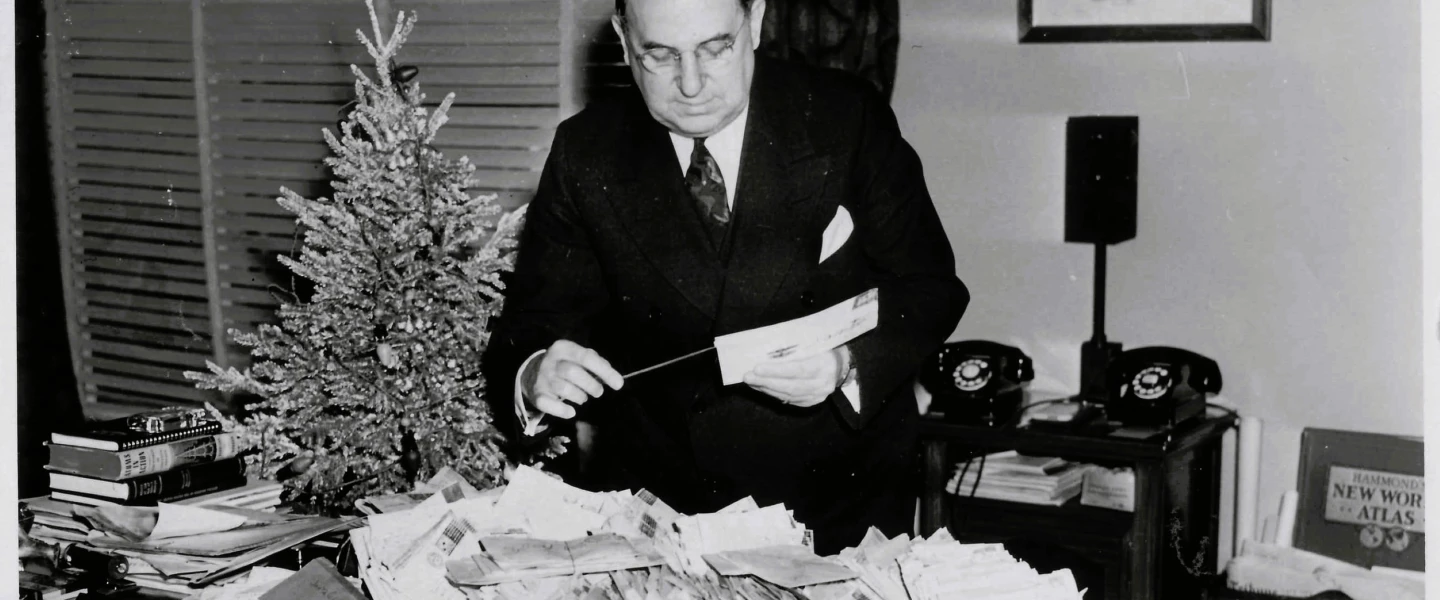
The U.S. Postal Service has a term for when the independent federal agency cannot sort or deliver a piece of mail due to an incorrect, illegible or insufficient address: a “nixie.” The same term could apply to Albert Goldman, the Jewish New York postmaster in the 1930s and 1940s, who in many ways foreshadowed social-media “influencers” of today and, in other ways, particularly his personal faith and motivations, proved to be ANK, “address not known.”
The day after Goldman died on May 5, 1967, The New York Times reminded readers that it called the late postmaster “most friendly, helpful and accommodating” when he retired in 1952, after more than 25 years in public office. “No worthy cause in this city has ever had to ring twice to enlist the enthusiastic support of Albert Goldman,” it added.
The Times recorded that Goldman, a “baldish, stout man, talkative, cheerful and energetic” who died at 84 of a stroke after a two-month illness, was most proud of supervising “4,000 Army and Navy postal units at home and abroad in World War II.” That corresponded with “the largest wartime mail volume handled anywhere” and earned him a Medal of Merit, the Times said.
The only hint the newspaper gave of the postmaster’s faith was noting that he was a founder of Yeshiva University’s Albert Einstein Medical College—now distinct from the university—and director of the Hebrew Home for the Aged. It also neglected to mention something upon which it had reported extensively: his role in expanding the postal service’s “Operation Santa” and shaping what remains a lively program nearly 100 years later.
As the Times put it in December 1947, Goldman was the “father of the Santa Claus fund.” TIME recorded in 1941 that Goldman was “official opener of letters-to-Santa Claus.” (One letter Goldman read that year, per the magazine, said: “You better bring all this stuff, or I’ll beat you to a pulp.”)
Jews penned many of the holiday’s central songs, including Irving Berlin’s “White Christmas” and Mel Tormé’s “Chestnuts Roasting on an Open Fire,” and Morris Propp, founder of M. Propp Company, was one of the first to sell Christmas lights widely. Goldman, who often spoke at churches and interfaith events, joins that tradition of Jews who have made their mark on the holiday.
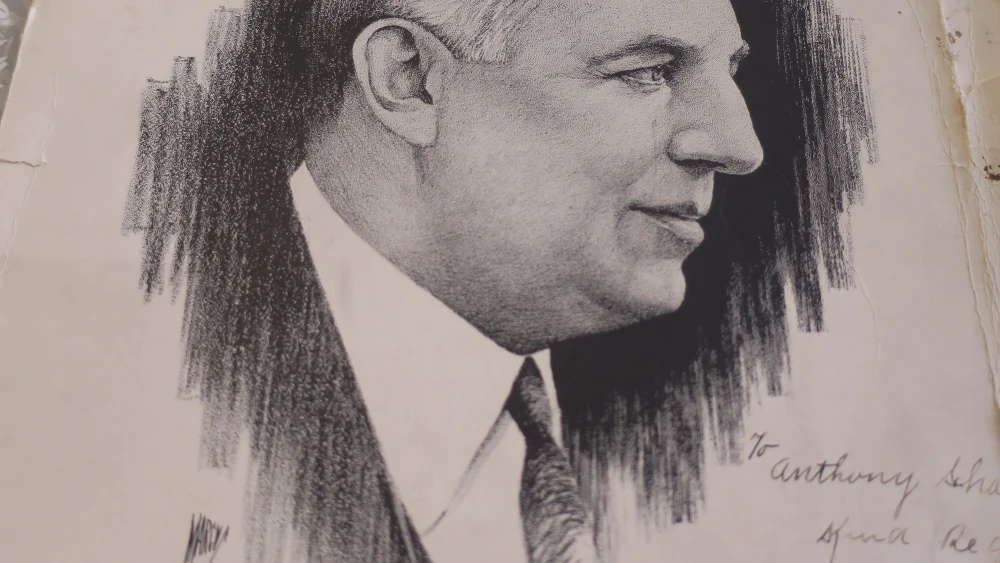
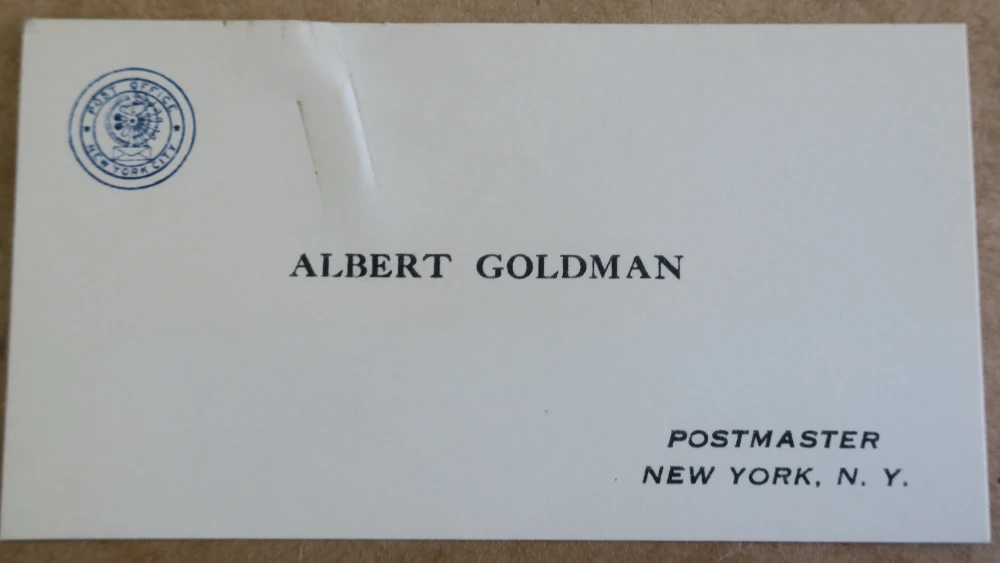
But after poring over more than 500 news stories, photo captions and advertisements in secular publications and in Yiddish and English Jewish ones to try to understand Goldman, his work and his Jewish identity, and after meeting for about an hour and a half with historians at the U.S. Postal Service’s sprawling headquarters in L’Enfant Plaza in Washington and thumbing through hundreds of photographs and documents from the USPS archives about Goldman, JNS came away with the distinct impression that this was a very public man, who remained fiercely private.
Although JNS followed a paper trail of hundreds of instances in which Goldman spoke at official New York and Jewish events, on the radio and to newspaper reporters, and a larger number of times he arranged to have himself photographed with celebrities and others, who Goldman was as a man—what he believed, what he felt deep down, how he grew up—appears to have been, to use a phrase, lost in the mail.
It took hours for JNS to establish, for example, that the son of two Russian immigrants who came to America as adults appeared to understand Yiddish.
As Goldman made an appeal for national defense bonds in June 1941 at the home of Bernard Bergman, a newspaper editor who was the Orthodox rabbi of the Lower East Side nursing home Home of the Sons and Daughters of Israel—and who was later convicted of Medicaid fraud—the Times reported that Tobias Wildstein, 109, led others to the front of the room with a “jingle of coins from pockets and handkerchiefs.”
“His voice steady and low, he told the postmaster in Yiddish: ‘I hope these few cents will build fortresses for our country, and I hope the postmaster will live to be as old as I am,’” the Times reported. “I hope while we are preparing for defense the guns will not reach our shores.” The paper added that Wildstein had earned the $18.75—$414.29 as of September, per the U.S. Bureau of Labor Statistics—that he donated by teaching boys for their bar mitzvahs.
“Mr. Goldman explained that there were no safer investments than defense bonds and stamps and that they paid a return of 2.9%. The money, he added, would go toward building ships and buying ammunition for the ‘protection of your life and my life and the country from possible invasion,’” the paper reported.
“‘This is the first time in all my endeavors for Jewish charities here and in Palestine,’ he said, ‘that I have appeared before any group of people where we should be giving out bonds to help in your welfare, rather than appealing to you for bonds for the safety of the world,’” it added.
In his many hundreds of press appearances, Goldman stood out to JNS in two other instances—rare stories where his voice comes through in quotes, both about the First Amendment.
The Times reported on Dec. 2, 1936, that Goldman presented an award from B’nai B’rith International’s Brooklyn lodge to the Brooklyn Eagle the prior night for being the New York City paper that had best promoted “interracial amity and comity as well as goodwill among the people of the United States.” According to the paper, the Jewish postmaster noted that the 2 million Jews in New York City “was due principally to bigotry and oppression in other countries.”
“‘This gathering assembled here tonight,’ he said, ‘is for the purpose of paying tribute to one of the great mediums through which educational work in tolerance and goodwill is being carried on.’” Goldman added, per the Times, that the “outstanding” paper, founded in 1841, “has had a long and honorable career dating back to before the memory of any person here present in this audience.”
“We regard the liberty of the press as one of the cornerstones of our national existence, and this liberty is indeed true of the great publication which is being honored here tonight,” he said.
Some two and a half years later, Goldman spoke with Sen. James Mead (D-N.Y.) in March 1939 at the first annual communion breakfast of the St. George Association of the New York postal employees at the Hotel Astor, which drew some 1,000 Protestant members.
Goldman “predicted a secure future for the country because ‘the real backbone of our system of government is provided by those who believe and live up to the truths of religion,’” the Times reported.
“Praising the Protestants for following the example of the Catholics and the Jews in forming societies in the postal service, he asserted that with such efforts by all creeds, ‘the obnoxious head of foreign ‘isms’ cannot rise in our group,’” the paper recorded. “‘Through organizations such as this we can accomplish much good,’ Mr. Goldman said. ‘We should be happy and deeply grateful that we live under the Stars and Stripes where religious freedom is guaranteed and our manner of worshiping God is not subject to the whim of any dictator or minority group temporarily in control.’”
Goldman “urged all postal employees to join their respective religious organizations, adding that they would then be ‘bound to enjoy the respect of their fellow men.’”
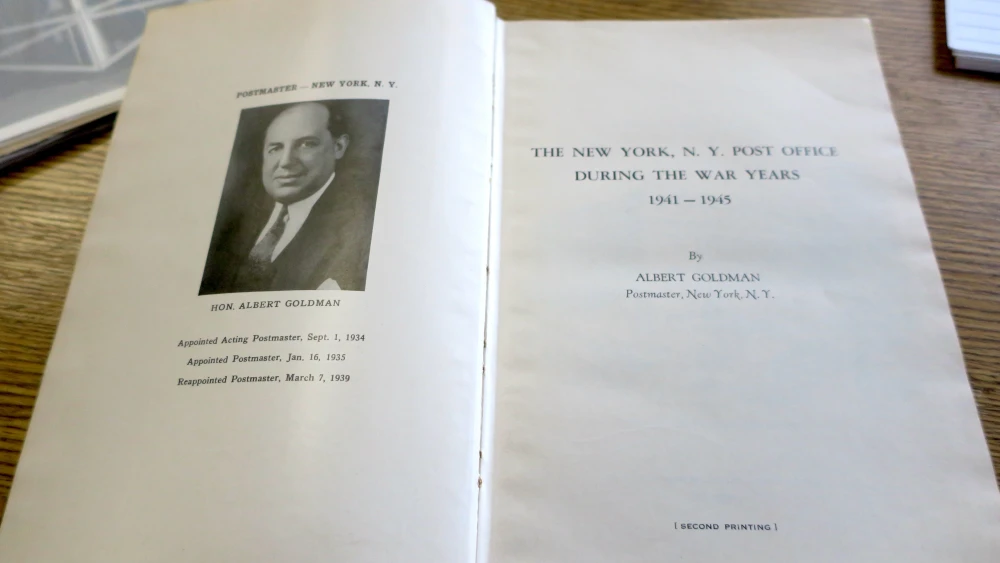
These snippets of Goldman’s views on religion and the press were exceedingly rare window envelopes that offered glimpses of what the Jewish postmaster thought—far more than in the nearly 430 pages of Goldman’s 1949 book, The New York, N.Y. Post Office During the War Years: 1941-1945, which JNS viewed.
In the book, which contains many charts, financial figures and those of mail weight and inside-baseball operations of the post office, Goldman, and a few other writers who are included, wax poetic on rare occasions, as when referring to registered mail as “the principal artery through which flows much of the economic lifeblood of the nation.” Or when referring to scales, that had been from “Anzio to Tripoli, London, Paris, and finally, the Nazi stronghold Berlin,” that “undoubtedly have had amazing and horrifying stories to relate if only they could have spoken.”
At one point, the book refers nonchalantly to “a piece of shrapnel removed from the body of the sender,” “Nazi flags, decorations and helmets” and “pistols (sometimes loaded)” that fell out and needed repackaging. “On one occasion, a trusting G.I. placed a bottle of Scotch in a frail cardboard box, and when the sack containing this package arrived, it contained the odor, some stains and the broken bottle.” It turned out that the other parcels in the sack “had absorbed most of the Scotch.”
The book refers to “services of thankful prayer” attended at the post office, “and many a tear of happiness was shed” on May 8, 1945, when World War II ended. What, if anything, the references to the Nazis and to the thankful prayer might have meant in particular to Goldman as a Jewish man, or, for that matter, if he lost family in the Holocaust, remains unclear.

‘Very into publicizing’
JNS spoke at length at USPS headquarters with June Brandt, senior research analyst in postal history, and Stephen Kochersperger, USPS historian. Brandt was the officer in charge, like an acting postmaster, in Wrightsville, Pa., and Kochersperger is a former postmaster of Julian, Pa., of 25 years.
Per the USPS website, Kochersperger is “a distant cousin of John Wanamaker, the 35th postmaster general, and is related to Charles Kochersperger, the defendant in an 1860 court case that led to the development of the Private Express Statutes, which guarantee the Postal Service’s exclusive right to carry letters for compensation.”
Kochersperger told JNS that Goldman’s public role “in a post office of that size would have probably been as much a part of his job as actually running the post office.”
“He would have had underlings to do the day-to-day post office operations,” he said. “He was supposed to be the public face of the post office.”
The historian said that Goldman, who was acting postmaster starting on Sept. 1, 1934, and postmaster from Jan. 16, 1935, until his retirement in 1952, “knew how to use the media.”
“I don’t know if you ever saw the famous movie ‘Miracle on 34th Street.’ I’m certain that that would not have happened but for Albert Goldman—the fact that the Postal Service was incorporated into that film to such a large extent,” he said.
JNS asked if Goldman’s PR acumen might have helped him land the job in the first place. Kochersperger said he wasn’t sure, but even if it did, “he took it to a whole other level.”
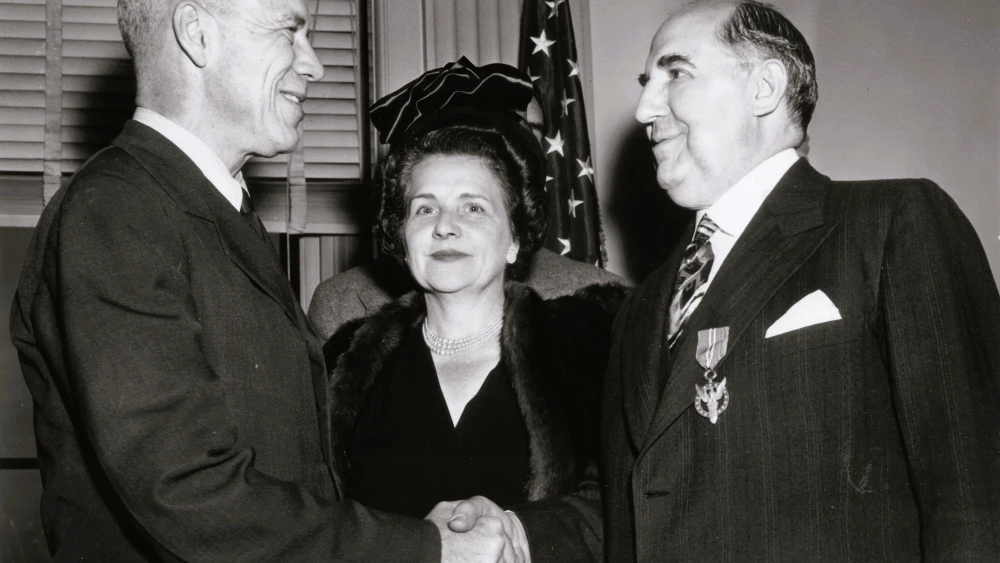
“Look how the media changed over that period of time. Radio was pretty young. There was no television. Movies were the thing, and he embraced it,” he said.
Kochersperger told JNS that Goldman had enormous mailbox-shaped temporary postal stations set up in busy places around the city. The stations, which might be 20 feet tall, had clerks inside who sold stamps, mailed packages and did “whatever you needed to do at the post office.”
“I’m sure that was his invention,” he said of Goldman.
Brandt told JNS that Goldman was very involved in a lot of New York charities. “You have to remember New York City coming out of Tammany Hall, it was all of the old Irish boys for years and years, so he was kind of breaking a glass ceiling to get into there,” she said.
The Times obituary for Goldman states that after he was a $6-a-week messenger boy for New York Edison Company’s Bronx office, he worked his way up quickly at the company over 24 years, taking charge of the company’s Bronx operation.
James “Jimmy” Walker, the New York City mayor, named Goldman New York City plant and structures commissioner in 1925, and Goldman “had a hand in building the Triborough Bridge and Holland Tunnel,” was “responsible also for opening the upper-deck roadway on the Queensboro Bridge” and removed Fifth Avenue’s “traffic towers” and “installed most of the city’s traffic lights,” per the Times.
“In 1933, he was ousted in a Tammany Hall reprisal for supporting the unsuccessful mayoral campaign of Joseph V. McKee. But President Franklin D. Roosevelt named him postmaster the next year,” the Times reported.
According to an article in the Times on Dec. 25, 1925, the Bronx Democratic organization backed Goldman; however, “Walker’s consideration of him as head of the Department of Plant and Structures, where he has said he believed a man of great executive ability and special knowledge was required, was said to have been based much more on Mr. Goldman’s qualifications than on politics.”
In what appeared to be a syndicated “Highlights of New York” column that appeared in the Chronicle-Spokesman on Aug. 24, 1934, as well as in American Jewish World, Martha Newmark noted that “during last year’s political chaos in Manhattan, Goldman chose to defy Tammany Hall, which had previously named him commissioner of plants and structures, and placed his hopes with Jim Farley’s protege, Joseph V. McKee. The latter lost, but not the friends who supported him.” (The postmaster general under FDR, Farley was also chairman of the Democratic National Committee.)
“The destinies of one of the world’s greatest post offices will rest, within a few days, in the chubby hands of a stoutish, earnest, good-humored diplomat named Albert Goldman,” Newmark wrote. “Goldman reaches a post never before attained by a Jew in New York, despite the fact that possibly the largest percentage of letters going out of the 33rd Street general office is the handiwork of Jewish correspondents.”
She added that Goldman, who went from “messenger boy to chief mailman,” is the “Alger story of a man who has won his latest office, because he repudiated the associates who first brought him political fame.” (Horatio Alger wrote stories of boys going from rags to riches.)
“Confining his philanthropic and community activities largely to the Bronx, where a bulky segment of New York Jewry is housed, Goldman became noted for his personal participation in those causes which interested him,” she wrote in the 1934 article. “He differed from most of the other Jewish politicians by refusing to lend his name to an activity unless he himself had some genuine share in it. Once having accepted the leadership of a cause, he could be relied upon to give energy, time and ideas.”
Brandt told JNS that “Operation Santa” was “a big deal.”
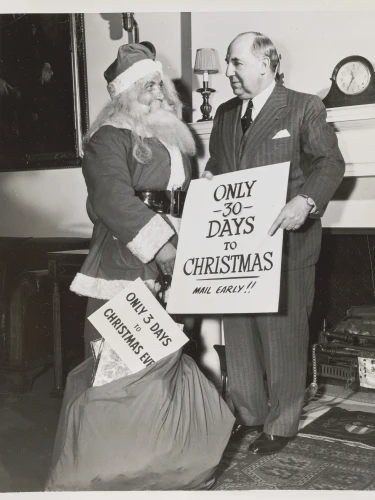
There had been a U.S. Postal Service program since 1912, when people could respond to letters addressed to Santa. Goldman expanded the program to include charitable organizations and corporations, which he encouraged to provide written responses and small toys to needy children.
“I think a lot of that was Goldman,” she told JNS.
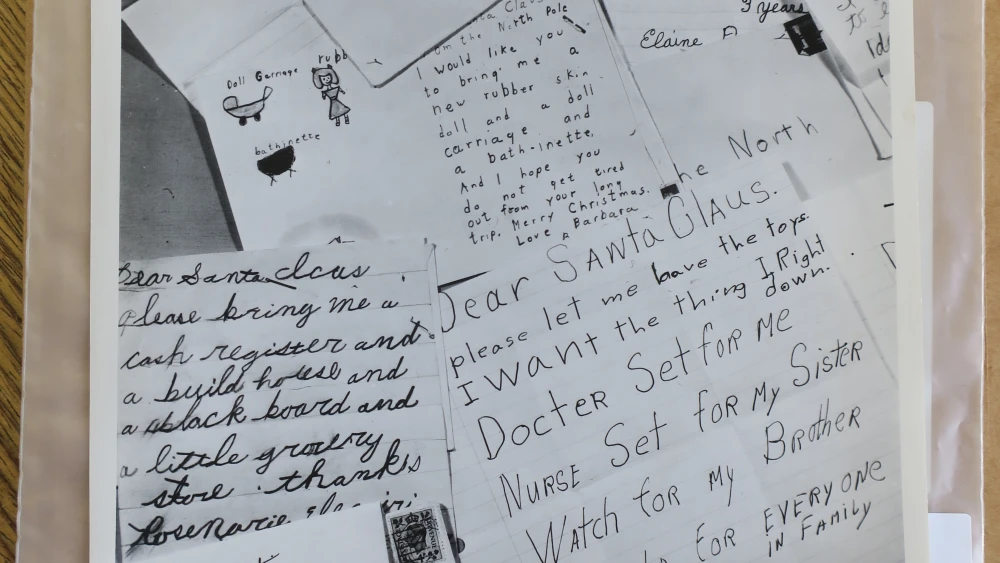
The Jewish postmaster also held big annual tree lightings in New York City and did lobby displays in the post office. “He went nuts with them,” she said.
“He always liked PR opportunities,” Brandt said. “He was very into publicizing.”
JNS thumbed through dozens and dozens of photos Brandt had pulled from the USPS archives, showing Goldman posing with actors and other celebrities. “This whole folder is him doing PR,” she said, handing a stack to JNS.
Kochersperger noted that Goldman was involved in a lot of parades. “I never saw him leading a parade,” he said. Brandt held up a photo of Goldman doing just that. “Well, here,” she said.
Of the displays in the post office lobby in New York, Kochersperger said that Goldman “must have been on good terms with the sign painter.” He added that the postmaster “knew where to put it where nobody would miss it.”
Brandt showed JNS dozens of photos of Goldman posing with people dressed as Santa. “Santa letters were his big thing,” she said.
“Do we have any of him dressed up as Santa?” Kochersperger asked. “No,” Brandt said. “We don’t have any of him dressed up as Santa.”
“There was never a photo op he didn’t like,” she added.
“He had his fingers in everything,” Kochersperger said. “You can see how brilliant he was, really. He was brilliant.” He added, of Goldman, that “we were lucky to have him.”
Brandt agreed that Goldman was brilliant. “His focus was to make the New York City post office relevant and well known,” she told JNS. “Some of the files you go through, the earlier files, he did radio campaigns, he got department stores to mail things early.”
Kochersperger said that they unearthed a newspaper headline that began, “Jew postmaster … ” Brandt said they couldn’t find it anymore. (JNS also couldn’t find it.)
“It looks like a very Jewish neighborhood he was living in, just judging by the names of the neighbors,” Kochersperger said of the Bronx neighborhood where Goldman lived.
Indeed, U.S. and New York Census forms reveal a good deal about Goldman and his neighbors, but there, too, was a need to send what the U.S. Postal Service would call a “mystery shopper” to make sense of the former postmaster.

Making sense of censuses
The April 13, 1937 issue of the Yiddish Forverts (Forward) is one of many issues of a Jewish paper to report on an Albert Goldman, who, after studying to be a Reform rabbi, became Leon Trotsky’s lawyer. On May 24, 1960, the Times recorded that Goldman, “former legal adviser to Leon Trotsky,” died at 63 of cancer the day before in Chicago.
“Mr. Goldman gained an international reputation in the early 1920s as a defender of Communists arrested in the United States, but became strongly anti-Communist after Stalin drove Trotsky from Russia and after a trip to Russia in the 30s,” the Times reported. “He became Trotsky’s general counsel and friend when the exiled Russian leader went to Mexico City to live in 1937.”
After that, Goldman was disbarred “automatically” in 1944, the Illinois Supreme Court reinstated him to the state bar in 1956 “after he said he had long since renounced his communistic ideas,” per the Times.
Another Albert Goldman, who died in 1957, shows up often in the Jewish press in Rochester, N.Y., and another who made a lot of news lived in Los Angeles.
When others by the same name are sorted out, the Jewish postmaster surfaces hundreds of times, often in photos shaking hands with people or holding checks. An ardent Zionist, Goldman was very involved in causes on behalf of British Mandatory Palestine and the Jewish state.
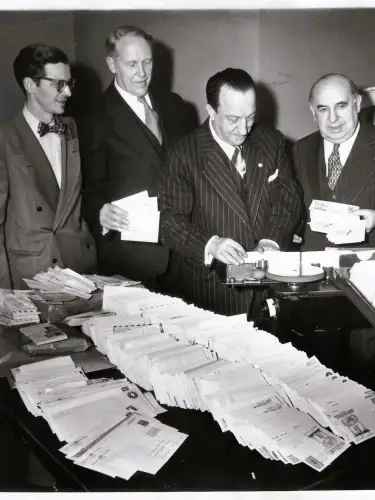
On March 4, 1949, the American Jewish World wrote that he chaired the Zionist Organization of America’s “friendship train” to “help ease the food shortage in Israel.”
A little more than four months later, the same publication reported on July 11 that the postmaster won a bronze plaque from Agudath Israel Youth Council of America in New York City for “his aid in rehabilitating newly-arrived orphaned Jewish children from Europe at Camp Agudah, Highmount, N.Y., the organization’s summer camp.”
Delineating his biography is confounding. Whether acting on a scoop that wasn’t repeated in other publications or creating the news, the Forverts reported in Yiddish on May 7, 1967, that Goldman was “born into poverty” and underwent hardship growing up on the Lower East Side. (His annual salary of $12,000 in 1934, when he became acting New York postman, would be about $295,272.73 in September 2025, per the U.S. Bureau of Labor Statistics.)
In her 1934 column, Martha Newmark wrote that Goldman “differs from most of New York’s Jewish politicians by not being a lawyer or a college graduate.”
“He worked his way up in the ranks as a lay expert in the affairs of New York’s electric light and power combine,” she wrote. “Slightly ponderous in speech, he has sufficient poise not to inflict long speeches on his listeners. He’ll probably be very happy in his new post, for postmasters are never regarded as good after-dinner bait. But one never can tell about New York’s Jews.”
Goldman showed up at age 47 in the 1930 Census, and was listed as having a radio set at home, being single and not having attended college after Sept. 1, 1929. A Selective Service System Form 1 registration card, serial number 2075, for Albert Goldman that JNS viewed identified him as the N.Y. postmaster, 59, living at 1000 Grand Concourse in the Bronx, and having been born in New York on July 16, 1882. A Mrs. Albert Goldman was listed.
In April 1930, he was listed as head of his family and renting, for $100 monthly, in the Concourse Plaza Hotel in the Bronx. (Per the U.S. Bureau of Labor Statistics, that sum in April 1930 was equal to $1,910.59 this past September.)
According to the census enumerator, Goldman, who was listed as “commissioner” in the industry “Plants and Structures,” could read and write and was born in New York to two Russian parents. Official biographies for the postmaster note that he was previously commissioner of the New York City Department of Plant and Structures.
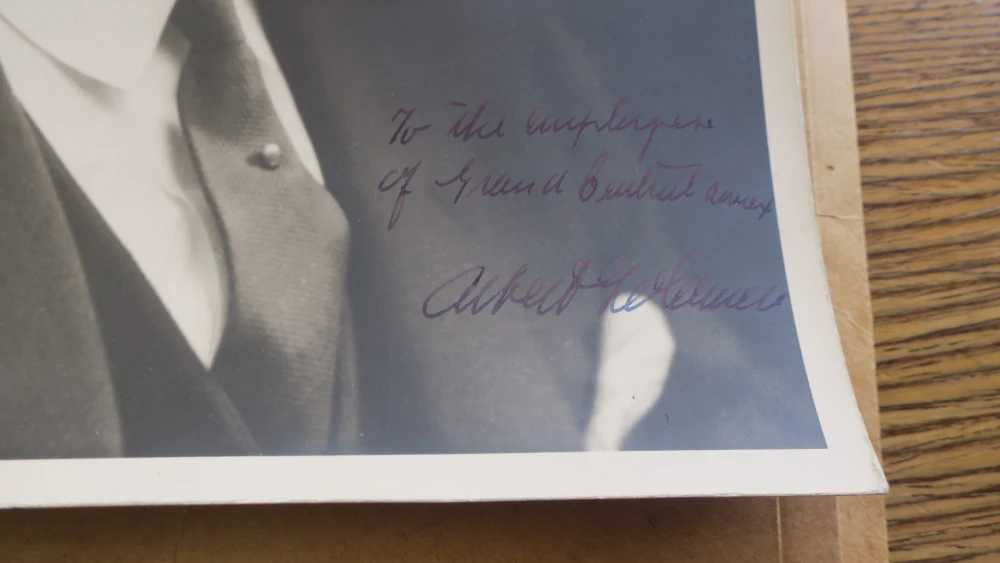
Goldman shows up somewhat unevenly in other documents.
In the 1900 Census, an Albert Goldman with two Russian parents—Frank Goldman, 53, and Theresa Goldman, 53—was listed as 19, having been born in July 1881. The parents were born in July and November of 1847, respectively. Frank arrived in the country in 1864, and Theresa in 1868. They had been married, at the time, for 39 years, and Theresa had nine living children of 12.
Per the 1900 Census, five children were living with Frank, a glassware dealer, and Theresa: Hyman Goldman, 20, who had something to do with a school (the enumerator’s penmanship is impressionistic); Harriet Goldman, 24, a teacher; Ross Goldman, also 24, perhaps working in military clothing; William Goldman, 28, with no profession listed; and Rachel Goldman, 29, a teacher.
Albert was listed with the same profession as Ross, perhaps military clothing. The family also employed a “servant,” Annie Sabutchy, 19, of Hungary, who immigrated in 1899.
A decade later, a 26-year-old Albert Goldman surfaced as an electrician. Although his age doesn’t fit, he was listed as the son of Terese Goldman, 66, whose age also doesn’t fit, and who was widowed after 35 years of marriage. That wouldn’t make sense if Terese was the same person as the 1900 Theresa, who had been married then for 39 years. But like Theresa, this Terese was a Russian native who had nine living children of 12.
Listed as living with her were Herman, 28; Harriette, 24, and a French servant, Caroline Heil, 18. (It would seem unlikely that a Harriet who was 24 in 1900 could remain the same age, and spell her name Harriette, in 1910.)
Herman Goldman was listed as a lawyer practitioner, Harriette as a “p.s. teacher” and Heil as a “general houseservant.” A Herman Goldman, who died on Jan. 24, 1968, is described in a Times obituary as a “tax expert, corporate lawyer and philanthropist and brother of the late Albert Goldman, postmaster of New York.”
The late Herman Goldman died at 87, an age in 1968 that fits with the Herman Goldman who was 28 in 1910. “One of his last donations was to the Hebrew Home for the Aged at Riverdale, the Bronx, where he dedicated a fountain in memory of his brother,” the Times reported. “Mr. Goldman was also a founder of the Albert Einstein College of Medicine and created the Herman Goldman Foundation, through which a contribution in memory of his brother was recently made to the Bronx Lebanon Hospital Center.”
The Times records Herman Goldman’s parents as the “late Frank and Toby Goldman” and notes that “he left no immediate survivors.” Toby, needless to say, is a different name from Theresa or Terese.
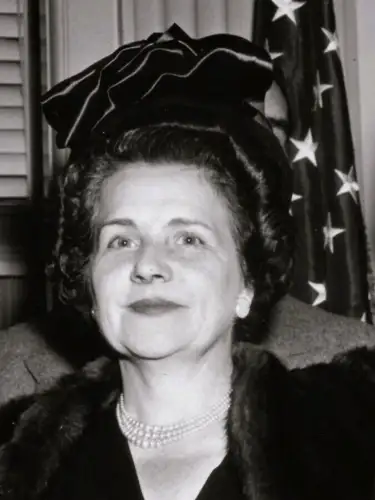
JNS couldn’t find Albert Goldman in the 1920 or 1940 Censuses, and the 1960 Census is not yet publicly available.
A Sept. 14, 1930, marriage license for Albert Goldman, 48, and Edna Murphy, 31, lists his father as Frank and what some databases say is “Anna” for his mother, although the script could read “Theresa.”
Per his birth certificate, Abraham Goldman was born on July 16, 1882, to Frank and Thresa Goldman, née Lovileski. Frank was listed working as a “glazer,” and Thresa had 10 living children out of 12.
In the 1905 New York State Census, Frank, 58, and Theresa, 56, are listed living with their children Herman, 25, a lawyer; Russell, 27, in real estate; Albert, 23, an electrician; Harriet, 24, a teacher; and William, 30, “at home.” Betta Florence, 20, of Russia, is a “servant.”
In 1950, Albert Goldman, 67, was head of a household with his wife, Edna Goldman, 51, who was also born in New York City. She was not seeking employment and worked “keeping house.” He was listed as “postmaster” and a government employee.
When Goldman retired on April 28, 1952, the Times reported that he stated, in part, that “my retirement will enable me to minister more adequately to the needs of Mrs. [Edna] Goldman, who has been ailing for some time past.” (The Times included the square brackets.)
Edna surfaces several times, as Mrs. Goldman, alongside her husband in news articles, although JNS found no newspaper announcement of their marriage or biographical information about her, including whether she was Jewish.
In June 1933 and 1934, Albert, then the plants and structures commissioner, and “Mrs. Goldman” were listed as judges of a kind of beauty and health contest for babies born at the Bronx Maternity and Women’s Hospital, per Times reporting. The Times reported on April 4, 1932, that the couple was among those at the bedside of W.F. Deegan, New York City tenement house commissioner, when he died and on Jan. 31, 1941, that the two were guests, with the likes of “Mrs. William Randolph Hearst,” at a party at the Waldorf thrown for President Franklin D. Roosevelt’s birthday.
When the post office honored “its men who fought in the war,” the Times reported on Feb. 25, 1949, that “Mrs. Goldman” pulled on the strings that “removed, simultaneously, the covering from the four curved plaques set in separate recesses in the walls of the rotunda.”
A photograph for sale on an online auction site shows Albert (shirtless) and Edna Goldman on the beach in Swampscott, Mass., with Dr. J. William Morrell and his wife on Aug. 14, 1938. Edna appears to be reading a book, while the other three read the newspaper.
JNS was unable to confirm if the couple had children, among other basic information.
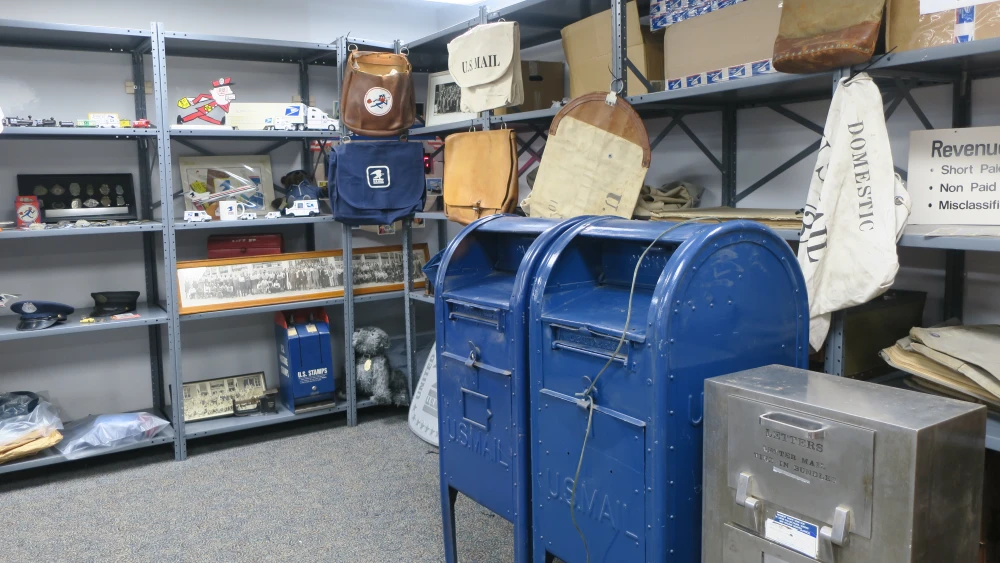
‘All of us can be rightfully proud’
Press coverage and other documentation about Goldman suggest that he was a member of B’nai B’rith International—which the nonprofit told JNS it was unable to verify—of the American Jewish Council and of five synagogues (some now defunct) across denominations: Tremont Temple, Gates of Mercy, Congregation Kehilath Jeshurun, Temple Adath Israel and Jacob Schiff Center.
Goldman reportedly had ties to the United Jewish Appeal and the Joint Distribution Committee, and was often photographed at fundraisers for both.
An unmarked document that JNS viewed at USPS headquarters listed pages of affiliations for Goldman, including chairman of the Bronx division of the Federation for the Support of Jewish Philanthropic Societies—which supported 116 groups in the New York area—secretary and director of Lebanon Hospital, Bronx director of the Young Men’s Hebrew Association and Young Women’s Hebrew Association.
Coverage in Yiddish and English Jewish news publications digitized on the website of the National Library of Israel doesn’t include any profiles of Goldman that explain his thinking and motivations. But certain details stand out.
“Albert Goldman, postmaster of New York City, arrived in Los Angeles Saturday for a short vacation, accompanied by his wife,” the B’nai B’rith Messenger informed on Aug. 11, 1939. “They are at the Ambassador Hotel.”
The Sentinel reported on Sept. 11, 1947, that not only was New York’s postmaster Jewish, but “more than 900 Jews are postal supervisors.” A May 21, 1926, article in the Forverts featured an oddly cropped photo of Goldman, informing that the then plans and structures commissioner is “in charge of the municipal radio station WNYC from where the Forward concerts are broadcasted.”
Goldman’s death received just 49 words of a Jewish Telegraphic Agency obituary on May 19, 1967, in the Indiana Jewish Post and Opinion, and just 102 words from the JTA article a week prior in Detroit Jewish News.
The writer AL D. Goldman, who penned the column “Not for Publication,” responded on Dec. 12, 1946, in the Sentinel to a Milton Goldstock of Long Island, who asked if he was related to the postmaster with the same surname. “If we were, you don’t think we’d allow such stuff as this to go through the mails, do you?” the columnist wrote.
Goldman announced that U.S. postal authorities could accept no more mail destined for occupied France, the Detroit Jewish Chronicle reported on Sept. 19, 1941. “The German occupation authorities suspended postal relations with this country, thus necessitating the American order,” it recorded.
Rabbi Louis I. Newman, who penned the column “Telling it in Gath” that played off 2 Samuel 1:20, wrote in the Sentinel on June 15, 1939, that Goldman is “a man of great kindliness, deeply interested in the rank and file of the nearly 21,000 employees under his jurisdiction” and “is the type of Jew in public life of whom all of us can be rightfully proud.”

On May 23, 1941, Intermountain Jewish News reported that Goldman, secretary of Lebanon Hospital, wore a white gown and mask during a photoshoot for the Jewish hospital’s 150,000th patient, a baby who got a $25 defense bond. Some eight years later, the Yiddish daily Der Tog reported on May 6, 1949, that per Goldman, letters could now be sent to Israel to Acre, Ramleh and Lod, “where the large airport is located.”
On Feb. 29, 1948—that was a leap year—Der Tog reported that Goldman issued an order, at the request of the Palestinian Authority, to halt sending money orders to Israel. According to the article, the New York post office had sent 8,525 money orders (worth $153,215) to Israel from July 1 to Dec. 31, 1947. In the last month, 1,187 money orders ($23,278.80) had been forwarded to Israel, with money orders averaging $15 to $20, it reported.
The Yiddish paper added that the American Express Company could still send money to Jerusalem, Tel Aviv and Haifa, and people could send money via their banks.
As of Jan. 26, 1981, Goldman was still making headlines, this time in the Boston Globe, where a W.M. of Ipswich, Mass., wrote of finding a “framed plaque commemorating a 1939 first-issue stamp sale by New York City postmaster Albert Goldman to my father, who was president of the Wool Club Business Club, during the dedication of New York’s Canal Street post office,” in an attic. Were the 50 three-cent stamps issued on the 25th anniversary of the canal worth anything, W.M. wanted to know.
“According to Newton’s Colony Coin Co., you would have to document that those were first-day-sale stamps through souvenir programs or autographs to realize much money on the sale of these stamps to a collector,” the letter writer was informed.
That’s a far cry from the way, for example, that Goldman showed up on July 10, 1935, in Ed Sullivan’s syndicated Broadway column. The television host wrote of the postmaster having “thought somebody was joking when he first saw a letter addressed to ‘Eighty Four, Pa.,” but “an investigation proved that there are quite a number of towns which have numbers for names,” like Fifteen, Ky.; Five, Ark.; Hundred, W.Va.; and Eighty Eight, Ky.
That Goldman somehow connected to Sullivan with such a set of curiosities is a testament, one imagines, to the postmaster’s media savvy. Although it is confounding to try to understand what the man who was so involved in so many Jewish charities and synagogues, and in supporting the young State of Israel, might have thought about such projects, there are breadcrumbs that offer hints.
The Times didn’t ask, or wasn’t able to or didn’t think it was worth noting what the Jewish postmaster was thinking and feeling when he announced, as the paper reported on May 11, 1944, that when sending mail overseas to prisoners of war, “books written by Jewish authors or refugees from Nazi or enemy-controlled territory are not acceptable.”
The paper also didn’t, or couldn’t, provide that kind of insight in its Aug. 30, 1931 article about Goldman’s arrangement for a “temporary footwalk over the Williamsburg Bridge” to be “used at certain periods during the approaching Jewish holidays on account of requirements of the orthodox Jewish religion,” and its Sept. 15, 1943 story about Goldman’s announcement that Chanukah gifts sent to U.S. soldiers overseas ought to be marked “for Jewish holiday” and “should not contain anything perishable, nor should they contain intoxicants, matches, lighter fluids, poisons or compositions which may kill or injure persons or damage the mail.”
But a Dec. 2, 1937, article in the Times, about $25,000 that was raised of a $6.25 million New York-Brooklyn campaign of the Federation for the Support of Jewish Philanthropic Societies, does offer a glimpse of the thinking of the Jew, who spoke so often in churches and who shaped the Christmas experience of many millions of Americans.
“Postmaster Albert Goldman pointed out that in the charity drives of New York’s post office employees no distinction was made as to race or creed,” the paper reported. “He was happy to see, he said, that the federation drive was handled on the same principles.”


