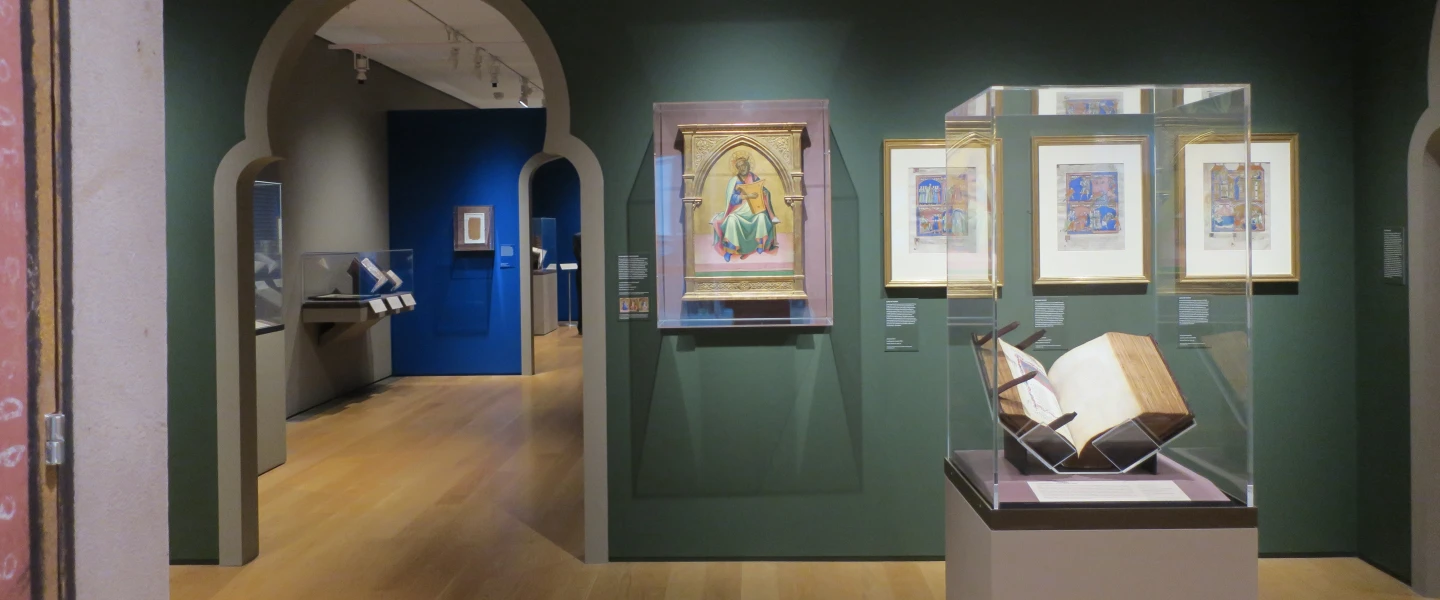
The Morgan Library and Museum’s exhibit “Sing a New Song: The Psalms in Medieval Art and Life” began as a proposal from guest curator Frederica Law-Turner for a show about Gothic psalters, or Christian devotional books that included Psalms.
Curators thought that was “a little too limited” and that the show should also address Psalms in other kinds of books and in other cultures, according to Roger Wieck, Melvin R. Seiden curator and department head of medieval and Renaissance manuscripts at the Morgan.
“It became very obvious and clear that we had to begin the show with a manuscript that shows the Psalms in Hebrew, because, of course, they were written in Hebrew,” Wieck, the show’s lead curator, told JNS. “There was no question that that was not going to be the very first manuscript that we placed in the show.”
The Morgan, a cultural and research institution that began as banker J.P. Morgan’s personal library in the early 1900s and opened to the public in Manhattan’s Murray Hill neighborhood in 1924, doesn’t have many Hebrew manuscripts since Morgan wasn’t interested in them, according to Wieck.
“It is one of our weak areas,” the curator said.
The Morgan owns “less than half a dozen ancient Hebrew manuscripts” but has, lately, been gifted modern works by Barbara Wolff, which have formed the basis of two shows, according to Wieck. “These are filling, at least in a 21st-century way, a lacuna in the collection,” he said.
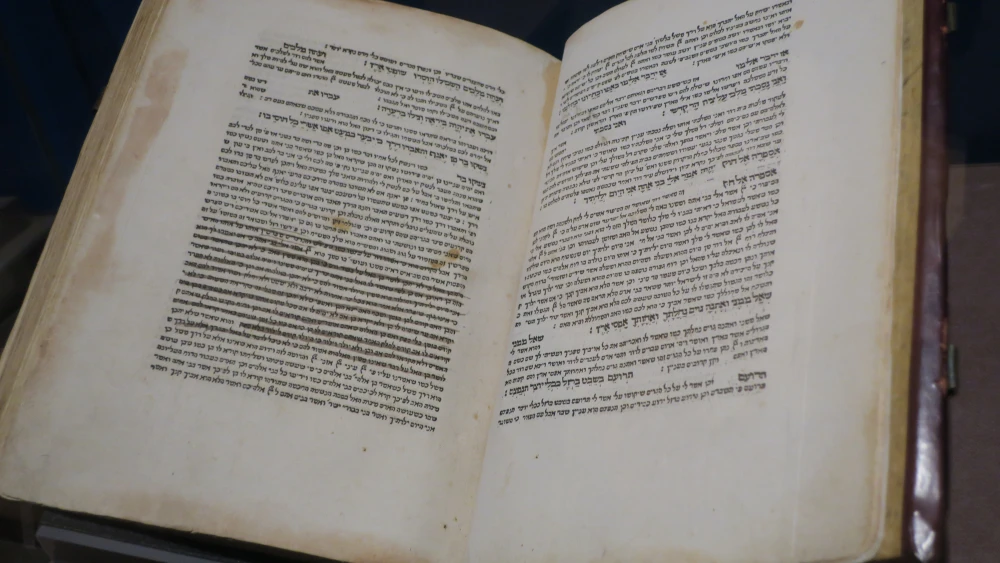
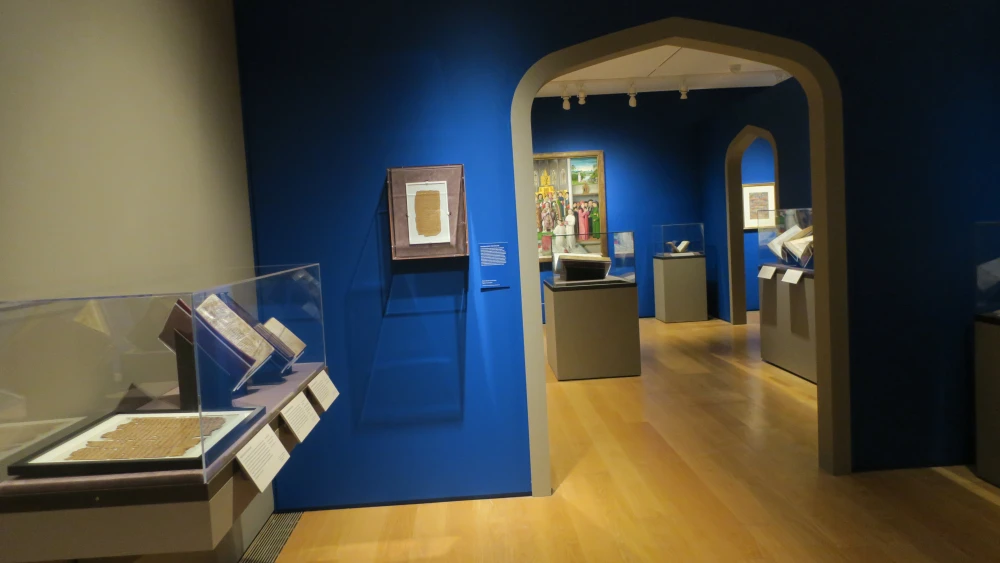
The show opens with a Hebrew Bible, MS G.48, likely created in the French city of Avignon and completed in December 1422. The Morgan acquired the manuscript in 1984, some 71 years after J.P. Morgan’s death. The scribe Simon ben Rabbi Samuel wrote—or “copied,” as scholars say of manuscripts—the book for the Jewish physician Vidal Astruc de Carcassonne.
“We happened to own that particular, wonderful Hebrew Bible,” Wieck told JNS. “We wanted that to be the very first thing people saw when they walked into the room.” (The exhibit is on view until Jan. 4. In addition to Wieck and Law-Turner, Deirdre Jackson and Joshua O’Driscoll, assistant and associate curator of medieval and Renaissance manuscripts at the museum, respectively, also worked on the show.)
Wieck allowed that among the challenges of the second-floor gallery at the Morgan is that the main entrance, where the Hebrew book is installed, comes off of an elevator, but there is also a door, off a flight of stairs, that brings visitors into the middle of the show. That’s why Wieck told JNS that he had the wall panels numbered, so those who come in from the side entrance will know to go back to the beginning.
The label accompanying the Hebrew Bible, which is opened to the first page of Psalms in the exhibition, also notes that Jewish books were “vulnerable to censorship and destruction” in “times of political upheaval and persecution.”
“Relatively few Hebrew manuscripts survive from the Middle Ages,” the label states. “This precious example attests to a thriving Jewish community in southern France in the 15th century.”
That troubling history comes up in two other labels. Of a 1477 Hebrew Psalms, PML 75567, with commentary by David Kimhi, a European rabbi and biblical commentator who lived roughly from 1160 to 1235 and is known by the acronym RaDaK, the Morgan notes that “like many Jewish books, copies of this psalter were destroyed or censored by Christian inquisitors.”
The printer’s statement, or colophon, in the book states that 300 copies were made, “of which fewer than 10% have survived,” the Morgan label notes. (The Morgan acquired the Hebrew book in 1978.)
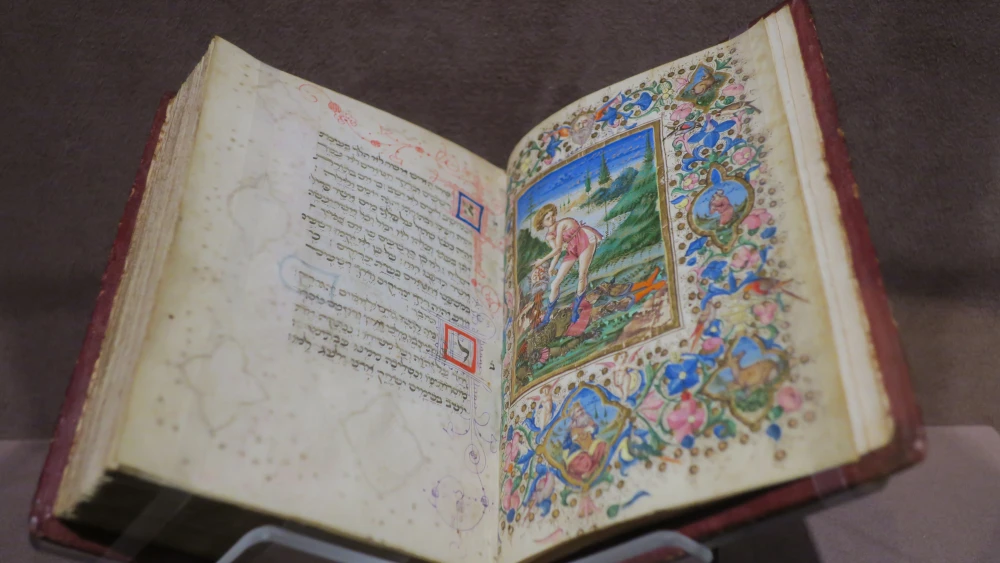
A label in the show about a 1467 Italian, Books of Truth (Sifrei Emet) in Hebrew, MS 409, penned by Isaac ben Ovadiah and illuminated by Mariano del Buono, from Yale University’s rare book library, is open to a page about David and Goliath. (The book of “truth” refers to the Hebrew word emet, which is also an acronym for the books Psalms, Job and Proverbs.)
Books of Psalms from Jewish communities in Europe are “extremely rare, in part because Hebrew books were intentionally destroyed in persecutory campaigns over the centuries,” the exhibit label states. “Scholars estimate that up to 95% of medieval Hebrew manuscripts have perished.”
An introductory label in the exhibition states that the show “addresses some of the most beloved texts in the Abrahamic tradition, but it does ‘sing a new song,’ to quote from Psalm 97, by exploring, in a manner not done before, how art, life and liturgy in the Middle Ages were suffused with the psalms.”
Poems from Psalms were “present at the beginning of one’s life and at one’s end,” and “their power was such that they even could work magic and assist the dead” between the sixth and 16th centuries, according to the label.
Although many countings have Psalms 96 and 98 referring to “singing a new song” to God, Wieck told JNS that “medievalists of the Latin West” use Jerome’s translation of the Bible in the Vulgate, which refers to singing “a new song” in Psalm 97 and in 95.
JNS asked Wieck what he made of the very same Christians, whom the exhibit reminds visitors were guilty of persecuting Jews and censoring and destroying Jewish books, including Psalms, then “suffusing” their lives with the very same text, which they adopted from Jewish tradition.
“You’ve touched on something that I have also, myself, just in my professional life, wondered about, as I am a specialist in medieval illumination and the arts, and the technology and the liturgy behind it, it’s like, what are you thinking?” he told JNS. “I’d like to ask the same question. What are you thinking?”
“Here you sing these Psalms every day, yet on Good Friday you go out and you beat up your Jewish neighbors. I don’t have an answer for you,” he said. “It’s something that also puzzles me very much from my cultural standpoint.”
‘A real person’
One of the main focuses of the exhibit is the biblical David, who many Jews and Christians believe authored Psalms. It addresses David as author, king, prophet and an ancestor of Jesus.
“We wanted to depict David as multifaceted—both positive and negative. He was a real person. A great king but also a great sinner,” Wieck told JNS. “That’s why, in a funny way, the exhibition comes around full circle, where his more positive attributes are somewhat more evident in the introductory section.”
In the fifth section of the show, viewers see depictions of David being punished and atoning for his sins, “the Books of Hours that are open to the penitential Psalms,” the curator said. “We wanted to make sure that the public was aware that David was a real human being, with his great highs and his great lows. That’s why one of the Crusader Bible leaves shows him committing adultery. So he slays the giant, but then he also lusts after a married woman.”
Elsewhere in the room, the museum displays a French Book of Hours, written in Latin and created sometime between around 1495 and 1503, with an illustration of the “Tree of Jesse,” a family tree emanating from behind the seated biblical figure. “The image functions as a genealogical diagram showing Jesse at the base, David higher up and Mary with the infant Christ at the top, occupying the place of honor” the label states.
On the wall behind the Book of Hours—a text with Psalms that were meant to be read, in parts, throughout the night like the Jewish practice of tikkun chatzot—is an image with a blown-up detail of the Jesse Tree. Wieck told JNS that it was an intentional decision given the “smallish” nature of the Book of Hours.
“We didn’t want for that to get lost,” he said, “because the bridge between the Jewish faith and Christian faith is that David is all of these things, but he is also a blood ancestor of the savior.”

‘Drenched’ in Psalms
Throughout the show (and in the museum itself), the museum identifies dates using “B.C.” and “A.D.” rather than “BCE” and “C.E.” Wieck told JNS that the museum discussed that question during the COVID pandemic and opted not to change its house style. “But I can’t remember why we went the old-fashioned way,” he said.
“The Morgan takes its labels really seriously. They’re not farmed out to interns or volunteers. They are written by the curators, and they are very much reviewed by our publications department, so that they make sense for the public,” he told JNS.
“This might even surprise you,” he added. “The director reads every label for every show, which is unusual, I think. He is very hands-on. We pay a lot of attention to our labels. They go through a real process.”
JNS also asked about some other elements that emerge in object labels. More than halfway through the show, a label accompanying a c. 1260 French Latin Bible states that “Christian interest in the original language of the Psalms—Hebrew—increased the demand for copies of Jerome’s Hebraicum, his translation from Hebrew into Latin.”
A panel earlier in the show first notes that psalmos is Greek for “song accompanied by a stringed instrument” and subsequently that Psalms is “known in Hebrew as Tehillim (Praises).”
Given the label’s note that Psalms was originally published in Hebrew and that it came midway through the show, JNS asked Wieck if he thought visitors knew that the Hebrew preceded translations in other languages or might think it went the other way.
“The Morgan’s audiences tend to be a little bit more savvy and educated than, let’s say, an audience going perhaps to the Museum of Natural History. They’re walking into a place that has the title ‘library and museum,’ so I am pretty sure that I would say that 90% to 95% of the people going through that show know that the Psalms were originally written in Hebrew,” the curator told JNS. “I assume so.”
“Somebody who purposely visits a show with the word Psalms in it and the adjective medieval, they know something already walking into the door,” he said.
JNS also asked about a wall text that called Psalms the “longest and most popular book of the Bible.” By one count, which is based on data from the Jerusalem-based Mamre Institute, the Hebrew book of Psalms has 150 chapters, 2,527 verses, 19,583 words and 78,822 letters. Jeremiah, per the site, has about one-third as many chapters (52) and about half as many verses (1,364), although it has more than 2,000 more words (21,831) and more than 6,000 more letters (84,899).
“I think it’s the chapter and verse,” Wieck told JNS.
JNS also asked about magical incantation bowls and other amulets, some of them in Aramaic, displayed in the show. Wieck said that in some regards, things haven’t changed dramatically since the Middle Ages.
“I think a lot of people have a lucky tie or a lucky shirt,” he told JNS. “I read that certain sports figures have various rituals in the locker rooms that they have to stick to. Whether one is really superstitious or covering your bases, I think people can find parallels and identify.”
“I think people are still a little bit superstitious,” he said.
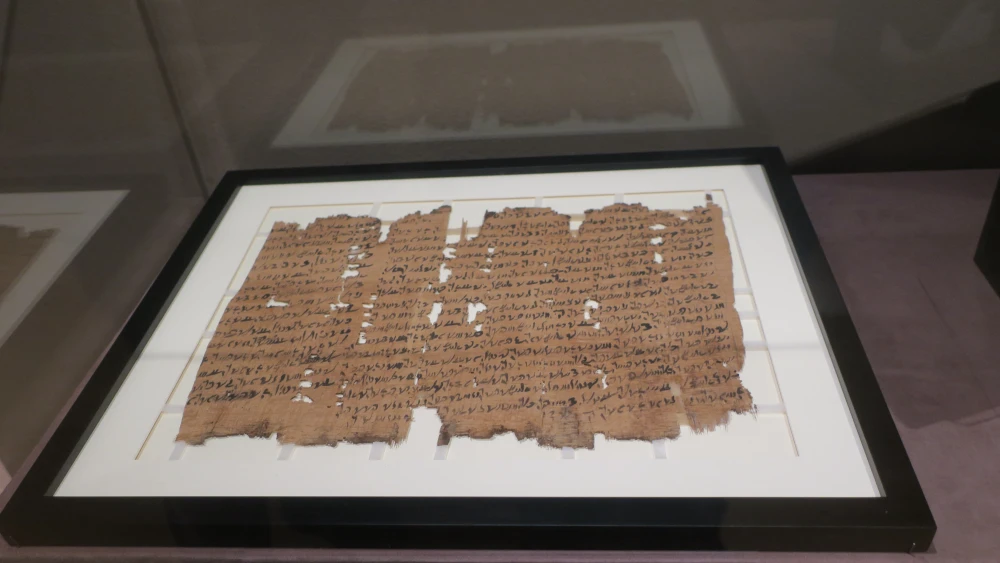
Elsewhere in the show are leaves depicting the life of David from the unbound, 13th-century “Crusader Bible,” which include later texts in Latin, Persian and Judeo-Persian, and a fragment from a larger Aramaic scroll, dating to the fourth century BCE Egypt, with hymns for the Jewish New Year. One of three texts on the displayed fragment is a “prototype” of Psalm 20 and “the earliest version of any biblical Psalm,” per the label.
The other two weren’t included in “the authoritative text of the Hebrew Bible, and thus their presence complicates the notion of an ‘original’ text,” the label states. “Various sets of songs, in different versions, circulated across ancient Jewish communities. It was only gradually that the psalms were codified into a standard set and sequence.”
The 1477 manuscript with the Kimhi commentary begins with Hebrew vowels (nikkudot) on the first few pages, but doesn’t do so in the rest, “presumably because it was still too difficult,” according to an exhibit label. “Although Jewish printers in Italy produced books just a few years after the new technology was introduced there in the 1460s, a complete Hebrew Bible was not printed until 1488. The delay was caused by the considerable technical challenge of adding vowel points to unvocalized Hebrew text.”
The book “is among the very first printed books of the Hebrew Bible,” it says.
Despite all of the objects of particular interest to Jews, the exhibit and its accompanying catalog weren’t about the Hebrew Bible at its core, according to Wieck.
“The show and the book are really about the drenching of the Psalms in Western, Christian medieval culture and early Renaissance life,” he told JNS. “It’s not about the cultures. It’s about the Christian West.”