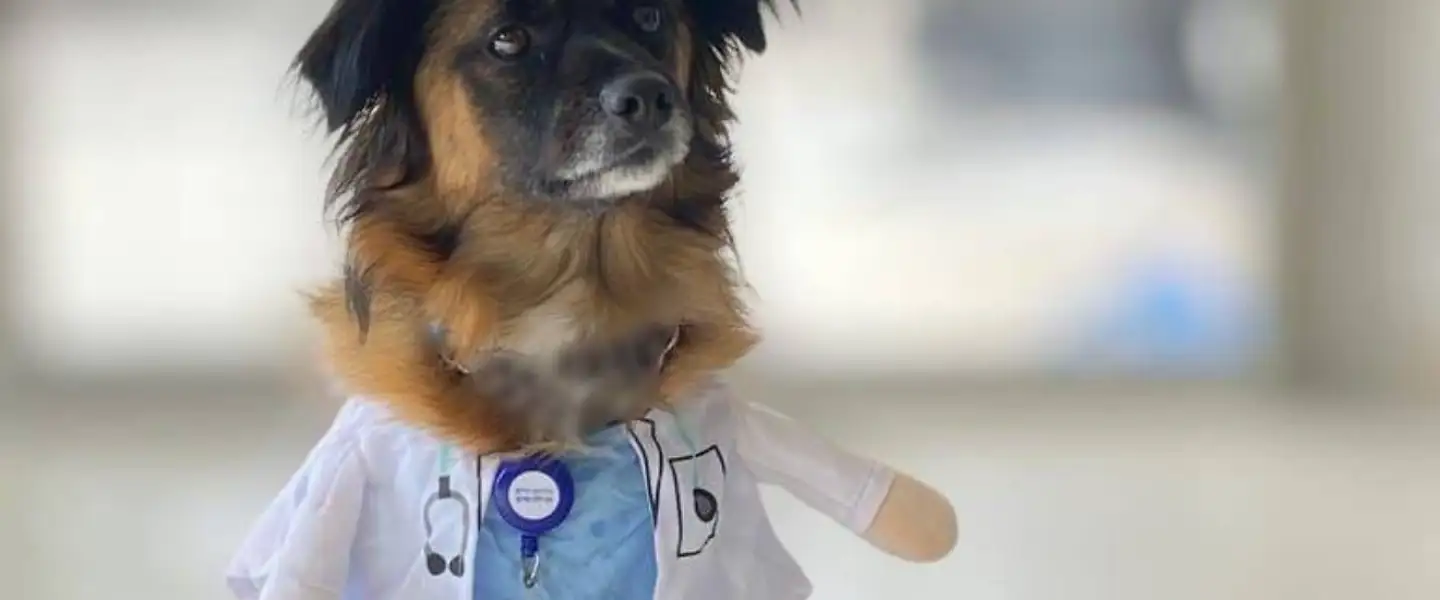
“The interaction with Teddy and the connection he creates gives patients energy, strength, motivation and a sense of inner happiness,” Keren Matry, a senior nurse and therapy dog specialist at Rabin Medical Center, told JNS.
While therapeutic dogs have been introduced into some hospital settings in Israel, Matry is among the first nurses to formally combine nursing with Animal-Assisted Therapy, alongside Michal Loewenstein, who also helped pioneer the field at Rabin Medical Center. She works with Teddy, her therapy dog, across nearly all hospital departments.
“Dogs may be present in rehabilitation units or on hospital grounds, but allowing a dog into intensive care with acute patients, as we do, is not common,” she said. “Nurses understand the environment and the risks, so it was important to integrate the two roles.”
Teddy, now six, was originally Matry’s personal dog. They began working together at the hospital four years ago. “When I put on his vest, he knows he’s going to work. He walks in as if it’s his own department,” she told JNS.
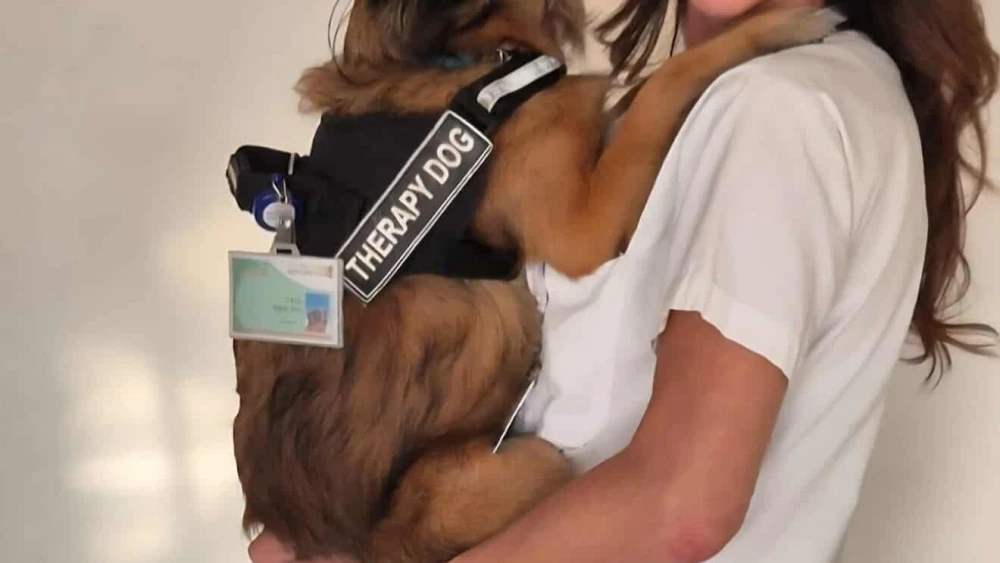
The pair started in geriatrics and now respond to consultation requests hospital-wide, including intensive care, oncology and surgery. Matry sets individual objectives for each patient and monitors medical status and contraindications.
The therapy focuses primarily on emotional goals and has shown measurable benefits: increased participation in treatment, reduced pain and anxiety, improved mood, decreased reliance on medication and an overall better hospital experience.
“As a patient, you lose part of your identity. You wear pajamas and an ID tag, you lose control, and you feel low. Then a dog walks in, and something opens up,” she explained.
“The dog brings warmth and unconditional acceptance. It doesn’t matter whether the patient can see, walk or speak.”
The interaction stimulates the release of oxytocin, helping reduce stress and promote relaxation. “We feel this energy, and the dog feels us. It’s mutual,” she said.
Matry recalled a survivor of the Oct. 7, 2023, Hamas massacre who lay injured under bodies for hours. “When I came with Teddy, something clicked. She began telling her story for the first time to her family. The dog gave her the confidence to speak,” she said.
In another case, a young woman hospitalized in critical condition after a violent attack was unable to be transferred to rehabilitation because she remained dependent on oxygen. “She started talking to Teddy and feeding him. While she focused on him, I gradually reduced the oxygen to zero. She didn’t notice. When I told her she was breathing fully on her own, the fear was gone, and she was sent to rehab,” said Matry.
The hospital is now conducting what she described as Israel’s first evidence-based study on the impact of nursing combined with Animal-Assisted Therapy on acute stroke patients. “The same patient performs exercises with and without the dog. We see a 40% improvement in completion rates when the dog is involved,” she said.
Some patients develop a sense of responsibility toward Teddy. “One uncooperative patient agreed to shower and get ready to take Teddy outside. Once downstairs, he stopped thinking about himself and focused entirely on whether Teddy was comfortable. He shifted from patient to caretaker,” she said.
Matry emphasized that Teddy is not the same as a patient’s own pet. “A personal dog is part of routine and responsibility. Teddy arrives at the hardest moments. He comes to take care of you,” she said.

She recalled a soldier injured in combat who had lost a close friend in the same incident. “When Teddy rested his head on him, they communicated without words. In the end, the soldier placed his Givati beret on Teddy,” she said.
Matry envisions a future in which each department includes a nurse working alongside a therapy dog. Teddy undergoes biannual health checks, and she is careful to protect his wellbeing. “He is not a robot. He works with joy because he knows I look after him,” she said.
In the neurology department, where Teddy spends much of his time, the focus is on the brain, emotions and behavioral responses. “If a therapy dog can stimulate damaged areas of the brain and support recovery, it is logical that they would be effective in a neurology ward,” Dr. Mark Hellmann, a senior neurologist and head of the neuroimmunology clinic at Rabin Medical Center, told JNS.
Hellmann said dogs possess a heightened sensitivity to emotional changes. “They often detect shifts in a patient’s emotional state before others do. Because they don’t rely on language, communication can be easier. Through stimulation of brain regions we cannot otherwise access, animals can evoke verbal and motor responses that others cannot. They reach patients,” he said.
He noted that in epilepsy cases, some dogs can sense an impending seizure before it occurs and alert the patient or those nearby, potentially allowing medication to be administered in time or reducing the severity of the episode.
Dogs’ lack of judgment and expectation can also help patients express emotions they might suppress around other people. According to Hellmann, this can enable medical staff to access damaged neurological pathways and observe meaningful responses or improvement.
While certain contraindications exist—such as avoiding contact with immunocompromised patients—a properly trained dog working alongside a qualified nurse who carefully screens patients poses minimal risk, he said.
“Anything that relieves the sadness and stress of hospitalization, even briefly, is a valuable service. Positive emotional stimulation supports the brain and recovery. There are many ways, both small and significant, that therapeutic animals can help,” Hellmann added.
In the neurological ward, JNS met Rebecca, 74, from Hod Hasharon, who was visiting her husband. She said Teddy’s presence had an immediate calming effect.
“My husband doesn’t want a dog at home, but I think it would calm me down and make me feel better,” said Rebecca, who is undergoing cancer treatment at Assuta Hospital. “I have cancer, and my husband is now in very serious condition with an infection and heart disease.”
“It would definitely help me to have a dog—some warmth and love. ‘A dog is a man’s best friend’ may be a cliché, but in this case, it’s true,” she said.