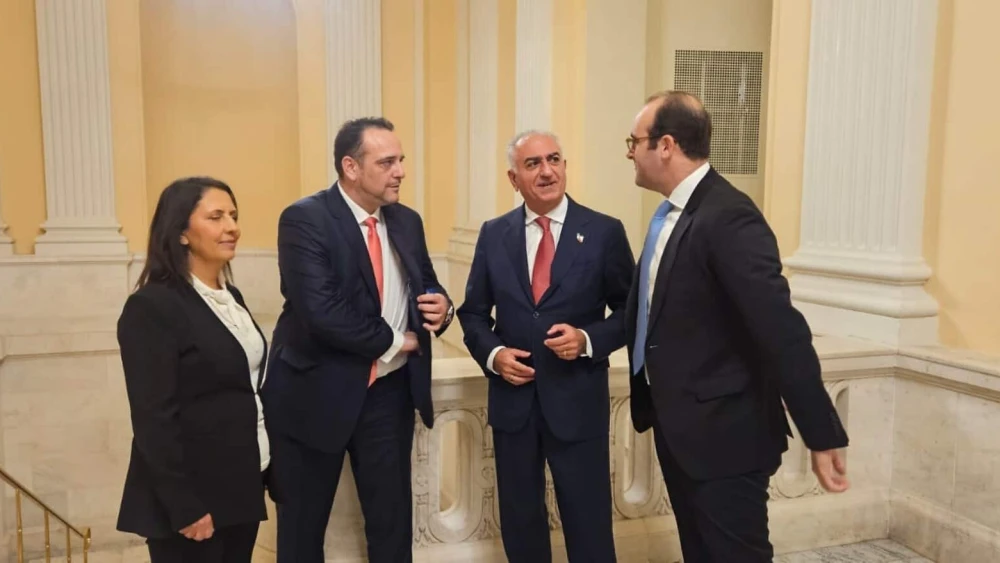
Iran’s Islamist regime is weaker than any time in nearly a half-century, and the international community can shorten its existence through a combined strategy of maximum pressure on the regime and maximum support for the people, the exiled Iranian Crown Prince Reza Pahlavi said on Wednesday.
He spoke six months after the 12-day war between Israel and Iran in which the Islamic Republic’s nuclear program was attacked, and amid a severe water crisis in the country.
“The Islamic Republic is weaker, more isolated, and more discredited than at any time in its existence,” Pahlavi said in a keynote address to a conference of Christian leaders and international lawmakers organized by the Israel Allies Foundation in Washington, D.C. “Its economy is broken. Its young people reject its ideology. Its own people speak of crisis. The regime projects strength outward because it is afraid inward.”
The 65-year-old son of the late Shah Mohammad Reza Pahlavi (1919–80), who has offered himself as a transitional leader after the fall of the regime, told the lawmakers that their governments can either prolong or shorten the regime’s life by their actions. He urged all Western countries to impose tough sanctions and designate the Iranian Revolutionary Corps Guard as a terrorist group and shutting down its front groups, charities and business networks, while helping the people stay connected to the outside world.
“You can choose to prioritize short-term deals with Tehran, or you can invest in the long-term security that only a free Iran can provide,” the prince said. “Every resolution you pass, every sanction you enforce, every diplomatic step you take sends a signal to the regime and to the people watching from inside Iran.”
He continued, “This is precisely the moment when clarity of purpose matters most. If we together can combine the courage of the Iranian people with the resolve of their allies in the free world, then change is not a dream. It is a realistic objective.”
Pahlavi, who is popular in the West but remains untested in Iran, said that peace with Israel—a peace he has dubbed the “Cyrus Accords” after the Persian King the Great (c. 600 – 530 BCE)—will only come with regime change.
“The Iranian Republic is the enemy of Israel. The Iranian people are not,” he said. “The bond between Iranian and Jews is ancient, proud and unique. It has survived empires and revolutions. It will also outlast the Islamic Republic.”