A top adviser to the commander of Iran’s Islamic Revolutionary Guard Corps (IRGC) said last week that 21 American bases in the region were targets for Iranian missiles.
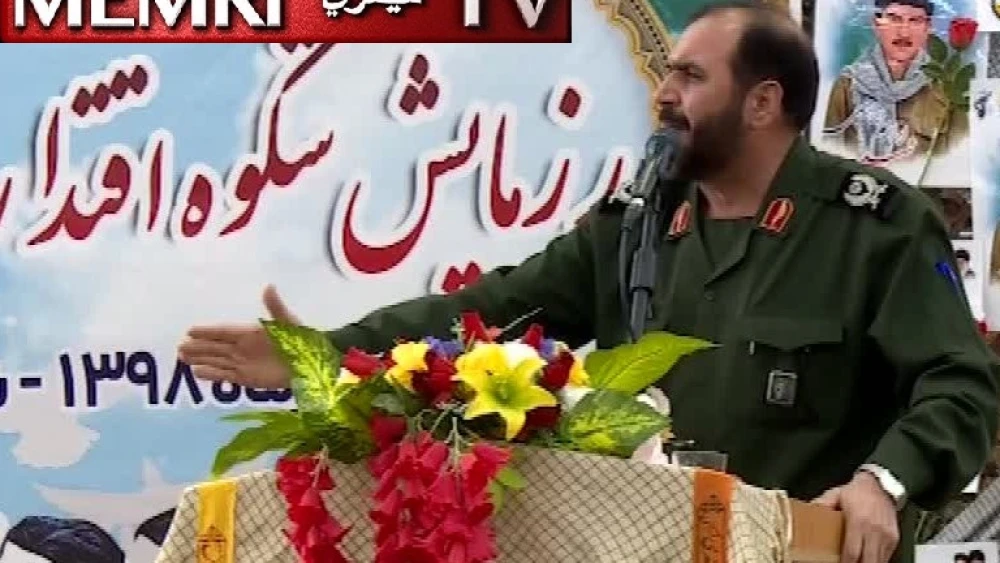
Citing a NATO statement that Iran was capable of launching 20,000 missiles a day, IRGC Gen. Allahnoor Noorollahi said in a Nov. 29 speech in the city of Bushehr that this figure is low, and that the Islamic Republic has prepared itself for “the greatest war against the greatest enemy.”
Tehran’s greatest enemy, he emphasized, was the United States, though he also referred to a speech by Iranian Supreme Leader Ali Khamenei in which Khamenei threatened to raze Haifa and Tel Aviv to the ground if Israel made any “mistake.”
Noorollahi’s speech, which aired on Bushehr TV (Iran), was delivered at an event commemorating 40 years since the establishment of the Basij, a paramilitary volunteer force that constitutes one of five IRGC forces.
The following are excerpts from Noorollahi’s address:
“Iran is the world’s fourth [strongest] missile power after the U.S., Russia and China. Unfortunately, some Gulf countries have become a military camp for our enemy. I must say this: 21 of their bases constitute targets for our missiles. NATO itself announced that Iran’s 110 missile bases and launching sites are capable of launching 20,000 missiles per day. This is what the enemy says. They only acknowledge part [of our capability].
“When a country reveals not only its underground missile bases but also its missile ‘cities’ to the enemy—this reflects readiness and capabilities. It means that we have capability to confront the greatest enemy. Brothers and sisters, I must conclude my speech, but I was given permission to say one more thing: By means of its defensive strategy, Islamic Iran has prepared itself for the greatest war against the greatest enemy.
[...]
“Saudi Arabia and the region’s countries are neither on our level nor are they our enemies. Our enemy is the [country] that came to Kuwait and built six large bases there. This enemy knows that if it transgresses. ... We do not want to cause harm to our neighbors unless we are forced to. Our commander [Khamenei] said a few years ago at the tomb of Imam Reza [in Mashhad]—you remember that well—that if Israel dared to make any mistake, we would raze Haifa and Tel Aviv to the ground.”