


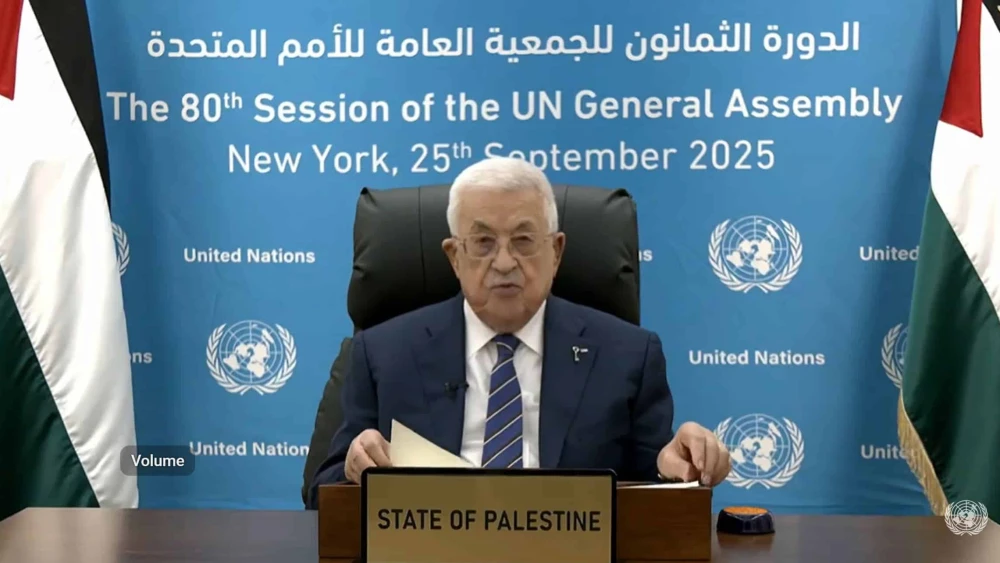
Mahmoud Abbas, the head of the Palestinian Authority, said on Thursday his regime is committed to implementing reforms amid reports that it will recover some control in the Gaza Strip.
“We launched a reform, which includes the prisoners’ salaries, in coordination with the U.S.,” Abbas told Israel’s Channel 12 News. Other reforms are underway in education, health, the economy and security, he said.
By prisoners’ salaries, he meant the monthly stipends the Palestinian Authority pays to the families of terrorists killed or captured while murdering Jews or trying to murder them. Earlier this year, the P.A. agreed to stop this funding, though payments are continuing under the guise of welfare support.
The commitment to reform follows an assertion about the Palestinian Authority in the 20-point plan of U.S. President Donald Trump for a ceasefire in Gaza.
“While Gaza re-development advances and when the P.A. reform program is faithfully carried out, the conditions may finally be in place for a credible pathway to Palestinian self-determination and statehood, which we recognize as the aspiration of the Palestinian people,” the document states. It also says that the “redevelopment of Gaza” will continue “until such time as the Palestinian Authority has completed its reform program.”
Israeli Prime Minister Benjamin Netanyahu and other right-wing politicians have opposed both the establishment of a Palestinian state—Netanyahu vowed on Sept. 21 that it would not happen —and Palestinian Authority control in Gaza.
Amichai Chikli, ministry of Diaspora affairs and combating antisemitism, wrote on X on Friday that he’d voted in favor of the ceasefire because, among other reasons, “the prospect of renewed Palestinian Authority control in Gaza had been ruled out” in the framework for the ceasefire deal.
The Palestinian Authority lost control of the Gaza Strip in June 2007, when Hamas staged a coup there. The ceasefire agreement, in which Hamas agreed to cede control of the Gaza Strip in favor of a U.S.-led coalition of Muslim-majority countries, is widely seen as an opportunity for the Palestinian Authority to increase its power in Gaza.
Reuters on Thursday asked the prime minister of the Palestinian Authority, Mohammad Mustafa, about his government’s role in Gaza after the ceasefire.
Mustafa said the P.A. had nominated about 5,500 people to be part of a Gaza police force being trained by Egypt. Ramallah aims to train at least 10,000 people for this purpose, according to the Reuters report.
“We’re already there,” Mustafa told the new agency about Gaza.
He was appointed by Abbas last year, as part of a shake-up of the Authority after then-President Joe Biden made clear he wanted to see a revitalized P.A. take charge in post-war Gaza.
“It’s one thing to have some international, temporary arrangements to help and monitor things, it’s another to govern and get things done,” Mustafa said.


