Belgian Prime Minister Bart De Wever on Saturday traveled to Germany to show solidarity with an Israeli musician whose concert in Belgium had been canceled due to his country of origin.
During his visit, De Wever announced he supports all E.U. sanctions against Israel and wants its war in Gaza to end, but also opposes the singling out of Israelis and Jews as part of the campaign against Israel’s war on Hamas.
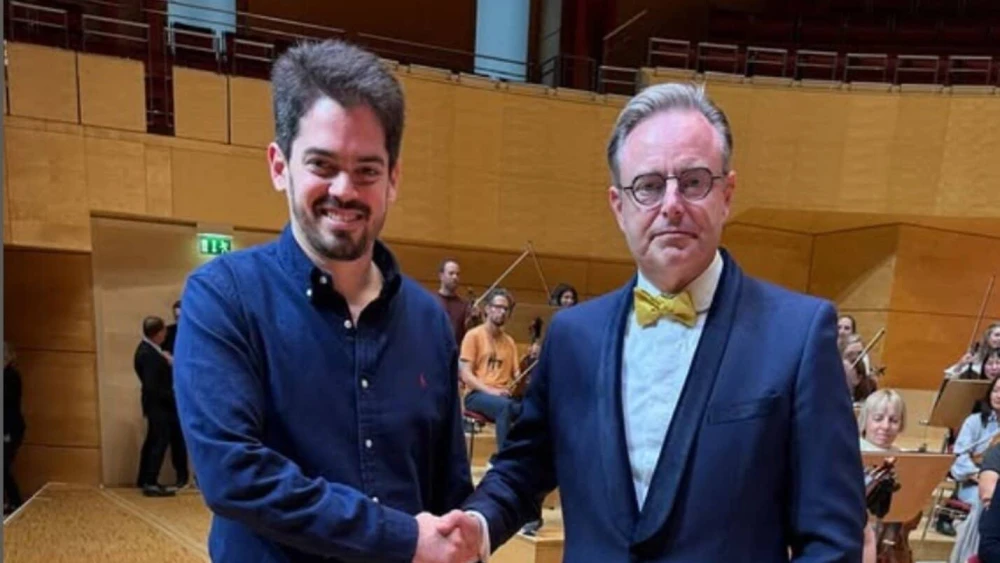
De Wever traveled to Essen in Germany where he attended the Munich Philharmonic concert, after organizers of a festival in the city of Ghent last week canceled the show in connection with the orchestra’s Israeli conductor, Lahav Shani.
De Wever posed for a picture with Shani, which he posted on social media.
“Belgium supports all targeted sanctions proposed by the European Union to end the war. The interests of innocent civilians, regardless of their origin or beliefs, are paramount in this regard,” De Wever wrote.
However, he added, “there will never, ever be any room for racism and antisemitism in this country. That is where I draw the line. I therefore strongly condemn the recent cancellation of the Münchner Philharmoniker by the Flanders Festival Ghent, solely on the basis of the origin of conductor Lahav Shani. I insisted on conveying this message to him personally and expressing my appreciation for his contribution to the power of music.”
De Wever heads the center-right New Flemish Alliance, which has a tenuous power-sharing coalition with the center-left Les Engages party of Foreign Minister Maxime Prévot. Earlier this month, Prévot, who is highly critical of Israel and has implied it’s carrying out a genocide, announced that Belgium would recognize a Palestinian state after the Israeli hostages in Gaza are freed and Hamas is disarmed.
Israeli Prime Minister Benjamin Netanyahu called De Wever “a weak leader who seeks to appease Islamic terrorism by sacrificing Israel,” and “wants to feed the terrorist crocodile before it devours Belgium. Israel [...] won’t go along and will continue to defend itself.”
It was an unusually harsh rebuke of De Wever, who has expressed skepticism about the recognition of Palestinian statehood and was widely seen as a relatively pro-Israeli force within the European Union.
Sam van Rooy, a lawmaker in the Belgian party for the right-of-center Flemish Interest party, dismissed De Wever’s gesture in Essen as an attempt to appease Jews and their allies.
“De Wever realizes, of course, that many Jews and non-Jews are angry about the Flemish and federal anti-Israel policies” of his government, van Rooy said on X. “So De Wever’s attempting to make amends” by speaking out against antisemitism, including in a meeting with Shani, van Rooy wrote. “Don’t fall for this ruse,” he added.
The concert’s cancellation provoked angry reactions in Belgium, Germany and beyond last week.
German Federal Government Commissioner for Culture and the Media Wolfram Weimer called the cancellation “pure antisemitism” and argued that, under the guise of criticism of Israel, the festival was enforcing a cultural boycott, something that can be illegal in Germany.
“This is an attack on the very foundations of our culture. If German orchestras and Jewish artists are collectively excluded, a red line has been crossed,” he said.
Weimer stressed that the Munich Philharmonic is “a flagship of German culture” and warned that European stages must not become “places where antisemites dictate the program.”
The Forum of Jewish Organizations of Flanders, the region in Belgium where Ghent is located, also condemned the cancellation, saying it “evokes painful memories of periods when Jews were boycotted and excluded worldwide.”
The organizers’ stated reason for canceling the concert is “not an argument, but a political pretext that masks antisemitism and justifies discrimination,” the forum said in a statement on Thursday. “Shani is being excluded because of who he is, not because of what he does. Systematically banning artists based on their origins is discriminatory, morally unacceptable and sets a dangerous precedent,” the statement continued.
Munich Mayor Dieter Reiter said in a statement on Wednesday: “I cannot comprehend the festival’s decision.” His city and he “stand firmly behind the Philharmonic and Lahav Shani,” the mayor wrote.